May 18 National Cheese Soufflé Day: History, Recipes, and How to Celebrate in 2026
- 0
- 13 Min Read
Last updated: May 18, 2026
Quick Answer: May 18 National Cheese Soufflé Day is an annual food observance celebrated every May 18 in the United States. It honors the classic French cheese soufflé, a dish built on a béchamel base and whipped egg whites that puff dramatically in the oven. The day encourages home cooks and food enthusiasts to attempt this iconic dish and appreciate the culinary technique behind it.
Key Takeaways
- May 18 National Cheese Soufflé Day falls on May 18 every year and celebrates one of French cuisine’s most technically impressive dishes.
- The cheese soufflé dates back to 18th-century France, with the word “soufflé” meaning “puffed” or “breathed” in French.
- Gruyère is the most traditional cheese for a classic soufflé, though sharp cheddar, Comté, and Parmesan all work well.
- Soufflés fall because steam escapes when the oven door is opened too early or when the egg whites are under-beaten.
- You can prepare the soufflé base up to 24 hours ahead; fold in egg whites and bake just before serving.
- The key difference between a soufflé and most other cheese dishes is structure: soufflés rely entirely on air trapped in egg whites for their rise.
- Beginners should use room-temperature eggs, a properly buttered ramekin, and avoid opening the oven during baking.
- National food days like this one are informal observances with no single official governing body; they spread largely through food media and social sharing.
What Is National Cheese Soufflé Day?
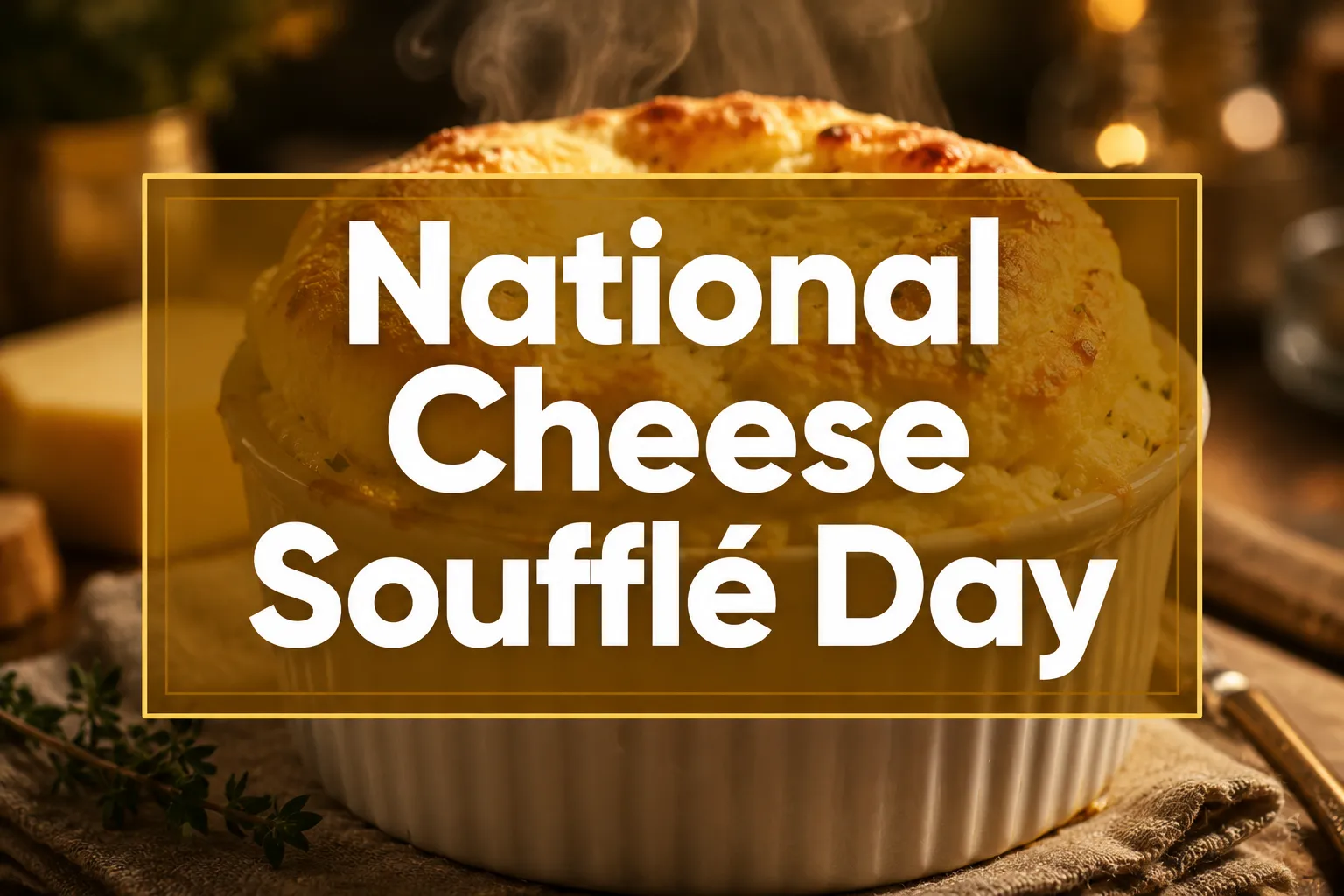
National Cheese Soufflé Day is an informal annual food holiday observed on May 18 in the United States. It celebrates the cheese soufflé, a French-origin baked dish made from a flavored sauce base (typically béchamel) enriched with egg yolks and cheese, then lightened with stiffly beaten egg whites. The result is a dish that rises high above its baking dish and delivers a crisp exterior with a creamy, airy interior.
The observance belongs to the broader category of American national food days, which number in the hundreds and cover everything from pizza to fettuccine. These days function as cultural touchpoints that bring attention to specific foods, encourage cooking at home, and generate community around shared culinary experiences. For more on how these food observances work, see the January 20 National Cheese Lover’s Day guide as a comparable example.
When Is National Cheese Soufflé Day Celebrated?
May 18 National Cheese Soufflé Day is observed every year on May 18. The date does not shift based on the day of the week, so in 2026 it falls on a Monday.
There is no leap-year adjustment or floating calendar rule. Mark it as a fixed date each year, and plan your soufflé baking accordingly.
Where Did Cheese Soufflé Day Come From?
The precise origin of May 18 as National Cheese Soufflé Day is not documented by a single verifiable source, which is common for American food holidays. Most national food days emerged informally through food bloggers, culinary media, and social media communities rather than through legislative proclamation or formal culinary organizations.
What is well-documented is the dish itself. The soufflé as a culinary category appears in French cookbooks as early as the late 1700s, and chef Marie-Antoine Carême is often credited with codifying the technique in the early 19th century. The cheese soufflé became a symbol of French fine dining and later a benchmark dish for culinary school students worldwide.
The day’s purpose, regardless of its exact origin, is straightforward: to encourage people to try making a dish that many consider intimidating and to appreciate the science and skill behind it.
What Is the Difference Between a Soufflé and a Regular Cheese Dish?
A soufflé is structurally unique because its rise depends entirely on air trapped inside beaten egg whites, not on leavening agents like baking powder. Most other cheese dishes, such as a cheese omelette, mac and cheese, or a gratin, rely on melting and binding rather than aeration.
Here is a direct comparison:
| Feature | Cheese Soufflé | Cheese Omelette | Mac and Cheese |
|---|---|---|---|
| Rise mechanism | Beaten egg whites | None | None |
| Texture | Airy, puffed, crisp outside | Soft, dense | Creamy, thick |
| Skill level | Intermediate to advanced | Beginner | Beginner |
| Serving window | Immediate (deflates fast) | Flexible | Flexible |
| Base sauce | Béchamel | Egg only | Cheese sauce or roux |
For cheese lovers who enjoy exploring different preparations, the 103 Mac and Cheese Cookbook is a useful resource for the comfort-food end of the cheese dish spectrum.
What Cheese Is Best for a Soufflé?
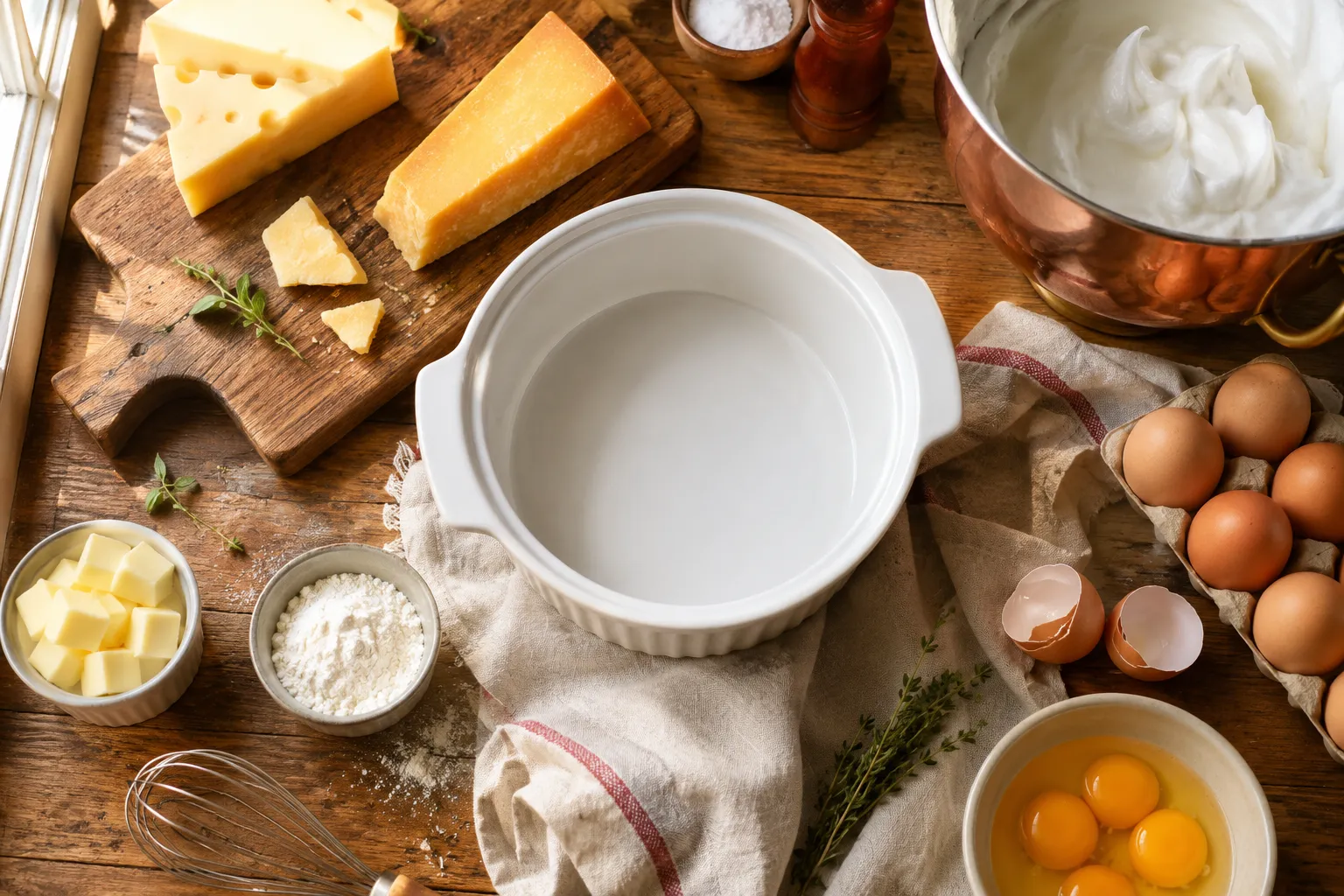
Gruyère is the classic choice for a cheese soufflé because it melts smoothly, has a nutty depth of flavor, and does not add excess moisture. That said, several cheeses work well depending on the flavor profile you want.
- Gruyère: Traditional, nutty, melts cleanly. Best all-purpose choice.
- Comté: Similar to Gruyère, slightly sweeter. Excellent substitute.
- Sharp cheddar: Bolder flavor, works well for a more casual soufflé.
- Parmesan: Best used as a secondary cheese or for dusting the ramekin. Adds sharp, salty notes.
- Emmental: Mild and melts well, good for a subtler flavor.
- Gouda (aged): Richer flavor, pairs well with a small amount of Dijon mustard in the base.
Avoid: Fresh cheeses like ricotta or mozzarella. They add too much moisture and can prevent the soufflé from setting properly.
How to Make a Cheese Soufflé: Step-by-Step
A classic cheese soufflé requires about 45 minutes total (15 minutes prep, 25-30 minutes baking). This recipe serves four in individual ramekins.
Ingredients:
- 3 tablespoons unsalted butter, plus more for ramekins
- 3 tablespoons all-purpose flour
- 1 cup whole milk, warmed
- 4 large egg yolks
- 5 large egg whites, room temperature
- 1 cup (about 90g) grated Gruyère
- 2 tablespoons grated Parmesan (for dusting)
- Salt, white pepper, and a pinch of nutmeg
- 1/4 teaspoon cream of tartar
Steps:
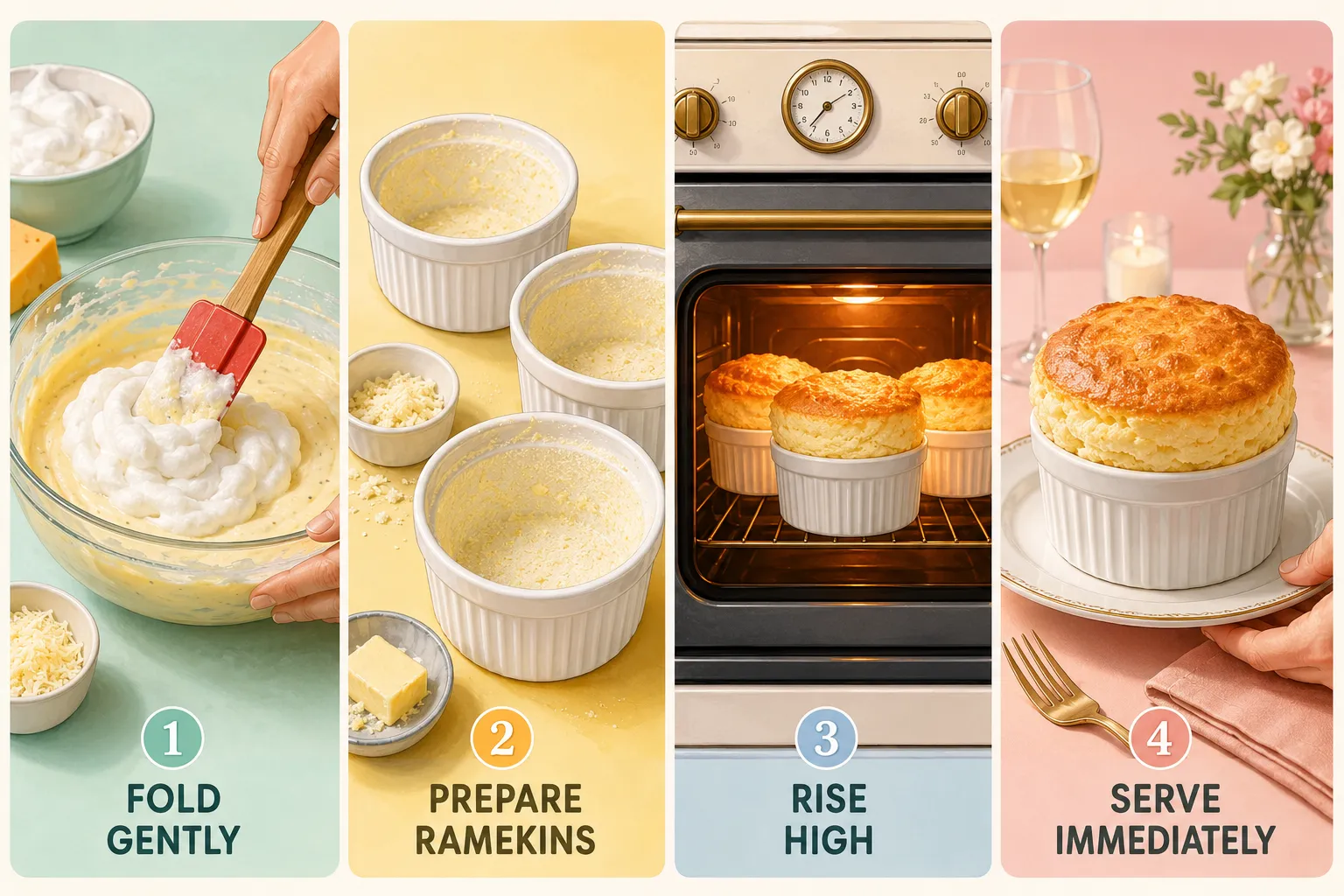
- Prepare the ramekins. Butter four 6-ounce ramekins thoroughly, then dust with grated Parmesan. Refrigerate until needed.
- Make the béchamel. Melt butter over medium heat. Whisk in flour and cook 1 minute. Gradually whisk in warm milk. Stir until thick, about 3 minutes. Season with salt, white pepper, and nutmeg.
- Add cheese and yolks. Remove from heat. Stir in Gruyère until melted. Let cool 5 minutes, then whisk in egg yolks one at a time.
- Beat egg whites. In a clean, dry bowl, beat egg whites with cream of tartar until stiff peaks form. Do not over-beat.
- Fold gently. Stir one-quarter of the egg whites into the cheese base to lighten it. Then fold in the remaining whites in two additions, using a large spatula with a gentle cutting and folding motion. Stop when just combined; streaks are fine.
- Fill and bake. Divide batter among prepared ramekins, filling to about 3/4 full. Run your thumb around the inside rim to create a shallow channel (this helps the soufflé rise straight). Bake at 375°F (190°C) for 25-28 minutes until risen and golden.
- Serve immediately. Soufflés begin to deflate within 2-3 minutes of leaving the oven.
Why Do Soufflés Fall, and How to Prevent It
Soufflés fall because the steam and hot air inside them escape as they cool, and the egg protein structure cannot hold the risen shape without heat. Some deflation is inevitable. The goal is to serve the soufflé before significant collapse occurs.
Common causes of premature falling:
- Opening the oven door during the first 20 minutes of baking (causes a sudden temperature drop)
- Under-beaten egg whites that cannot hold enough air
- Over-folding the batter, which deflates the whites before baking
- Using a ramekin that is too large, causing the batter to spread thin
- Oven temperature too low, so the structure never fully sets
Prevention tips:
- Keep the oven door closed until the minimum baking time has passed.
- Beat egg whites to stiff (not dry) peaks. They should hold a firm point but still look glossy.
- Fold with a light hand. Ten to twelve deliberate strokes is usually enough.
- Use the correct ramekin size. A 6-ounce ramekin for a single serving is standard.
- Preheat the oven fully before the soufflé goes in.
Key rule: A soufflé waits for no one. Have your guests at the table before the soufflé comes out of the oven, not the other way around.
Can You Make Cheese Soufflé Ahead of Time?
Yes, with one important limitation: you can prepare the base (béchamel plus cheese plus egg yolks) up to 24 hours in advance, but you must fold in the beaten egg whites and bake the soufflé just before serving. The base keeps well covered in the refrigerator. Bring it to room temperature for 20-30 minutes before folding in the whites.
Some professional kitchens use a “twice-baked” soufflé technique, where the soufflé is baked, cooled (it will fall), and then reheated in cream just before service. This method sacrifices some height but is far more practical for dinner parties.
Choose the make-ahead base method if: you want a classic risen soufflé with full drama. Choose the twice-baked method if: you need to serve multiple guests on a schedule without timing stress.
Easy Cheese Soufflé Tips for Beginners
May 18 National Cheese Soufflé Day is a great occasion to attempt this dish for the first time. These tips reduce the most common beginner mistakes.
- Use room-temperature eggs. Cold egg whites do not whip as well and take longer to reach stiff peaks.
- Ensure your bowl is grease-free. Any fat residue prevents egg whites from whipping properly. Wipe the bowl with a cut lemon or a paper towel dampened with white vinegar before use.
- Do not skip buttering the ramekin. Butter allows the soufflé to climb the sides cleanly.
- Measure your cheese by weight, not volume. Grated cheese packs inconsistently; 90g is more reliable than “1 cup.”
- Trust the recipe time. Resist the urge to peek. Set a timer and walk away.
- Season boldly. The egg whites dilute flavor significantly. The base should taste slightly over-seasoned before the whites go in.
If you enjoy French-inspired baking, the French pastry tag on stillcooking.com has additional resources for classic techniques.
How to Celebrate May 18 National Cheese Soufflé Day in 2026
Celebrating May 18 National Cheese Soufflé Day does not require a reservation at a French restaurant, though that is certainly one option. Here are practical ways to mark the day.
At home:
- Make a classic Gruyère soufflé using the recipe above.
- Host a small dinner and serve individual soufflés as a starter.
- Try a savory variation with Comté and caramelized onion, or a mild cheddar version with a touch of smoked paprika.
On social media:
- Share your soufflé attempt with the hashtag #NationalCheeseSouffleDay.
- Post a before-and-after of the risen soufflé and the inevitable (and charming) deflation.
For cheese lovers who want to go deeper:
- Explore the history of French cheese culture alongside the dish.
- Pair your soufflé with a crisp white Burgundy or a dry Alsatian Riesling.
- Check out the January 20 National Cheese Lover’s Day guide for more cheese-focused celebration ideas year-round.
For those who enjoy food holidays in general, the national food days tag on stillcooking.com lists dozens of similar observances throughout the year.
Frequently Asked Questions About National Cheese Soufflé Day
What day is National Cheese Soufflé Day? National Cheese Soufflé Day is celebrated on May 18 every year. It is a fixed date that does not change based on the day of the week.
Is National Cheese Soufflé Day an official U.S. holiday? No. It is an informal food observance, not a federal or state holiday. It has no legal standing but is widely recognized in food media and culinary communities.
What does “soufflé” mean in French? The word “soufflé” comes from the French verb “souffler,” meaning to blow or to breathe. It refers to the puffed, airy quality of the dish.
How long does a cheese soufflé take to make? From start to finish, a classic cheese soufflé takes about 45 minutes: roughly 15 minutes of preparation and 25-28 minutes of baking time.
Can I use pre-shredded cheese for a soufflé? It is better to grate cheese fresh from a block. Pre-shredded cheeses are coated with anti-caking agents (such as cellulose) that can affect how smoothly the cheese melts into the béchamel.
Why does my soufflé not rise? The most common causes are under-beaten egg whites, over-folding the batter, or an oven that was not fully preheated. Make sure egg whites reach stiff peaks and that the oven is at the correct temperature before the soufflé goes in.
Can I make a gluten-free cheese soufflé? Yes. Substitute the all-purpose flour in the béchamel with a gluten-free flour blend or cornstarch (use about half the amount if using cornstarch). The technique remains the same.
What can I serve with a cheese soufflé? A simple green salad with a light vinaigrette is the classic pairing. The soufflé is rich and airy, so it benefits from something acidic and fresh alongside it.
How many calories are in a cheese soufflé? A single-serving cheese soufflé made in a 6-ounce ramekin contains roughly 250-350 calories, depending on the type and amount of cheese used. This is an estimate based on standard recipe proportions.
Is a cheese soufflé the same as a cheese puff (gougère)? No. A gougère is a choux pastry puff flavored with cheese, baked until crisp and hollow. A soufflé is a baked egg dish with a different base and a much more delicate structure.
What is a twice-baked soufflé? A twice-baked soufflé is baked once, allowed to cool and fall, then reheated (often in cream or sauce) just before serving. It is more practical for dinner parties and has a denser, creamier texture than a freshly baked soufflé.
Are there sweet soufflé variations? Yes. Chocolate, Grand Marnier, and vanilla are all classic sweet soufflé flavors. The technique is nearly identical to a savory soufflé, with a pastry cream base replacing the béchamel.
Conclusion
May 18 National Cheese Soufflé Day is one of the most technically interesting food holidays on the calendar. It shines a light on a dish that rewards patience, precision, and a willingness to embrace a little kitchen drama. The soufflé’s reputation for difficulty is somewhat overstated: with room-temperature eggs, a clean bowl, a properly buttered ramekin, and a closed oven door, most home cooks can produce a credible result on the first attempt.
Actionable next steps for 2026:
- Plan ahead. Make your béchamel base the night before May 18 and refrigerate it.
- Source good cheese. Visit a cheese counter for a wedge of Gruyère or Comté rather than relying on pre-shredded bags.
- Invite someone to share it. A soufflé is best enjoyed immediately and with company.
- Document the rise. Set up your phone to capture the moment the soufflé comes out of the oven; the visual payoff is worth it.
- Explore more food holidays. The national food observances tag is a good starting point for planning the rest of the year’s culinary celebrations.
The cheese soufflé is not just a dish. It is a demonstration of what happens when basic ingredients, proper technique, and a little heat come together at exactly the right moment.