
Last updated: November 3, 2026
Quick Answer
The artichoke is the edible flower bud of a thistle plant (Cynara scolymus) native to the Mediterranean region. The edible portions include the fleshy base of the outer leaves, the inner tender leaves, and the prized heart at the center. Artichokes are steamed, boiled, roasted, or grilled and pair well with butter, lemon, garlic, and aioli.
Key Takeaways
- Artichokes are the unopened flower buds of a Mediterranean thistle plant cultivated for over 3,000 years.
- The edible parts are the base of each leaf bract, the tender inner leaves, and the firm heart beneath the fuzzy choke.
- Fresh artichokes squeak when squeezed and feel heavy for their size; avoid those with dry, splayed leaves.
- Boiling or steaming for 30 to 45 minutes is the easiest cooking method for whole artichokes.
- Artichokes are high in fiber, folate, vitamin C, and antioxidants, making them one of the most nutritionally dense vegetables.
- Bitterness is usually caused by overcooking, skipping acid in the water, or buying old produce.
- Raw artichoke hearts are edible but must be trimmed and acidulated immediately to prevent browning.
- Supply from Spain and Italy has tightened in late 2026 due to heat stress, frost damage, and grower exits, pushing prices higher.
- Dogs can eat plain artichoke in small amounts, but seasoned preparations should be avoided entirely.
- Artichoke hearts in jars or cans are a practical substitute for fresh when out of season.
What Exactly Is an Artichoke and Where Do They Come From?
The artichoke is the immature flower bud of Cynara scolymus, a large thistle-family plant that originated in the Mediterranean basin, most likely in North Africa or the Sicilian coast. Archaeological and written records trace its cultivation back more than 3,000 years, with ancient Greek and Roman texts documenting it as both a food and a medicinal plant. Today, the leading commercial producers are Italy, Spain, Egypt, Argentina, and the United States (primarily California).
The plant grows as a large, silvery-green perennial that can reach six feet in height. It produces multiple buds per season. Left to bloom, those buds open into striking purple thistle flowers. Growers harvest them before flowering to capture the edible bud at peak tenderness.
Key origins at a glance:
- Likely domesticated in North Africa and spread through Greek and Arab trade routes
- Introduced to France in the 15th century and to the Americas by European colonists in the 18th and 19th centuries
- California’s Monterey County accounts for the overwhelming majority of U.S. commercial production
For cooks who want to explore this vegetable across dozens of preparations, the 289 Artichoke Cookbook is an excellent starting point.
What Part of the Artichoke Do You Actually Eat?
Most first-time buyers are confused by the artichoke’s armored appearance. In practice, three parts are edible: the fleshy base (not the fibrous tip) of each outer leaf bract, the tender fully edible inner leaves, and the solid heart at the base after the fuzzy choke is scraped away.
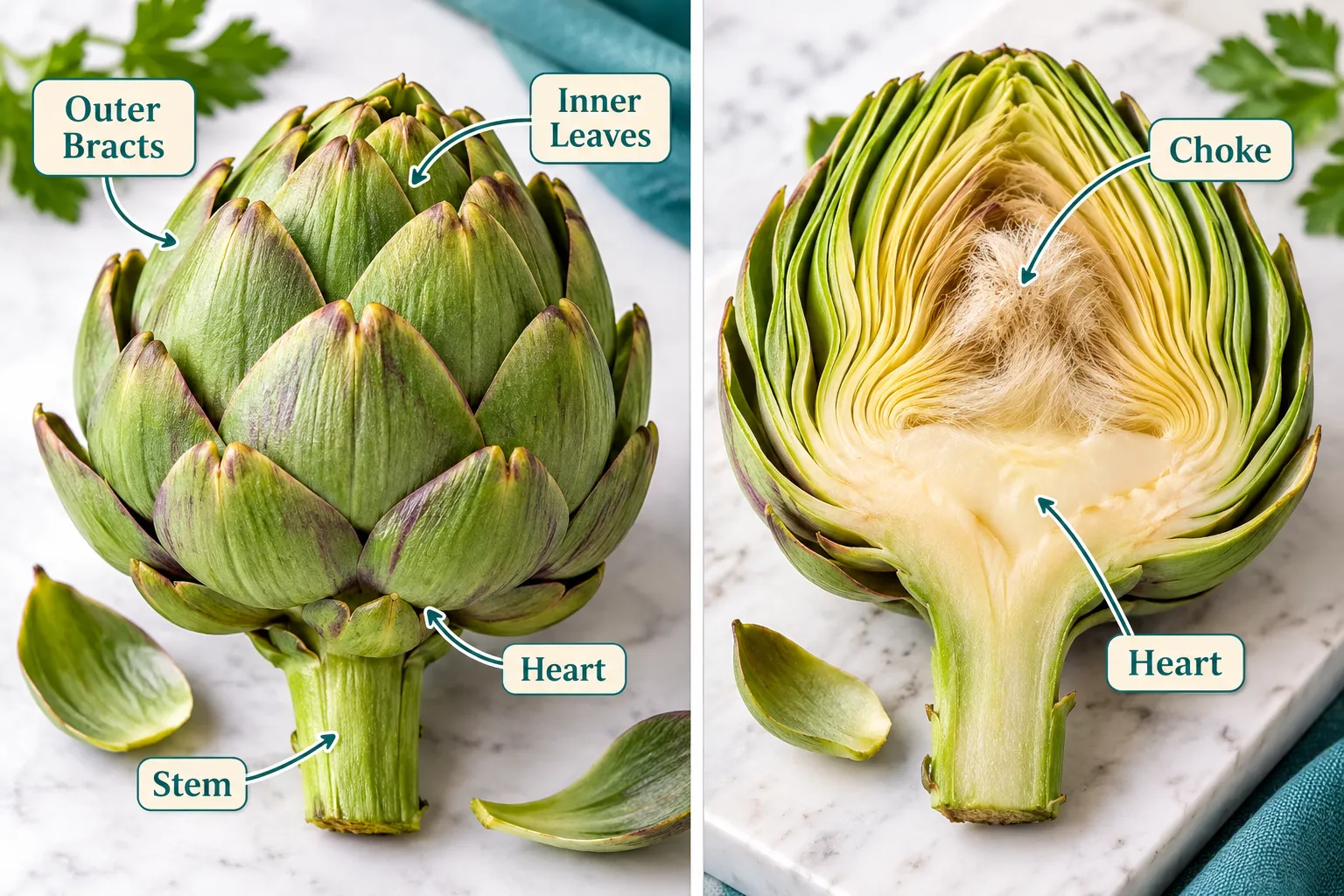
Here is a simple breakdown:
| Part | Edible? | How to Eat |
|---|---|---|
| Outer leaf bracts | Partially | Scrape the fleshy base with teeth; discard the rest |
| Inner pale leaves | Fully | Eat whole after cooking |
| Fuzzy choke | No | Scrape out with a spoon before eating the heart |
| Heart | Fully | Cut into pieces; the best part |
| Stem | Yes (trimmed) | Peel the outer layer; cook alongside the bud |
The heart is consistently the most prized portion. It is sold separately as jarred or canned artichoke hearts, which is why the term appears so frequently in recipes independent of the whole vegetable.
What Does Artichoke Taste Like?
Artichoke has a mild, slightly nutty, and faintly sweet flavor with an earthy undertone. The heart is the richest in flavor, more buttery and complex than the outer leaves, which carry a slight bitterness. A naturally occurring compound in artichoke called cynarin temporarily suppresses sweet taste receptors, which is why water or wine can taste unusually sweet immediately after eating artichoke.
This flavor profile makes artichoke a natural pairing for:
- Lemon butter or garlic aioli
- Parmesan and breadcrumbs (stuffed preparations)
- White wine pan sauces
- Creamy dips (spinach-artichoke dip being the most familiar)
The flavor intensifies with roasting and mellows with steaming. Overcooking pushes the vegetable toward a sulfurous, waterlogged taste that many people mistake for the artichoke’s natural character.
How Do You Know If an Artichoke Is Fresh?
A fresh artichoke feels heavy for its size, has tightly closed, compact leaves, and squeaks audibly when squeezed. The cut stem end should look moist and light-colored, not dried or darkened.
Signs of a good artichoke:
- Tight, compact bracts that resist spreading
- Deep green color (some purple is normal in certain varieties)
- Audible squeak when the bud is gently pressed
- Moist, pale stem cut
Signs to avoid:
- Splayed, open leaves (indicates over-maturity)
- Black or dried leaf tips from poor storage
- Lightweight for its size (dried out)
- Strong off-smell at the stem
Winter frost can actually improve flavor by converting starches to sugars, which is why artichokes harvested in colder months are often sweeter. In late 2026, European markets, particularly Spain’s Granada and Benicarló regions, have seen tighter supplies and elevated prices following heat-related yield losses and grower exits. The traditional Blanca Tudela variety in Benicarló is steadily being replaced by the hybrid Green Queen cultivar, which is now the most widely planted type in that region.
How Do You Cook Artichokes? The Easiest Method
Steaming or boiling a whole artichoke is the most approachable method for home cooks. It requires no special technique and produces a consistently tender result.
Basic steaming method (serves 2):
- Rinse artichokes under cold water.
- Trim the top inch off with a serrated knife.
- Snip sharp leaf tips with kitchen scissors.
- Rub all cut surfaces immediately with a lemon half to prevent browning.
- Place in a steamer basket over two inches of salted water.
- Add a bay leaf and a halved lemon to the water.
- Cover and steam 35 to 45 minutes until an outer leaf pulls away easily.
- Serve with melted butter, garlic aioli, or lemon vinaigrette.
Other reliable cooking methods:
- Boiling: Submerge in acidulated salted water; weight the buds down with a plate to keep submerged.
- Grilling: Halve pre-cooked artichokes, brush with olive oil, and grill cut-side down for 5 minutes.
- Roasting: Quarter artichokes, season generously, and roast at 400°F for 25 minutes.
- Braising: Brown halved artichokes in olive oil, add white wine and broth, and simmer covered.
Those interested in expanding vegetable cooking beyond artichokes will find useful techniques in the 97 Vegetarian Recipes collection and the 1560 Potato Recipes library for side-dish inspiration.
Why Are My Artichokes Tough or Bitter?
Tough or bitter artichokes are almost always the result of one of four problems: old produce, under-cooking, skipping acid, or using the wrong variety for the application.
Common causes and fixes:
- Tough outer leaves: The artichoke was either not cooked long enough or was too mature at purchase. Steam an additional 10 minutes and test again.
- Bitter flavor: No acid (lemon or vinegar) was added to the cooking water. Acid counteracts the natural tannins in the bracts. Always add lemon juice or a splash of white wine vinegar to the water.
- Waterlogged and sulfurous taste: Overcooked. Artichokes cooked past the point where a leaf pulls free easily turn soggy and develop off-flavors.
- Fibrous heart: The artichoke was harvested too late or stored too long. This is a buying problem, not a cooking one.
A common mistake is pulling leaves off before the artichoke is fully cooked. The test is simple: tug an outer leaf. It should release with gentle, steady pressure. Resistance means more cooking time is needed.
Are Artichokes Healthy? Key Nutritional Benefits
Artichokes are one of the most nutritionally dense vegetables available. A single medium artichoke (about 120g cooked) provides roughly 60 calories alongside meaningful amounts of fiber, folate, vitamin C, and vitamin K.
Nutritional highlights per medium cooked artichoke:
| Nutrient | Amount | % Daily Value (approx.) |
|---|---|---|
| Calories | 60 | — |
| Fiber | 6-7g | ~25% |
| Folate | 61 mcg | ~15% |
| Vitamin C | 12mg | ~13% |
| Vitamin K | 18 mcg | ~15% |
| Magnesium | 50mg | ~12% |
Artichokes are particularly notable for their prebiotic fiber (inulin), which supports gut microbiome health. The compound cynarin has been studied for potential liver-protective and cholesterol-modulating effects, though research is ongoing. Artichokes are naturally low in fat and sodium, and their antioxidant content (including chlorogenic acid and luteolin) is among the highest of all commonly consumed vegetables.
For readers focused on plant-forward cooking and health-driven recipes, 154 Homemade Recipes offers a broad range of wholesome preparations.
Can You Eat Raw Artichokes or Artichoke Hearts?
Raw artichoke hearts are edible, but require proper preparation. The outer leaves are too fibrous and bitter to eat raw; only the trimmed heart and inner leaves are palatable without cooking.
How to eat artichokes raw:
- Use only very fresh, small to medium artichokes (baby artichokes are ideal for this).
- Remove all outer leaves down to the pale inner leaves.
- Cut away the top third and trim the stem.
- Immediately rub all surfaces with lemon juice to prevent oxidation.
- Slice thin with a mandoline and dress with olive oil, lemon, Parmesan, and black pepper (a classic Italian preparation called carciofi crudi).
Raw preparations work best in salads and antipasto. They carry a more pronounced bitterness and a crisper texture than cooked artichokes. If the bitterness is too strong, a 10-minute soak in acidulated water before slicing will reduce it.
What’s the Difference Between Artichoke Hearts and Whole Artichokes?
Whole artichokes are the complete flower bud, cooked and eaten leaf by leaf. Artichoke hearts are the trimmed, solid base of the bud with all leaves and the fuzzy choke removed, only the most tender, flavorful portion remains.
Practical comparison:
- Whole artichoke: Best for a standalone vegetable course or as an interactive shared appetizer. Takes 40 to 50 minutes to cook from scratch.
- Canned or jarred artichoke hearts: Convenient, pre-cooked, and ready to slice or chop into dips, pasta, pizza, grain bowls, or grain salads. Water-packed versions are more neutral; oil-packed versions carry additional flavor.
- Frozen artichoke hearts: Similar utility to canned; require a brief thaw and drain before use.
For everyday weeknight cooking, jarred hearts are a reasonable substitute when fresh artichokes are out of season or supply is tight. In autumn and early winter 2026, tight supply from both Spanish and Italian producers has made fresh artichokes more expensive than usual, making jarred hearts an especially practical choice.
How Much Do Artichokes Cost at the Store?
Artichoke prices vary significantly by season, region, and supply conditions. In a normal season, whole fresh artichokes in U.S. supermarkets retail between $1.50 and $3.00 per head. In late 2026, prices are elevated above typical levels.
In Spain, origin prices for fresh artichokes have been reported at approximately EUR 1 per kilogram at farm level and over EUR 2 per kilogram at the warehouse, with PDO-designated product from Benicarló commanding a premium. Frost damage in northern Apulia, Italy, destroyed a significant portion of the region’s crop, further constraining European supply.
Buying guidance:
- Best value season: Spring (March through May) in the U.S.; autumn through winter in Mediterranean markets.
- Canned hearts: Typically $2 to $4 per 14-oz can; excellent cost-to-flavor ratio year-round.
- Frozen hearts: $4 to $7 per pound; convenient and consistent quality.
When whole artichokes are expensive or unavailable, jarred artichoke hearts deliver the same flavor in soups and sauces. The 1718 Soup Cookbook and 1436 Sauce Recipes both include preparations that use artichoke hearts as a core ingredient.
Are There Vegetables Similar to Artichokes?
Several vegetables share flavor notes or textural qualities with artichoke, making them useful substitutes or complementary pairings.
- Cardoon (Cynara cardunculus): The direct wild ancestor of the artichoke. The stalks rather than the buds are eaten; flavor is very similar, slightly more bitter.
- Jerusalem artichoke (sunchoke): Unrelated to true artichokes despite the name; a root vegetable with a nutty, sweet flavor and similarly high inulin content.
- Fennel: Shares a slightly anise-herbal character and works well in many of the same Mediterranean preparations.
- Asparagus: Similar in texture when roasted; slightly grassy flavor makes it an acceptable substitute in pasta dishes.
- Heart of palm: Closest in texture to a canned artichoke heart; mild flavor, works well in dips and salads.
None of these fully replicate the artichoke’s unique cynarin-driven flavor, but they provide workable alternatives in most cooked applications.
Can Dogs Eat Artichokes?
Yes, dogs can eat plain artichoke in small amounts. Artichoke is not toxic to dogs and provides some fiber and antioxidant benefit. However, any preparation that includes garlic, onion, heavy salt, butter, or seasoning must never be given to dogs, as those ingredients are harmful or toxic to them.
Safe feeding guidelines for dogs:
- Offer only plain, cooked or raw artichoke with no seasoning.
- Remove the tough outer leaves; offer only the soft inner leaves or small pieces of heart.
- Treat it as an occasional snack, not a dietary staple.
- Introduce slowly to monitor for digestive sensitivity; high fiber content can cause gas in some dogs.
When in doubt, consult a veterinarian before introducing any new food to a dog’s diet.
Common Mistakes People Make Cooking Artichokes
Even experienced cooks encounter problems with artichokes. The following mistakes account for most poor results.
- Skipping the acid treatment. Cut artichoke turns brown within minutes. Always rub with lemon or drop trimmed pieces into lemon water immediately.
- Not trimming enough. The sharp tip of each leaf bract and the tough outer layer of the stem need to be removed. Under-trimmed artichokes are fibrous and unpleasant.
- Undercooking. The most common error. A whole medium artichoke needs 35 to 45 minutes of steaming. Taste-test by pulling a leaf; it should release cleanly.
- Forgetting to remove the choke. Before eating or serving, the fuzzy choke above the heart must be scraped out with a spoon. It is inedible and unpleasant if swallowed.
- Using old produce. An artichoke more than four to five days past harvest will be fibrous regardless of cooking technique. Buy fresh and use within two days of purchase.
- Boiling without seasoning the water. Salt, lemon, a bay leaf, and a garlic clove in the cooking water make a measurable difference in the final flavor.
- Discarding the stem. After peeling the outer fibrous layer, the stem is flavorful and has the same texture as the heart. Cook and eat it.
Full Artichoke Recipe Card
Title
Classic Steamed Whole Artichoke with Garlic Lemon Butter
Recipe Subtitle
A timeless Mediterranean preparation that turns one humble vegetable into an elegant shared course.
Recipe Description
Whole artichokes are trimmed, steamed to perfect tenderness, and served with a simple garlic lemon butter sauce. This preparation highlights the vegetable’s natural flavor without masking it. It works equally well as a first course, a vegetable side, or a centerpiece for a plant-forward meal.
Recipe Keywords
steamed artichoke recipe, how to cook whole artichoke, garlic lemon butter artichoke, easy artichoke recipe, fresh artichoke preparation, Mediterranean vegetable, artichoke dipping sauce
Difficulty Level
Easy
Preparation Time
15 minutes
Cooking Time
40 minutes
Rest Time
5 minutes
Cooking Temperature (Fahrenheit)
212°F (boiling/steaming point)
Calories
Approximately 120 calories per serving (including dipping sauce)
Best Season
Spring and early winter; ideal for entertaining or a weeknight vegetable course
Cooking Methods
- Steaming
- Boiling (alternative)
- Grilling (finishing option)
- Roasting (alternative whole method)
Cuisines Suggestions
- Italian
- French
- California Mediterranean
Recipe Badges
- Vegetarian
- Gluten-Free
- High-Fiber
Recipe Keys
- Always acidulate cut surfaces immediately to prevent browning and off-flavors.
- Cook until an outer leaf releases with gentle pressure, do not rush the steaming time.
- Remove the fuzzy choke before eating the heart; it is inedible and should not be served to guests without prior removal.
Ingredients
- 2 large fresh artichokes
- 1 lemon, halved (plus extra for rubbing)
- 4 cloves garlic, minced
- 4 tablespoons unsalted butter
- 2 tablespoons fresh lemon juice
- 1 tablespoon extra-virgin olive oil
- 1 teaspoon kosher salt (for cooking water)
- 1/2 teaspoon black pepper
- 1 bay leaf
- 2 tablespoons fresh flat-leaf parsley, finely chopped (for garnish)
Instructions
- Fill a large pot with 3 inches of water. Add the kosher salt, bay leaf, and the squeezed lemon halves. Bring to a boil.
- While the water heats, rinse each artichoke under cold running water, separating the leaves slightly to flush out any debris.
- Using a serrated knife, trim the top 1 inch off each artichoke in a single flat cut.
- Use kitchen scissors to snip the sharp tip off each remaining outer leaf bract.
- Trim the stem to about 1 inch; peel the outer fibrous layer of the stem with a vegetable peeler.
- Immediately rub all cut surfaces with the remaining lemon half to prevent oxidation.
- Place a steamer basket in the pot. Set the artichokes stem-side up in the basket.
- Cover the pot tightly and steam for 35 to 45 minutes, checking water level at the 20-minute mark and adding more if necessary.
- Test doneness by grasping an outer leaf and pulling firmly; it should release with steady pressure. If it resists, steam an additional 5 minutes and test again.
- While artichokes finish cooking, melt butter in a small saucepan over medium-low heat. Add minced garlic and cook gently for 2 minutes until fragrant but not browned.
- Remove garlic butter from heat. Stir in fresh lemon juice, olive oil, and black pepper.
- Remove artichokes from the steamer. Allow to rest 5 minutes before serving.
- Transfer artichokes to serving plates. Pour garlic lemon butter into individual ramekins.
- Garnish artichokes with fresh parsley. Serve immediately.
Equipment
- Large pot with lid (at least 6-quart capacity)
- Steamer basket
- Serrated knife
- Kitchen scissors
- Small saucepan
Nutrition (per serving, 1 artichoke with 2 tablespoons garlic butter)
| Nutrient | Amount |
|---|---|
| Calories | 120 kcal |
| Protein | 4g |
| Total Fat | 7g |
| Carbohydrates | 14g |
| Dietary Fiber | 7g |
| Sodium | 320mg |
Notes
- Prevent browning aggressively. Artichokes oxidize faster than most vegetables. Keep a bowl of lemon water nearby during prep and drop trimmed pieces in immediately.
- Size affects timing significantly. Small artichokes (under 8 oz) may be done in 25 minutes; very large ones can require up to 55 minutes. Always rely on the leaf-pull test rather than a fixed timer.
- Make ahead for entertaining. Artichokes can be steamed up to 24 hours in advance, cooled, wrapped tightly, and refrigerated. Reheat by steaming for an additional 8 minutes or serve at room temperature for a composed salad application.
FAQs
Q: Can I microwave artichokes instead of steaming them? Yes. Wrap a trimmed, moistened artichoke tightly in plastic wrap and microwave on high for 8 to 10 minutes, rotating once halfway through. The result is comparable to steaming for most applications, though the texture is slightly softer.
Q: Why does my wine taste sweet after eating artichokes? The compound cynarin, found naturally in artichoke, temporarily suppresses taste receptors responsible for detecting sweetness. Once those receptors are briefly blocked, the residual sugars in wine, water, or any beverage seem unusually pronounced. This effect typically fades within a minute or two.
Q: Can I grill artichokes from raw? Grilling raw artichokes is not recommended. The outer leaves will char before the heart cooks through. Pre-cook by steaming or boiling first, then halve and grill cut-side down for 4 to 5 minutes to develop color and char marks.
Q: What sauce goes best with steamed artichoke? Garlic lemon butter and classic aioli are the two most compatible sauces. Both complement the vegetable’s earthy, mildly bitter flavor without competing with it. A simple hollandaise works well for a more formal presentation.
Conclusion
The artichoke rewards patience, in the garden, in the market, and in the kitchen. Understanding its structure, choosing it fresh, acidulating cut surfaces immediately, and cooking it fully are the four habits that separate a forgettable experience from an exceptional one.
In practical terms: buy heavy, compact buds; steam until a leaf pulls free; always remove the choke; and keep the dipping sauce simple enough to let the vegetable speak. In late 2026, supply is tighter and prices are higher than in previous seasons due to climate-related crop losses across Spain and Italy, so selecting the freshest available specimen and using every edible part, including the stem, is both economical and wise.
For cooks ready to move beyond the basics, artichokes work beautifully in braises, stuffed preparations, grain bowls, and pasta. The 289 Artichoke Cookbook offers a structured path through those more advanced applications. For complementary vegetable and plant-forward cooking, 97 Vegetarian Recipes and 154 Homemade Recipes provide a reliable foundation. Start with one steamed artichoke, serve it with garlic lemon butter, and the technique will become permanent.