March 10 National Blueberry Popover Day: History, Recipes, and How to Celebrate in 2026
- 0
- 14 Min Read
Last updated: March 10, 2026
Quick Answer: March 10 National Blueberry Popover Day is an annual food holiday celebrated every March 10 that honors the blueberry popover, a light and hollow egg-based pastry studded with fresh or frozen blueberries. The day encourages home bakers and food lovers to bake popovers from scratch, visit local bakeries, and share the results on social media. No single governing body officially created the holiday, but it has been widely observed and listed on national food calendar sites for years. [2]
Key Takeaways
- March 10 National Blueberry Popover Day is observed annually on March 10.
- Popovers are made from a thin egg-and-milk batter that puffs dramatically in a hot oven, creating a hollow, crispy shell.
- Blueberries are the star ingredient; highbush varieties such as Duke or Bluecrop work best because of their firm texture and balanced sweetness.
- The biggest reason popovers fail is a cold pan or cold batter, both must be warm before baking.
- A standard blueberry popover contains roughly 150 to 200 calories, depending on size and added butter.
- Popovers differ from muffins in batter consistency, pan type, and final texture: popovers are hollow and crispy, muffins are dense and cakey.
- You can prepare popover batter up to 24 hours ahead and refrigerate it, but bring it to room temperature before baking.
- Specialty bakeries in most mid-size and large U.S. cities sell popovers, with prices typically ranging from $3 to $6 per popover as of 2026.
What Is a Blueberry Popover?
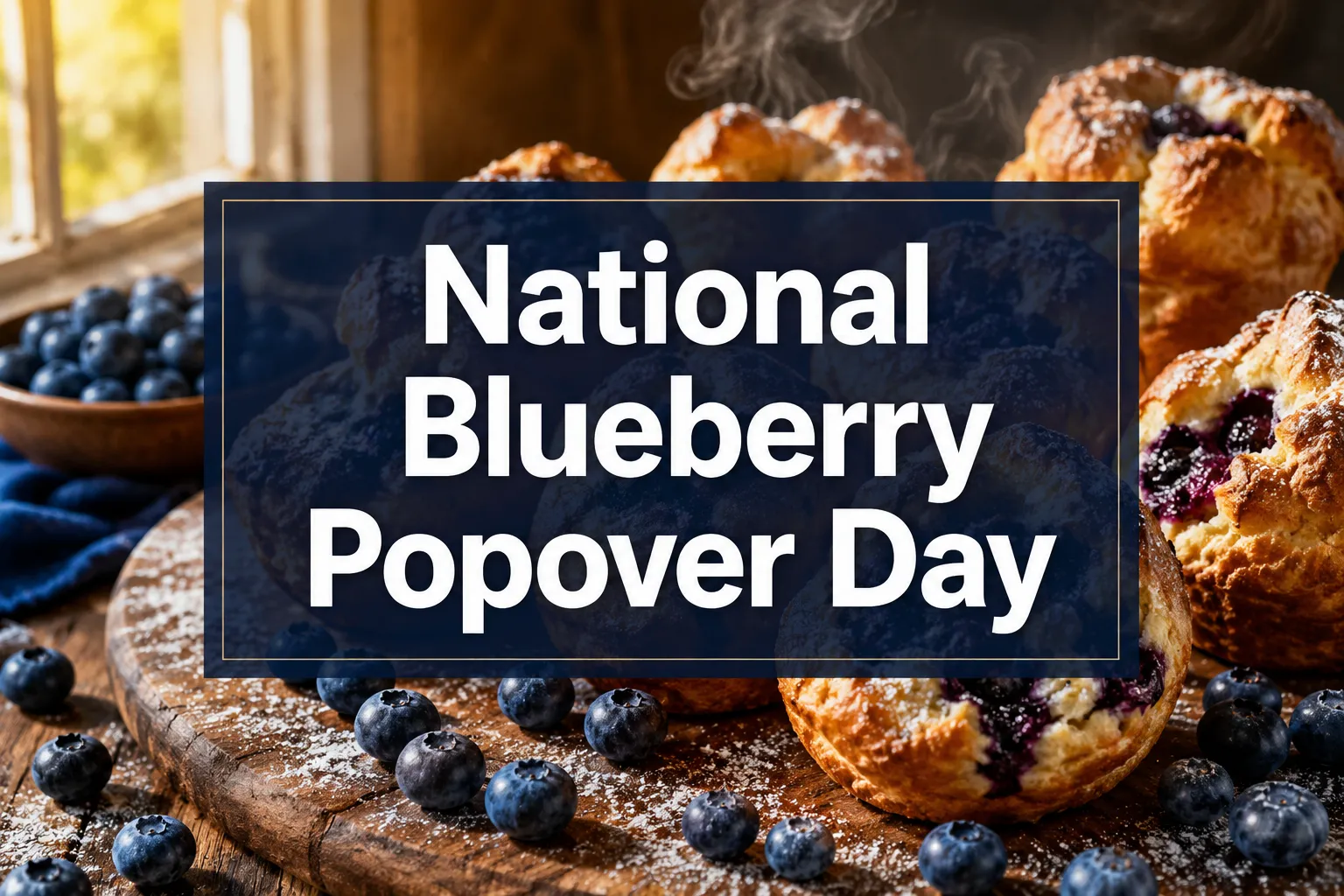
A blueberry popover is a light, hollow pastry made from a thin batter of eggs, milk, flour, and butter, with fresh or frozen blueberries folded in. The batter is poured into a hot, greased popover pan or muffin tin and baked at high heat. Steam trapped inside the batter causes it to puff and “pop over” the rim of the pan, forming a crispy golden shell with a soft, eggy interior.
The result is something between a Yorkshire pudding and a cream puff. The outside is crisp and deeply golden. The inside is largely hollow, with a tender, slightly custardy lining. Blueberries add bursts of tartness and color throughout.
Popovers are typically served warm, either plain, dusted with powdered sugar, or split open and filled with whipped cream, lemon curd, or additional fresh blueberries. They pair naturally with a morning cup of coffee, for more on pairing baked goods with specialty brews, see this guide to National Gourmet Coffee Day.
Why Is March 10 National Blueberry Popover Day?
March 10 National Blueberry Popover Day exists to celebrate one of America’s most underrated baked goods. The exact origin of the holiday is not officially documented, and no single person or organization has been publicly credited with founding it. [3] This is common among informal food holidays, many of which emerged through food bloggers, bakery promotions, or national day calendar aggregators in the early 2000s.
What is clear is that the date, March 10, falls in a period when fresh blueberries are arriving from warmer growing regions, making the timing practical for home bakers. The holiday appears consistently on major food observance calendars including National Today and Checkiday. [2][3]
“Food holidays like this one serve a genuine purpose: they give home bakers a reason to try something outside their usual rotation.”
If you enjoy celebrating food holidays throughout the year, the national food holidays tag on stillcooking.com is a useful resource for planning ahead.
Upcoming observance dates for March 10 National Blueberry Popover Day:
| Year | Day of Week | Date |
|---|---|---|
| 2026 | Tuesday | March 10, 2026 |
| 2027 | Wednesday | March 10, 2027 |
| 2028 | Friday | March 10, 2028 |
| 2029 | Saturday | March 10, 2029 |
| 2030 | Sunday | March 10, 2030 |
| 2031 | Monday | March 10, 2031 |
Who Invented the Blueberry Popover?
No single person is credited with inventing the blueberry popover specifically. The popover itself is an American adaptation of the British Yorkshire pudding, which dates back to at least the 18th century. American cooks adopted the same steam-leavened batter technique but baked it in individual cups rather than a large pan, and the popover became a fixture of New England cooking by the mid-1800s.
Blueberries were added as a natural regional variation, given that New England and the Mid-Atlantic states have long been major blueberry-growing regions. The Jordan Pond House in Acadia National Park, Maine, is one of the most famous spots historically associated with popovers in the United States, though their version is traditionally served plain with jam rather than with blueberries baked inside. [3]
How to Make Blueberry Popovers from Scratch
Making blueberry popovers from scratch takes about 45 minutes total, including prep and bake time. The process is straightforward, but a few specific steps determine whether the popovers actually pop.
Best Blueberry Popover Recipe
Ingredients (makes 6 standard popovers):
- 3 large eggs, at room temperature
- 1 cup whole milk, warmed to about 100°F
- 1 cup all-purpose flour, sifted
- 1/2 teaspoon salt
- 1 tablespoon unsalted butter, melted, plus more for greasing the pan
- 3/4 cup fresh or frozen blueberries (do not thaw if frozen)
- Optional: 1 tablespoon sugar for a slightly sweeter popover
Steps:
- Preheat the oven to 450°F. Place the empty, greased popover pan in the oven while it heats. A hot pan is the single most important factor for a good rise.
- Blend the batter. Whisk eggs and warm milk together first, then add flour, salt, and melted butter. Whisk until smooth but do not overmix. A few small lumps are fine. Let the batter rest at room temperature for 10 minutes.
- Fill the pan quickly. Remove the hot pan from the oven, pour batter into each cup until about two-thirds full, then drop 5 to 6 blueberries into each cup.
- Bake at 450°F for 20 minutes. Do not open the oven door during this time. Then reduce heat to 350°F and bake for another 10 to 15 minutes until deep golden brown.
- Pierce and serve immediately. Use a skewer to poke a small hole in each popover right out of the oven to release steam and keep them crispy.
For more inspiration on blueberry-forward baking, the blueberry cookbook collection on stillcooking.com offers dozens of additional recipe ideas.
Best Blueberry Varieties for Popovers
Firm, medium-sized blueberries work best in popovers because they hold their shape during the high-heat bake and release just enough juice without making the batter soggy.
Top choices:
- Duke (highbush): Firm, mildly sweet, widely available fresh in early spring. Excellent for baking.
- Bluecrop (highbush): The most commonly grown commercial variety in North America. Balanced flavor and firm enough to survive oven heat.
- Elliott (highbush): Slightly tart, holds up well. Good choice if you want more contrast against a plain batter.
- Wild (lowbush) blueberries: Smaller and more intensely flavored than cultivated varieties. They distribute more evenly through the batter and create a more uniform blueberry flavor throughout.
Avoid very large, soft blueberries (such as some late-season varieties) as they tend to release too much liquid and can cause the bottom of the popover to steam rather than crisp.
Blueberry Popover vs. Dutch Baby Pancake: What Is the Difference?
A blueberry popover and a Dutch baby pancake use similar batter ingredients but are baked in different pans and produce very different results. A popover is baked in individual cups, rises tall and hollow, and has a crispy exterior. A Dutch baby is baked in a single large skillet, puffs into a wide bowl shape, and has a softer, more custardy texture throughout.
Key differences at a glance:
| Feature | Blueberry Popover | Dutch Baby Pancake |
|---|---|---|
| Pan | Individual popover cups | Single cast-iron skillet |
| Shape | Tall, hollow, individual | Wide, shallow bowl |
| Exterior | Crispy, golden brown | Soft, lightly browned |
| Serving size | Individual | Shared (sliced) |
| Bake time | 30-35 minutes | 20-25 minutes |
Both are steam-leavened and egg-forward, which is why they are often compared. Choose a popover for individual servings with a crispy shell; choose a Dutch baby for a shareable, softer result. Fans of egg-based baked goods also tend to enjoy National Blueberry Pancake Day on January 28 as another opportunity to celebrate blueberries in breakfast baking.
Difference Between Popovers and Muffins
Popovers and muffins look similar when placed side by side in a pan, but they are fundamentally different products. A popover uses a thin, liquid batter with a high egg and milk ratio, no chemical leavening, and relies entirely on steam to rise. A muffin uses a thick batter with baking powder or baking soda as the leavening agent and produces a dense, cakey crumb.
The result: popovers are hollow and crispy on the outside, while muffins are solid and soft throughout. Popovers must be served immediately after baking or they deflate. Muffins hold their texture for hours or days.
Why Did My Popovers Not Pop? Common Mistakes
Flat or collapsed popovers are almost always caused by one of four specific errors. Identifying which one applies makes the fix straightforward.
The four most common blueberry popover mistakes:
- Cold pan. The pan must be preheated in the oven before adding batter. A cold pan causes the bottom of the batter to set slowly, which prevents the steam from building fast enough to push the batter upward.
- Cold or refrigerator-temperature batter. Room-temperature eggs and warm milk are essential. Cold ingredients slow steam production at the critical early stage of baking.
- Opening the oven door. Even a brief drop in oven temperature during the first 20 minutes collapses the rise. Set a timer and leave the oven closed.
- Overfilling the cups. Cups should be no more than two-thirds full. Overfilled cups cannot expand upward and tend to spill over and flatten.
Edge case: If the oven runs cool (common in older ovens), popovers may not pop even when technique is correct. Use an oven thermometer to verify the actual temperature, and consider increasing the initial bake temperature by 25°F.
Can You Make Blueberry Popovers Ahead of Time?
The batter can be made up to 24 hours in advance and stored covered in the refrigerator, but the baked popovers themselves do not hold well. Once baked, popovers should be eaten within 15 to 20 minutes for best texture. They deflate and soften as they cool.
Practical make-ahead strategy:
- Mix batter the night before and refrigerate.
- Remove batter from the refrigerator at least 30 minutes before baking to bring it to room temperature.
- Preheat the pan and oven fresh each time, this step cannot be done in advance.
- If you must reheat a baked popover, place it in a 350°F oven for 5 minutes uncovered. It will not fully recrisp, but it will warm through.
Blueberry Popover Nutrition Facts
A standard blueberry popover (approximately 65 to 75 grams) contains roughly 150 to 200 calories, depending on the recipe and size. The values below are estimates based on a standard recipe using whole milk, eggs, all-purpose flour, and fresh blueberries.
| Nutrient | Approximate Amount (per popover) |
|---|---|
| Calories | 160-200 kcal |
| Total Fat | 5-7 g |
| Saturated Fat | 2-3 g |
| Carbohydrates | 22-26 g |
| Protein | 6-8 g |
| Sugar | 4-6 g |
| Fiber | 1-2 g |
Popovers are lower in fat and sugar than most muffins or croissants of comparable size. For context, a standard croissant typically contains 230 to 270 calories and significantly more saturated fat. Adding powdered sugar, whipped cream, or butter as a topping will increase the calorie count accordingly.
Where to Buy Blueberry Popovers Near Me
Specialty bakeries, hotel breakfast restaurants, and New England-style cafes are the most reliable places to find blueberry popovers. They are not as commonly stocked as muffins or croissants, so calling ahead is recommended.
Where to look:
- Specialty bakeries: Search “artisan bakery” or “New England bakery” in your city. Many offer seasonal popover flavors, with blueberry being common in spring.
- Hotel restaurants and brunch spots: Popovers have long been a brunch staple at upscale hotel dining rooms, particularly on the East Coast.
- Farmers markets: Some small-batch bakers sell fresh popovers at weekend markets, especially in blueberry-growing regions.
- Online: Frozen popover batter kits are available from several specialty food retailers and can be shipped nationally.
Blueberry popover prices at bakeries typically range from $3 to $6 per individual popover as of 2026, depending on the city and establishment. Some bakeries offer them as part of a brunch set with jam and butter for $8 to $12.
How to Celebrate March 10 National Blueberry Popover Day in 2026
March 10 National Blueberry Popover Day is best celebrated by baking, sharing, and discovering. Here are specific, actionable ways to mark the day.
At home:
- Bake a batch using the recipe above and invite friends or family for a morning coffee and popover session.
- Try a variation: add lemon zest to the batter, swap blueberries for a mix of berries, or serve with blueberry compote instead of fresh fruit.
- Document the bake and share on social media using the hashtag #NationalBlueberryPopoverDay.
Out and about:
- Call a local specialty bakery ahead of March 10 and ask if they plan to feature popovers that day.
- Organize a small baking competition among friends or coworkers with different popover flavor variations.
For food educators:
- Use the day as a classroom opportunity to demonstrate steam-leavened baking and compare it to chemically leavened products like muffins or quick breads.
If you enjoy tracking food holidays throughout the year, the national food observances tag on stillcooking.com is a practical resource for planning future celebrations.
FAQ: March 10 National Blueberry Popover Day
What day is National Blueberry Popover Day? National Blueberry Popover Day is observed every year on March 10. In 2026, it falls on a Tuesday. [2]
Is National Blueberry Popover Day an official U.S. holiday? No. It is an informal food observance, not a federally recognized holiday. It is listed on national food calendar sites but has no official government backing. [3]
Can I use frozen blueberries in popovers? Yes. Frozen blueberries work well and do not need to be thawed before adding to the batter. Using them frozen actually reduces the risk of excess juice bleeding into the batter during mixing.
Do popovers need a special pan? A dedicated popover pan with tall, narrow cups produces the best results because the shape channels steam upward. A standard 12-cup muffin tin works as a substitute but produces shorter, wider popovers.
Why are my popovers dense instead of hollow? Dense popovers usually result from overmixing the batter (which develops too much gluten) or from baking at too low a temperature. Use a light hand when mixing and verify oven temperature with a thermometer.
How long do blueberry popovers stay fresh? Blueberry popovers are best eaten within 20 minutes of baking. They can be stored at room temperature for up to 4 hours but will lose their crispness. Reheat in a 350°F oven for 5 minutes to partially restore texture.
Are blueberry popovers gluten-free? Standard popover recipes use all-purpose flour and are not gluten-free. A 1:1 gluten-free flour blend can be substituted, though the rise may be slightly less dramatic.
What is the difference between a popover and a Yorkshire pudding? They use nearly identical batter. The main difference is cultural and contextual: Yorkshire pudding is a British dish traditionally served with roast beef and savory drippings, while American popovers are served as a sweet or neutral pastry, often with fruit, jam, or butter.
Can children help make blueberry popovers? Yes. Children can help measure and mix ingredients, grease the pan, and add blueberries to each cup. Adult supervision is required for the oven steps due to the high baking temperature.
What drinks pair well with blueberry popovers? Black coffee, Earl Grey tea, and fresh-squeezed orange juice all complement the mild sweetness of a blueberry popover. A latte or cappuccino also pairs well for a brunch setting.
Conclusion
March 10 National Blueberry Popover Day is a straightforward and genuinely enjoyable food holiday that rewards a modest investment of time and effort. The blueberry popover is one of the more impressive baked goods a home baker can produce, and the science behind its dramatic rise makes it an educational bake as much as a delicious one.
Actionable next steps for 2026:
- Gather ingredients now: eggs, whole milk, all-purpose flour, butter, and fresh or frozen blueberries.
- Invest in a popover pan if you do not already own one, the tall cups make a measurable difference in the final rise.
- Bake a batch on March 10 and share the results on social media with the hashtag #NationalBlueberryPopoverDay.
- Explore local specialty bakeries ahead of the date to find out if they plan to feature popovers.
- Use the blueberry cookbook resource for additional blueberry baking ideas to extend the celebration beyond March 10.
The key to success is simple: warm pan, warm batter, and a closed oven door. Get those three things right and the popovers will take care of themselves.
References
[1] National Blueberry Popover Day March – https://www.flowerstales.com/2021/03/national-blueberry-popover-day-march.html [2] National Blueberry Popover Day – https://www.checkiday.com/4389edbdffae77eb9306ad828cd31466/national-blueberry-popover-day [3] National Blueberry Popover Day – https://nationaltoday.com/national-blueberry-popover-day/ [5] National Blueberry Popover Day – https://www.journee-mondiale.com/en/day/national-blueberry-popover-day/