
Last updated: November 17, 2026
Quick Answer
November 17 National Homemade Bread Day is an annual U.S. food observance celebrated every November 17. It encourages home bakers of all skill levels to bake bread from scratch, share loaves with others, and reconnect with the tradition of handmade baking. It is a cultural awareness event, not a government-designated public holiday.
Key Takeaways
- November 17 National Homemade Bread Day falls on Tuesday, November 17, 2026, and recurs on November 17 every year.
- The day is credited to the National Homemade Bread Committee, with roots in Ann Arbor, Michigan.
- It is a cultural observance only, not a statutory holiday, and is recognized across food-day calendars, libraries, and community organizations.
- Anyone can celebrate by baking a simple loaf, attending a community tasting event, or sharing a recipe with neighbors.
- Beginner-friendly breads include no-knead white bread, banana bread, and flatbreads, all of which require minimal equipment.
- Homemade bread typically takes 2.5 to 4 hours from start to finish, most of which is hands-off rising time.
- A stand mixer is not required; a large bowl, a wooden spoon, and clean hands are enough.
- Community events tied to the day in 2026 include library bread tastings and campus baking gatherings.
- Sourdough requires a starter culture and more patience, making it less beginner-friendly than standard yeast bread.
- Homemade bread avoids the preservatives, emulsifiers, and added sugars found in many commercial loaves.
What Is National Homemade Bread Day and Why November 17?
November 17 National Homemade Bread Day is a U.S. food holiday observed annually on November 17 to celebrate the art and tradition of baking bread from scratch at home. It is not a federal or state public holiday, but it appears consistently across food-day calendars, library newsletters, and awareness sites as a recognized annual observance [1][2].
The fixed date of November 17 places the holiday squarely between the fall harvest season and the Thanksgiving holiday rush, making it a natural fit for home bakers planning ahead. As one regional newspaper noted, the timing gives cooks a timely reason to bake loaves early and freeze them before the holiday crunch [3]. It also coincides with other food observances on the same date, including National Baklava Day [4][5].
Why it matters in 2026: In 2026, National Homemade Bread Day falls on a Tuesday. Multiple awareness and food-day platforms, including ObservanceDaily, HolidaysCalendar, and Sync2Cal, confirm the November 17 date for 2026 and list it as recurring through at least 2030 [1][2][5].
History and Origin of National Homemade Bread Day
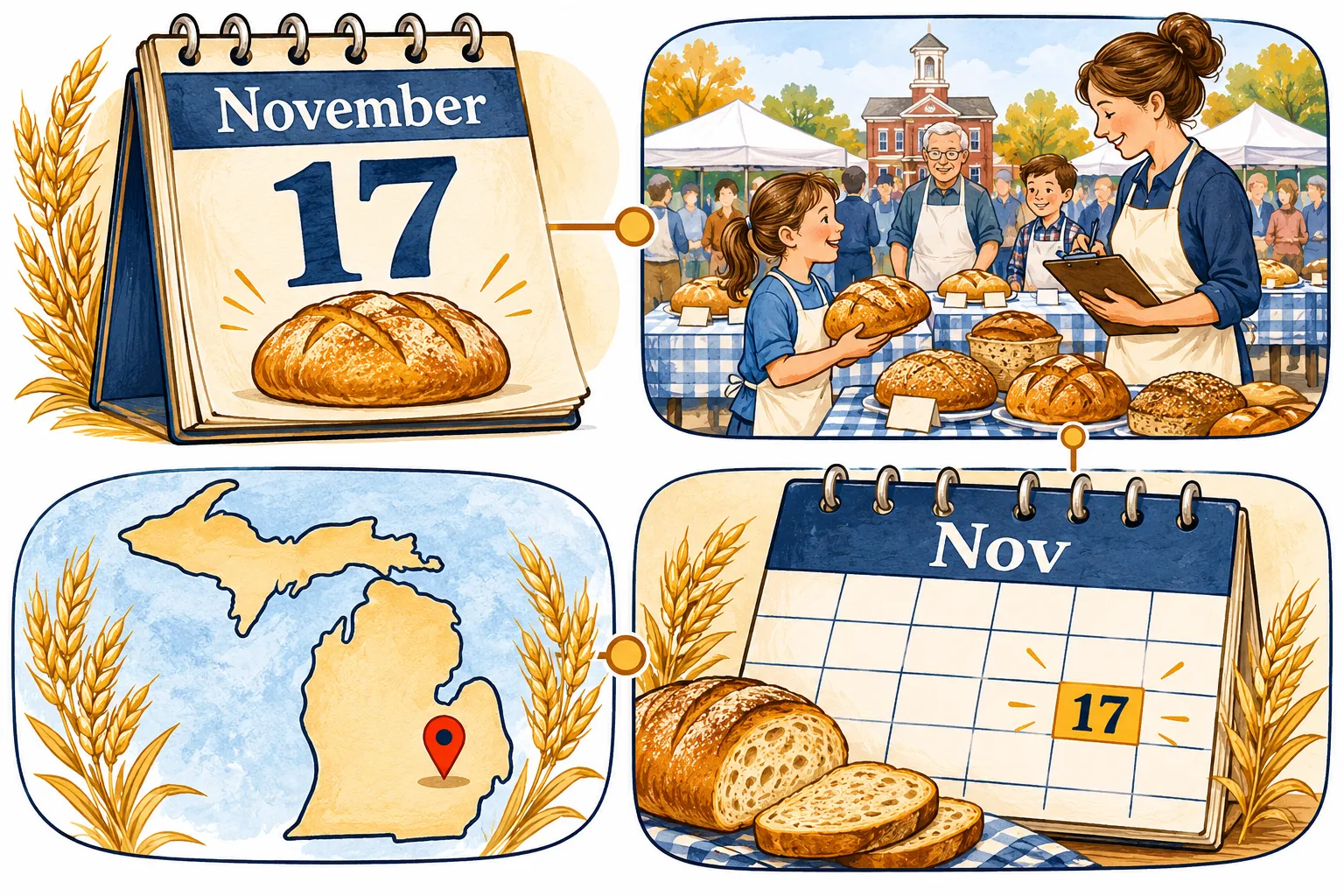
The observance is credited to the National Homemade Bread Committee, with its origins traced to Ann Arbor, Michigan. Several food-holiday sources describe the committee as having established the day to encourage people to move away from store-bought bread and bake their own loaves at home [2][4].
No single founding year is universally documented across public sources, but the day is now a fixture in annual food-holiday roundups and institutional calendars. Libraries, colleges, and community groups across the country use November 17 as a hook for bread-baking classes, tastings, and skill-building events [6][7].
The North Dakota State Library’s November 2026 newsletter, for example, reminded readers of the date and linked it to an online pastry class covering everything from challah to chocolate babka [7]. This kind of institutional adoption shows how the day has grown well beyond a simple food-calendar listing into a genuine community engagement moment.
How Do You Celebrate November 17 National Homemade Bread Day?
Celebrating November 17 National Homemade Bread Day is straightforward: bake a loaf, share it, or learn something new about bread-making. There is no official ceremony or registration required.
Common ways people celebrate:
- Bake a loaf from scratch and share it warm with butter and neighbors or coworkers.
- Attend a community bread tasting, such as the event hosted by the Perry Branch Library in Perry, Michigan, which runs from 10 a.m. to 6 p.m. and allows participants to taste varieties and vote for a favorite [6].
- Join a campus or community gathering like the Austin Community College Student Life event, which offers breads, spreads, and recipe sharing [6].
- Take an online baking class. The North Dakota State Library highlighted an on-demand class with pastry chef Jenny McCoy covering gingerbread coffee cake, panettone, and challah [7].
- Freeze a homemade loaf now for Thanksgiving, a strategy endorsed by food writers who tie the holiday to early holiday prep [3].
- Share a recipe on social media or with family using the hashtag #NationalHomemadeBreadDay.
Choose the option that fits your skill level: If you’ve never baked bread before, start with a no-knead recipe or banana bread. If you’re experienced, try an enriched dough like brioche or a shaped loaf.
For more food-holiday inspiration, see how other culinary observances are celebrated, such as Panini Month and the traditions around National Raspberry Cake Day.
What Types of Bread Are Easiest to Make at Home?
For beginners, the easiest homemade breads are those with the fewest steps, shortest ingredient lists, and forgiving timelines. No-knead breads, quick breads, and flatbreads are the best starting points.
Beginner-friendly bread types:
| Bread Type | Difficulty | Time Required | Equipment Needed |
|---|---|---|---|
| No-knead white loaf | Very easy | 12-18 hrs (mostly rest) | Large bowl, Dutch oven |
| Banana bread | Very easy | 1 hr 15 min | Loaf pan, mixing bowl |
| Flatbread / naan | Easy | 45-60 min | Skillet or griddle |
| Basic sandwich loaf | Easy, Medium | 2.5-3 hrs | Loaf pan, stand mixer (optional) |
| Focaccia | Easy, Medium | 2-3 hrs | Baking pan, olive oil |
| Sourdough boule | Advanced | 24-48 hrs | Dutch oven, sourdough starter |
Banana bread and flatbreads use baking powder or soda rather than yeast, so there’s no proofing time and no risk of the dough failing to rise. No-knead bread requires almost no hands-on effort but does need advance planning due to its long rest time.
Sourdough vs. Regular Bread: Which Is Easier to Make?
Regular yeast bread is significantly easier to make than sourdough, especially for first-time bakers. Standard yeast bread uses commercial dry yeast, which is reliable and fast-acting. Sourdough relies on a live starter culture that must be maintained and fed over days or weeks before it is strong enough to leaven a loaf.
Key differences:
- Sourdough starter: Must be cultivated 5-7 days in advance or sourced from someone who already maintains one.
- Fermentation time: Sourdough typically requires 12-48 hours of cold or room-temperature fermentation for best flavor.
- Troubleshooting: An under-active starter produces dense, flat loaves. Yeast bread is far more forgiving.
- Flavor payoff: Sourdough develops a complex, tangy flavor through lactic acid fermentation. Standard yeast bread is milder and bready.
Choose sourdough if: You enjoy a multi-day project, you already have or can obtain a starter, and you want a bread with longer shelf life and a more complex taste.
Choose regular yeast bread if: You want results on the same day, you’re baking for the first time, or you need a reliable loaf for a specific occasion like November 17 National Homemade Bread Day.
How Long Does It Take to Make Homemade Bread From Scratch?
A standard homemade yeast loaf takes roughly 2.5 to 4 hours from start to finish, with the majority of that time being hands-off rising. Active preparation (mixing, kneading, shaping) takes about 20 to 30 minutes.
Typical timeline for a basic white loaf:
- Mix ingredients: 10 minutes
- First rise (bulk fermentation): 1 to 1.5 hours
- Shape the dough: 5 minutes
- Second rise (proofing): 45 to 60 minutes
- Bake: 25 to 35 minutes
- Cool before slicing: 20 to 30 minutes
Quick breads like banana bread cut this down to about 75 minutes total, since they skip the yeast-rising stages entirely. No-knead breads extend the timeline to 12-18 hours due to their slow cold fermentation, but require almost no active effort.
Common mistake: Slicing the loaf too early. Bread continues to set internally after leaving the oven, and cutting it hot results in a gummy crumb.
What Equipment Do You Need to Make Bread at Home?
The bare minimum equipment to bake a loaf of bread is a large mixing bowl, a loaf pan or baking sheet, and an oven. Nothing more is strictly required for a beginner recipe.
Core equipment list:
- Large mixing bowl (at least 4-quart capacity)
- Measuring cups and spoons
- Loaf pan (9×5 inch for sandwich-style loaves)
- Clean kitchen towel or plastic wrap (for covering dough during rising)
- Oven thermometer (optional but recommended, since oven temperatures vary)
Optional upgrades:
- Dutch oven: creates the steam needed for a crisp artisan crust
- Stand mixer with dough hook: saves effort on high-hydration doughs
- Bench scraper: useful for shaping and dividing dough
- Digital kitchen scale: more accurate than volume measurements for flour
Can You Make Bread Without a Stand Mixer?
Yes. A stand mixer makes kneading easier, but it is not required. Thousands of bread recipes are designed for hand-kneading, and no-knead recipes specifically bypass the kneading step entirely.
To knead by hand, push the dough away with the heel of your hand, fold it back, rotate, and repeat for 8 to 10 minutes until the dough is smooth and elastic. It is a workout, but it also gives you direct tactile feedback on the dough’s readiness, which no machine can replicate.
How Do You Know When Bread Dough Is Ready to Bake?
Bread dough is ready to bake when it has roughly doubled in size during the second rise and passes the “poke test.” Press a floured finger about half an inch into the dough; if the indentation springs back slowly and partially, the dough is properly proofed. If it springs back instantly, it needs more time. If it doesn’t spring back at all, it may be over-proofed.
Additional readiness checks:
- The dough feels airy and slightly jiggly, not dense.
- It has visible bubbles just under the surface.
- It holds its shape when you remove it from the proofing container.
Over-proofed dough can still be baked but may collapse in the oven and produce a dense crumb. Under-proofed dough will produce a tight, heavy texture with large uneven holes.
Common Mistakes When Baking Homemade Bread
Most bread-baking failures come from a small set of repeatable errors. Knowing them in advance prevents frustration on a baking day like November 17 National Homemade Bread Day.
Top mistakes and how to fix them:
- Killing the yeast with hot water: Liquid above 110°F (43°C) can destroy active yeast. Use warm water that feels comfortable on your wrist, around 100-105°F.
- Adding too much flour: A sticky dough is not a failed dough. Over-flouring produces dry, dense loaves. Trust the recipe’s ratio.
- Skipping the second rise: Some bakers rush from first rise to oven. The second rise (after shaping) is what gives bread its final texture and open crumb.
- Opening the oven too early: This drops the internal temperature and can cause the loaf to collapse. Wait until at least three-quarters of the bake time has passed.
- Not cooling the bread: Cutting into a hot loaf releases steam and results in a gummy interior. Wait at least 20 to 30 minutes.
Why Does Homemade Bread Taste Better Than Store-Bought?
Homemade bread typically tastes better than commercial bread because it uses fewer ingredients, no preservatives, and can be eaten fresh. Most supermarket sandwich bread contains emulsifiers, dough conditioners, and added sugars that extend shelf life but dull the flavor.
A simple homemade loaf needs only flour, water, salt, yeast, and perhaps a small amount of oil or butter. That simplicity lets the natural flavors of fermentation and the Maillard browning reaction (the crust’s golden color and deep flavor) come through. Fresh bread also has a crust-to-crumb texture contrast that disappears within hours in commercial packaging.
“Homemade bread, even an imperfect loaf, carries real value, for the person baking it, the people sharing it, and the table it comes to.”, a sentiment echoed across food-day observance guides [1][8]
Homemade bread also pairs naturally with other from-scratch accompaniments. Fruit preserves make a classic topping, and freshly baked loaves are the foundation of a great Italian sandwich.
What’s the Difference Between Artisan Bread and Homemade Bread?
Homemade bread is any bread baked at home, regardless of technique. Artisan bread refers to a style of bread, usually with a crisp crust, open irregular crumb, and minimal ingredients, that prioritizes traditional slow-fermentation methods over speed or convenience.
All artisan bread made at home is homemade, but not all homemade bread is artisan. A banana bread or a soft sandwich loaf is homemade but not artisan. A slow-fermented sourdough boule or a hand-shaped baguette baked in a home Dutch oven would qualify as artisan.
In practice on National Homemade Bread Day: Any loaf counts. The day’s focus is on the act of baking at home, not the technique or style.
Are There National Homemade Bread Day Events Near Me?
Community events tied to November 17 National Homemade Bread Day do exist and are worth searching for locally. In 2026, confirmed events include a homemade bread tasting at the Perry Branch Library in Perry, Michigan, running from 10 a.m. to 6 p.m. (or until bread runs out), where attendees taste varieties and vote for a favorite, registration is required by calling the branch directly [6]. Austin Community College also hosted a Student Life bread and spreads event at its Northridge Campus on November 17 [6].
How to find events near you:
- Search your local library’s events calendar for “bread” or “baking” in November.
- Check community center and food co-op event pages.
- Search Eventbrite or Meetup for “bread baking” or “baking class” in your city.
- Look for bakery open-house events, as some use the day for demos or giveaways.
If no event is available locally, hosting a small neighborhood bread swap is a simple alternative. Bake a loaf, invite two or three neighbors to do the same, and trade slices. No formal organization required.
Best Easy Bread Recipes for Beginners
The best starting recipe for a beginner on National Homemade Bread Day is a no-knead white loaf or a classic banana bread, both of which are forgiving and require no special equipment.
No-knead overnight white loaf (outline):
- Combine 3 cups all-purpose flour, 1/4 tsp instant yeast, 1.5 tsp salt, and 1.5 cups warm water in a bowl.
- Stir until a shaggy dough forms. Cover and rest at room temperature for 12 to 18 hours.
- Turn out onto a floured surface, fold twice, and shape into a ball.
- Rest for 15 minutes, then transfer to a floured cloth and proof for 1 to 2 hours.
- Preheat oven to 450°F with a Dutch oven inside. Bake covered for 30 minutes, then uncovered for 15 minutes.
Banana bread (outline):
- Mash 3 ripe bananas. Whisk in 1/3 cup melted butter, 3/4 cup sugar, 1 egg, 1 tsp vanilla.
- Stir in 1 tsp baking soda, a pinch of salt, and 1.5 cups all-purpose flour.
- Pour into a greased loaf pan and bake at 350°F for 60 to 65 minutes.
Both recipes scale easily and work well as gifts. Pair a fresh loaf with fruit preserves for a complete homemade gift. If you enjoy baking for celebrations, also explore National Hazelnut Cake Day for another great baking holiday.
FAQ
What date is National Homemade Bread Day? National Homemade Bread Day is observed annually on November 17. In 2026, it falls on a Tuesday [1][2].
Is National Homemade Bread Day a public holiday? No. It is a cultural food observance, not a federal or state holiday. Banks, schools, and businesses remain open [2][5].
Who created National Homemade Bread Day? The day is credited to the National Homemade Bread Committee, with origins in Ann Arbor, Michigan [2][4].
What is the easiest bread to bake for the first time? Banana bread is the easiest starting point because it uses baking soda instead of yeast, requires no kneading, and bakes in about an hour with common pantry ingredients.
Do I need a bread machine to celebrate? No. A mixing bowl, a loaf pan, and an oven are all that is strictly needed. A bread machine can simplify the process but is not required [8].
Can I make gluten-free bread for National Homemade Bread Day? Yes. Gluten-free bread recipes using rice flour, almond flour, or certified gluten-free oat flour are widely available. These use xanthan gum or psyllium husk to replicate the structure that gluten provides.
How do I store homemade bread? Wrap cooled bread in a clean cloth or paper bag at room temperature for up to 2 days. For longer storage, slice and freeze in an airtight bag for up to 3 months.
Can I freeze bread baked on November 17 for Thanksgiving? Yes. Homemade loaves freeze well and can be thawed at room temperature or warmed in the oven. Baking in mid-November and freezing ahead is a recommended strategy for holiday meal prep [3].
What other food holidays fall on November 17? National Baklava Day and Halvah Day are also observed on November 17 in the United States [4][5].
Is sourdough appropriate for beginners on this day? Sourdough is not ideal for beginners because it requires a live starter and multi-day fermentation. A standard yeast loaf or quick bread is a better choice for a first attempt.
Conclusion
November 17 National Homemade Bread Day is a low-barrier, high-reward observance that fits anyone from a first-time baker to a seasoned home cook. The day falls on a convenient mid-November date that naturally aligns with holiday cooking, early Thanksgiving prep, and community gatherings.
Actionable next steps for November 17, 2026:
- Pick one recipe matched to your skill level: banana bread for beginners, a no-knead loaf for intermediate bakers, or a shaped enriched dough for the experienced.
- Check your local library or community center for a bread tasting or baking class event [6][7].
- If baking ahead for Thanksgiving, bake your loaf on November 17 and freeze it immediately after cooling [3].
- Share the loaf, the recipe, or both. The community aspect of this day is as important as the baking itself.
- Explore more baking-adjacent celebrations throughout the year, including Panini Month and National Hazelnut Cake Day.
Homemade bread does not need to be perfect. It just needs to be made.
References
- National Homemade Bread Day. observancedaily.com.
- National Homemade Bread Day. holidayscalendar.com.
- Article 89f42394 0b30 5b13 Bddb Bc3e8b2c1fe2. hpenews.com.
- Day. foodholidays.app.
- National Food Days. sync2cal.com.
- Homemade Bread Tasting at Perry Branch Library. foodholidays.app.
- Nov. daysoftheyear.com.