Last updated: March 30, 2026
Quick Answer: March 30 National Turkey Neck Soup Day is an annual food observance celebrated every March 30 in the United States. It honors turkey neck soup, a slow-simmered, collagen-rich dish with deep roots in Southern, African American, and nose-to-tail cooking traditions. The day encourages home cooks to use the whole bird, reduce food waste, and enjoy a deeply nourishing bowl of soup.
Key Takeaways
- March 30 National Turkey Neck Soup Day falls every year on March 30 and is a non-federal, informal food holiday.
- Turkey necks are an economical, flavor-packed cut that produce a rich, gelatinous broth when slow-cooked.
- The holiday has strong cultural ties to Southern U.S. and African American culinary traditions, as well as global nose-to-tail cooking practices.
- Turkey neck soup is high in protein, collagen, and minerals, making it a genuinely nutritious meal.
- The soup freezes well for up to three months, making it an efficient batch-cooking option.
- No single organization has been officially credited with founding the observance, though food holiday registries list it consistently. [1][2]
- Celebrating is simple: make a pot at home, visit a soul food or Southern restaurant, or share the dish with family.
What Is Turkey Neck Soup Day?
March 30 National Turkey Neck Soup Day is an informal U.S. food holiday that celebrates turkey neck soup as a dish worth honoring in its own right. The day appears on multiple national food holiday calendars and is observed annually on March 30. [1][3]
The observance is not a federal holiday and carries no official government recognition. Like many food days on the national calendar, it exists to draw attention to a specific dish, encourage people to cook it, and celebrate the cultural history behind it. For more on how food observances like this one work, see our guide to February 4 Homemade Soup Day.
Turkey neck soup is made by simmering turkey necks, often with vegetables and aromatics, for an extended period until the meat falls off the bone and the broth develops a deep, rich flavor. The result is a hearty, warming soup that has fed families across generations.
Why Is March 30 Turkey Neck Soup Day?
The specific origin of March 30 as the date for this observance is not formally documented by a named founder or sponsoring organization. [2][4] Most food holiday registries simply list it as an established annual observance without attributing it to a specific campaign or brand.
What is clear is that the date falls in late March, a transitional period between winter and spring when warming soups remain appealing. The timing also aligns with a broader cultural interest in using up winter pantry staples before the warmer months arrive.
The holiday fits into a larger movement of food days that highlight underappreciated ingredients and traditional cooking methods, similar to observances like January 22 National Southern Food Day, which also celebrates heritage cooking rooted in American history.
Turkey Neck Soup Cultural Significance
Turkey neck soup carries meaningful cultural weight, particularly in Southern U.S. and African American cooking traditions. Turkey necks, like other secondary cuts, were historically used by communities who could not afford or access prime cuts of meat. Cooks transformed these humble ingredients into deeply flavorful dishes through long, slow cooking, a practice often called nose-to-tail or whole-animal cooking.
This approach to cooking reflects both resourcefulness and culinary skill. The practice of using every part of an animal, including the neck, feet, and organs, is found across many global food cultures, from Caribbean stews to Eastern European broths to Asian congees.
“Turkey neck soup is not a dish born of scarcity alone. It is a dish born of knowledge, patience, and respect for the ingredient.”
In 2026, nose-to-tail cooking continues to gain mainstream recognition as both a sustainable and flavorful approach to eating. March 30 National Turkey Neck Soup Day gives that tradition a moment of formal acknowledgment. [5]
For readers interested in exploring more traditional American food culture, the 1718 Soup Cookbook and the 524 Turkey Cookbook offer extensive recipe inspiration.
Turkey Neck Soup Health Benefits: Is Turkey Neck Soup Good for You?
Turkey neck soup is genuinely nutritious. Turkey necks are rich in protein, collagen, and minerals such as calcium and phosphorus. When simmered for several hours, the collagen from the bones and connective tissue breaks down into gelatin, which gives the broth a thick, silky texture and may support joint and gut health, according to general nutritional science principles.
Key nutritional advantages of turkey neck soup:
- High protein content: Turkey neck meat provides substantial protein per serving, supporting muscle maintenance and satiety.
- Collagen and gelatin: Long-simmered bones release gelatin, which is associated with joint support and improved broth texture.
- Minerals: Bone broth from turkey necks contains calcium, magnesium, and phosphorus.
- Low cost, high nutrient density: Turkey necks are among the most affordable cuts available, making this a budget-friendly nutrient-dense meal.
- Vegetable additions: Standard additions like carrots, celery, and onions add vitamins A, C, and K to the bowl.
Choose turkey neck soup if you want a warming, filling meal that is lower in cost than prime-cut turkey dishes but higher in collagen and mineral content than boneless chicken breast soup.
How to Make Turkey Neck Soup: Easy Turkey Neck Soup Recipe
Turkey neck soup is straightforward to make and requires minimal active cooking time. The key is patience: a long, slow simmer extracts maximum flavor and collagen from the necks.
Basic Turkey Neck Soup Recipe (serves 4-6)
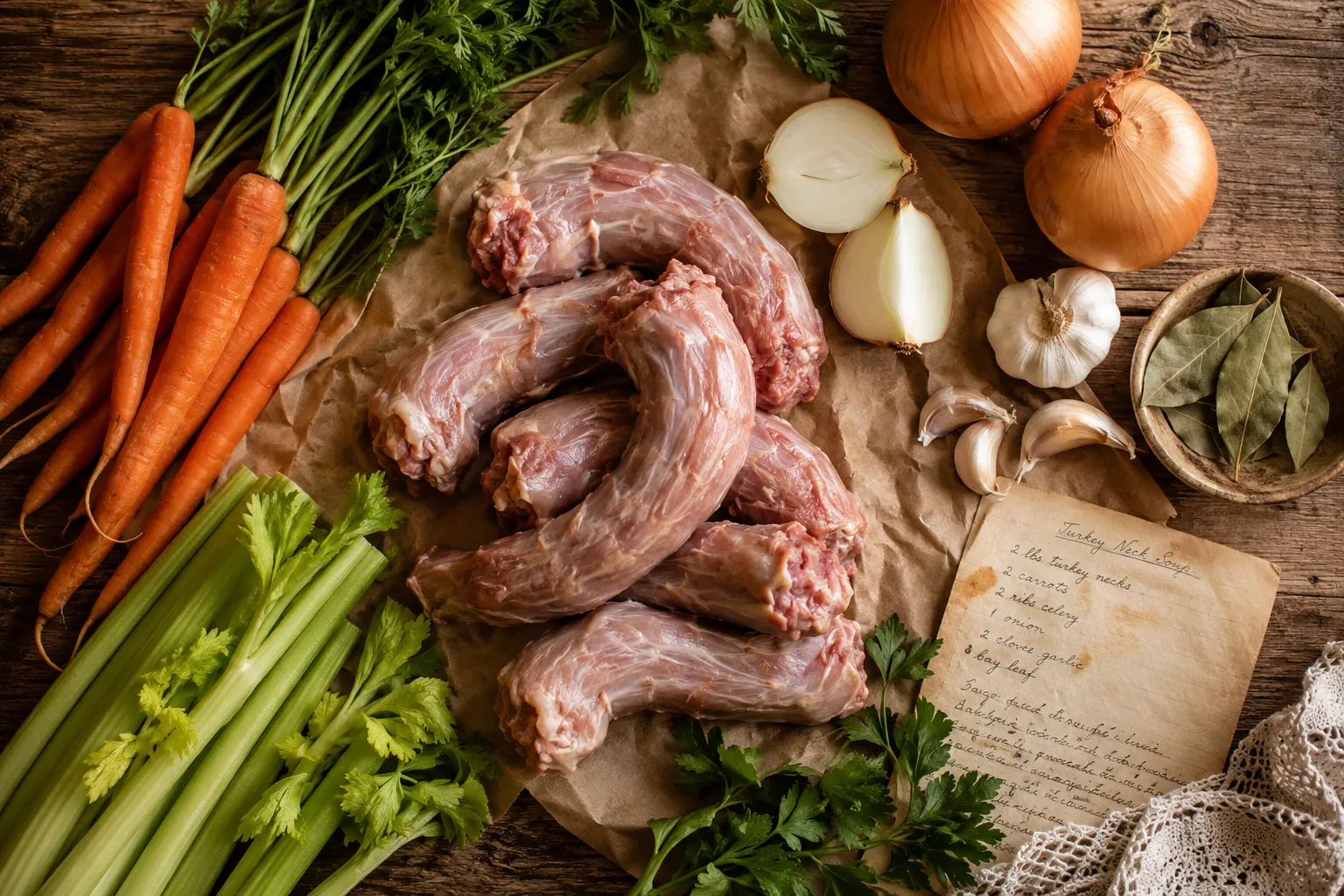
Ingredients:
- 2 to 3 pounds turkey necks
- 1 large onion, roughly chopped
- 3 carrots, sliced
- 3 celery stalks, sliced
- 4 garlic cloves, minced
- 2 bay leaves
- 1 teaspoon black pepper
- 1 teaspoon salt (adjust to taste)
- 1 teaspoon thyme (dried or fresh)
- 8 cups water or low-sodium chicken stock
- Optional: potatoes, turnips, or egg noodles
Steps:
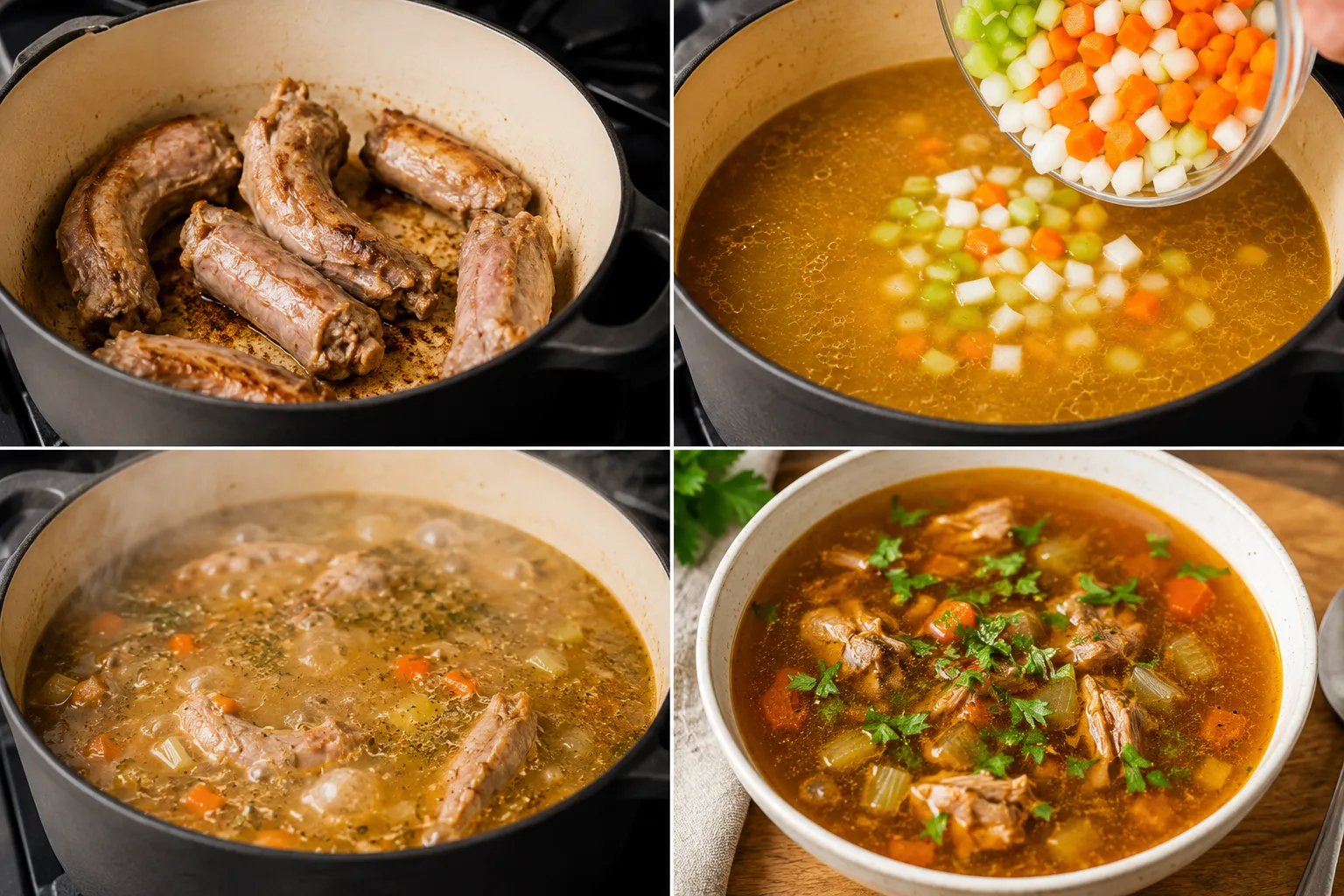
- Brown the turkey necks. Heat oil in a large pot over medium-high heat. Brown the necks on all sides, about 3-4 minutes per side. This step builds flavor through the Maillard reaction and is worth the extra time.
- Add aromatics. Add onion, garlic, and celery to the pot. Cook for 2-3 minutes until softened.
- Add liquid and seasonings. Pour in water or stock. Add bay leaves, thyme, salt, and pepper.
- Simmer low and slow. Bring to a boil, then reduce heat to a gentle simmer. Cook for 2 to 3 hours, skimming foam from the surface during the first 30 minutes.
- Add vegetables. In the final 45 minutes, add carrots and any other vegetables.
- Remove and shred the meat. Lift the turkey necks out, let them cool slightly, then pull the meat off the bones. Return the meat to the pot and discard the bones.
- Taste and adjust. Season as needed before serving.
Common mistake: Rushing the simmer. Turkey necks need at least 2 hours to become tender and release their collagen. A 90-minute simmer will produce edible but noticeably less rich results.
What Goes in Turkey Neck Soup: Traditional Recipes and Variations
The classic turkey neck soup base includes turkey necks, onion, celery, carrots, garlic, and herbs. Beyond that foundation, traditional recipes vary significantly by region and family tradition.
Common additions by tradition:
| Tradition | Common Additions |
|---|---|
| Southern U.S. | Potatoes, turnip greens, hot sauce, smoked seasoning |
| Caribbean | Scotch bonnet pepper, allspice, thyme, green onions |
| Eastern European | Root vegetables, parsley root, dill, egg noodles |
| Asian-inspired | Ginger, star anise, soy sauce, bok choy |
What goes in turkey neck soup depends largely on what you want from the final dish. For a thick, stew-like result, add potatoes and reduce the liquid. For a clear, mineral-rich broth, skip the starchy vegetables and strain the soup before serving.
Turkey Neck Soup vs. Chicken Soup
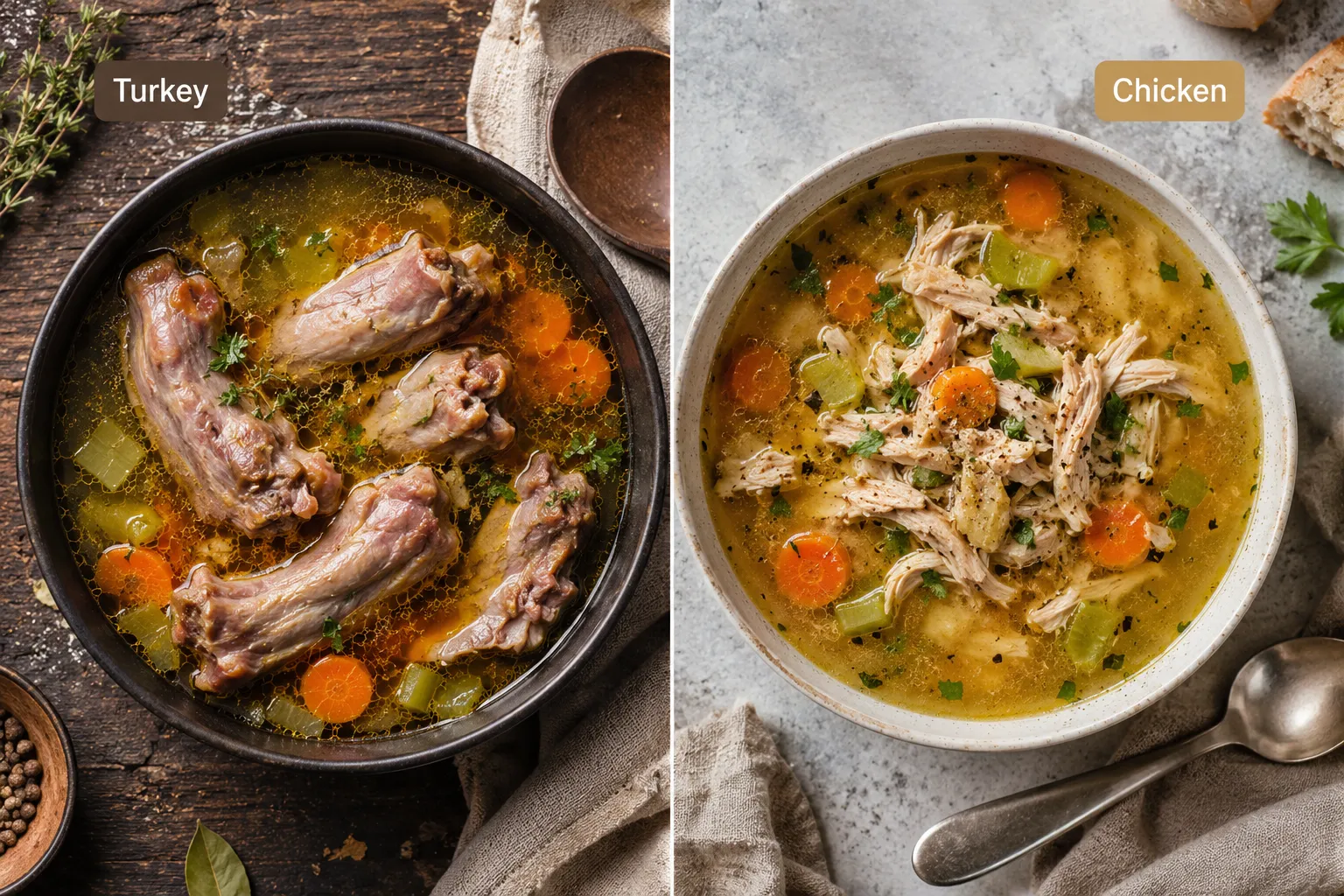
Turkey neck soup and chicken soup share a similar preparation method but differ in flavor intensity, cost, and nutritional profile. Turkey necks produce a richer, more gelatinous broth than a standard chicken carcass because of the higher ratio of connective tissue and bone to meat.
Key differences:
- Flavor: Turkey neck broth is deeper and more savory. Chicken soup tends to be lighter and more delicate.
- Collagen content: Turkey necks, with their dense connective tissue, generally yield more gelatin per pound than chicken pieces.
- Cost: Turkey necks are typically less expensive per pound than whole chickens or chicken parts at most U.S. grocery stores.
- Cooking time: Turkey necks benefit from a longer simmer (2-3 hours vs. 1-1.5 hours for chicken).
- Availability: Chicken soup ingredients are available everywhere; turkey necks may require a visit to a butcher, specialty grocer, or larger supermarket.
Choose turkey neck soup if you want a bolder, more collagen-rich broth and are comfortable with a longer cooking time. Stick with chicken soup if you want a quicker preparation or a lighter flavor profile.
Where to Buy Turkey Necks and Find Turkey Neck Soup Near You
Turkey necks are sold at most large supermarkets, often in the poultry section or the freezer aisle. Specialty butcher shops, Hispanic grocery stores, and Asian markets frequently carry fresh turkey necks year-round. African American-owned butcher shops and soul food markets are also reliable sources, particularly around the holidays.
Where to find turkey neck soup at a restaurant:
- Soul food restaurants in the Southern U.S. frequently feature turkey neck soup or stewed turkey necks on the menu.
- Caribbean restaurants may serve turkey neck in broth-based dishes.
- Some diners and home-style cooking establishments in the South list it as a daily special.
Tip for March 30: Search for “soul food near me” or “Southern restaurant near me” on Google Maps and call ahead to ask if turkey neck soup is on the menu for the day. Many smaller restaurants rotate specials daily and will prepare it on request.
Can You Freeze Turkey Neck Soup? How Long Does It Last?
Turkey neck soup freezes exceptionally well, making it an ideal candidate for batch cooking. The high gelatin content actually helps preserve texture and flavor through the freeze-thaw cycle better than thinner soups.
Storage guidelines:
- Refrigerator: Turkey neck soup keeps for 3 to 4 days in an airtight container.
- Freezer: Properly stored in freezer-safe containers or bags, it lasts up to 3 months with good quality. It remains safe beyond that but flavor may decline.
- Reheating: Reheat gently on the stovetop over medium-low heat. The broth will re-liquefy from its gelled state as it warms.
Freezing tip: Freeze in individual or two-serving portions for easy weeknight meals. Leave 1 inch of headspace in containers to allow for expansion.
How to Celebrate March 30 National Turkey Neck Soup Day in 2026
Celebrating March 30 National Turkey Neck Soup Day does not require special equipment or a trip to a specialty store. The most direct way to mark the day is to cook a pot of turkey neck soup at home.
Practical ways to celebrate:
- Cook from scratch. Use the recipe above or explore variations in the 1718 Soup Cookbook for inspiration.
- Visit a soul food or Southern restaurant. Support local restaurants that keep these traditions alive.
- Share the dish. Invite family or neighbors for a bowl. Turkey neck soup is a natural communal dish.
- Post on social media. Use the hashtag #TurkeyNeckSoupDay to connect with other home cooks celebrating the day.
- Teach the technique. If you have children or younger family members, March 30 is a good opportunity to pass on slow-cooking skills and food history.
For readers who enjoy celebrating food holidays throughout the year, other notable observances worth bookmarking include January 21 National New England Clam Chowder Day and February 4 Homemade Soup Day.
FAQ: March 30 National Turkey Neck Soup Day
Q: When is National Turkey Neck Soup Day? A: National Turkey Neck Soup Day is observed every year on March 30. [1]
Q: Is National Turkey Neck Soup Day a federal holiday? A: No. It is an informal food observance with no government recognition. It is “national” in name only, similar to most food holidays on the calendar. [2]
Q: Who created National Turkey Neck Soup Day? A: The founding organization or individual is not publicly documented. The day appears across multiple food holiday registries without a credited creator. [4]
Q: Are turkey necks healthy to eat? A: Yes. Turkey necks are high in protein, collagen, and minerals. They are a nutrient-dense, low-cost cut that produces a rich, gelatinous broth when slow-cooked.
Q: How long should you cook turkey necks for soup? A: Simmer turkey necks for at least 2 to 3 hours over low heat. This extracts maximum collagen and ensures the meat becomes tender enough to pull off the bone.
Q: Can you make turkey neck soup in a slow cooker? A: Yes. Add all ingredients to a slow cooker and cook on low for 7 to 8 hours or on high for 4 to 5 hours. The result is comparable to stovetop simmering.
Q: Where can I buy turkey necks? A: Large supermarkets, butcher shops, Hispanic grocery stores, and Asian markets typically carry turkey necks. They are often available frozen year-round.
Q: Is turkey neck soup the same as turkey broth? A: Not exactly. Turkey neck soup includes vegetables, seasonings, and shredded meat in the final bowl. Turkey broth is a strained liquid base made from bones and aromatics, used as a cooking ingredient rather than served as a complete dish.
Q: Can I add noodles or rice to turkey neck soup? A: Yes. Egg noodles, rice, or small pasta shapes are common additions. Add them in the final 15 to 20 minutes of cooking to prevent them from becoming mushy.
Q: How does turkey neck soup relate to Southern food culture? A: Turkey necks are a staple of Southern and African American cooking, where nose-to-tail preparation and slow-simmered broths have been central to the cuisine for generations. The soup represents both resourcefulness and deep culinary knowledge.
Conclusion
March 30 National Turkey Neck Soup Day is more than a quirky entry on the food holiday calendar. It is a genuine opportunity to engage with a dish that carries real cultural history, delivers strong nutritional value, and rewards the cook with one of the most flavorful broths a home kitchen can produce.
Actionable next steps for 2026:
- Source turkey necks from a local butcher or grocery store before March 30.
- Follow the basic recipe above or adapt it with regional spices and vegetables that reflect your own food traditions.
- If cooking is not an option, find a soul food or Southern restaurant in your area and order the dish to support businesses that keep this tradition alive.
- Explore the 524 Turkey Cookbook for additional turkey-based recipes that go beyond the holiday bird.
- Mark your calendar now so March 30 National Turkey Neck Soup Day does not pass unnoticed in 2026.
The soup is simple, the ingredients are affordable, and the result is a bowl that connects the cook to generations of resourceful, skilled kitchen tradition. That is worth celebrating.
References
[1] Turkey Neck Soup Day – https://nationaltoday.com/turkey-neck-soup-day/ [2] Turkey Neck Soup Day – https://www.checkiday.com/9790a12b52edbd8f9dc2c1d9627ead80/turkey-neck-soup-day [3] National Turkey Neck Soup Day March 30 – https://calendar.cx/national-turkey-neck-soup-day-march-30/ [4] Turkey Neck Soup Day – https://www.calendarr.com/united-states/turkey-neck-soup-day/ [5] dayspedia – https://dayspedia.com/us/calendar/holiday/1198/
Leave a Reply