February 28 National Chocolate Soufflé Day: History, Recipes, and How to Celebrate
- 0
- 13 Min Read
}
Last updated: February 28, 2026
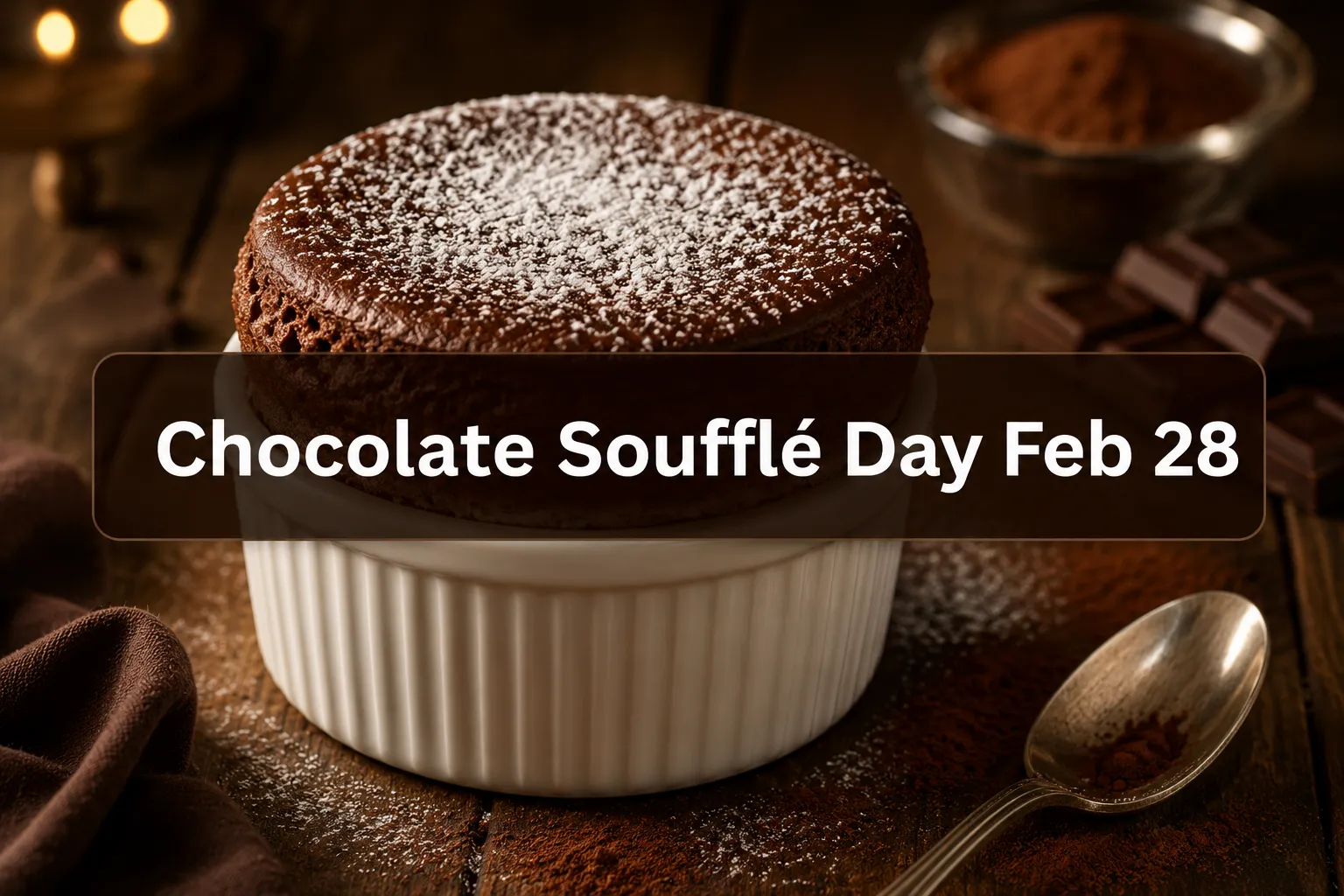
Quick Answer: February 28 National Chocolate Soufflé Day is an annual food holiday observed in the United States that celebrates one of French cuisine’s most technically demanding desserts. It falls on February 28 every year and is recognized by food enthusiasts, home bakers, and restaurants across the country. The day is informal and carries no public holiday status, but it gives chocolate lovers a compelling reason to attempt this iconic dish.
Key Takeaways
- February 28 National Chocolate Soufflé Day is observed annually on February 28 in the United States, with no formal public holiday designation.
- The chocolate soufflé traces its roots to 18th-century French cuisine, with the word “soufflé” derived from the French verb souffler, meaning “to breathe” or “to puff.”
- A classic chocolate soufflé takes roughly 30 to 45 minutes from prep to table, including a 12-to-15-minute bake time.
- Soufflés rise because of air trapped in whipped egg whites that expands in the oven, they fall when that air escapes after baking.
- The most common beginner mistakes include under-whipping egg whites, opening the oven door too early, and skipping the ramekin preparation step.
- Chocolate soufflé and chocolate mousse are related in technique but differ in texture, temperature, and structure.
- Many fine-dining restaurants offer chocolate soufflé as a signature dessert and may run special promotions on February 28.
- February is a strong month for chocolate holidays, it also includes National Dark Chocolate Day on February 1 and National Chocolate Fondue Day on February 5.
What Is National Chocolate Soufflé Day?
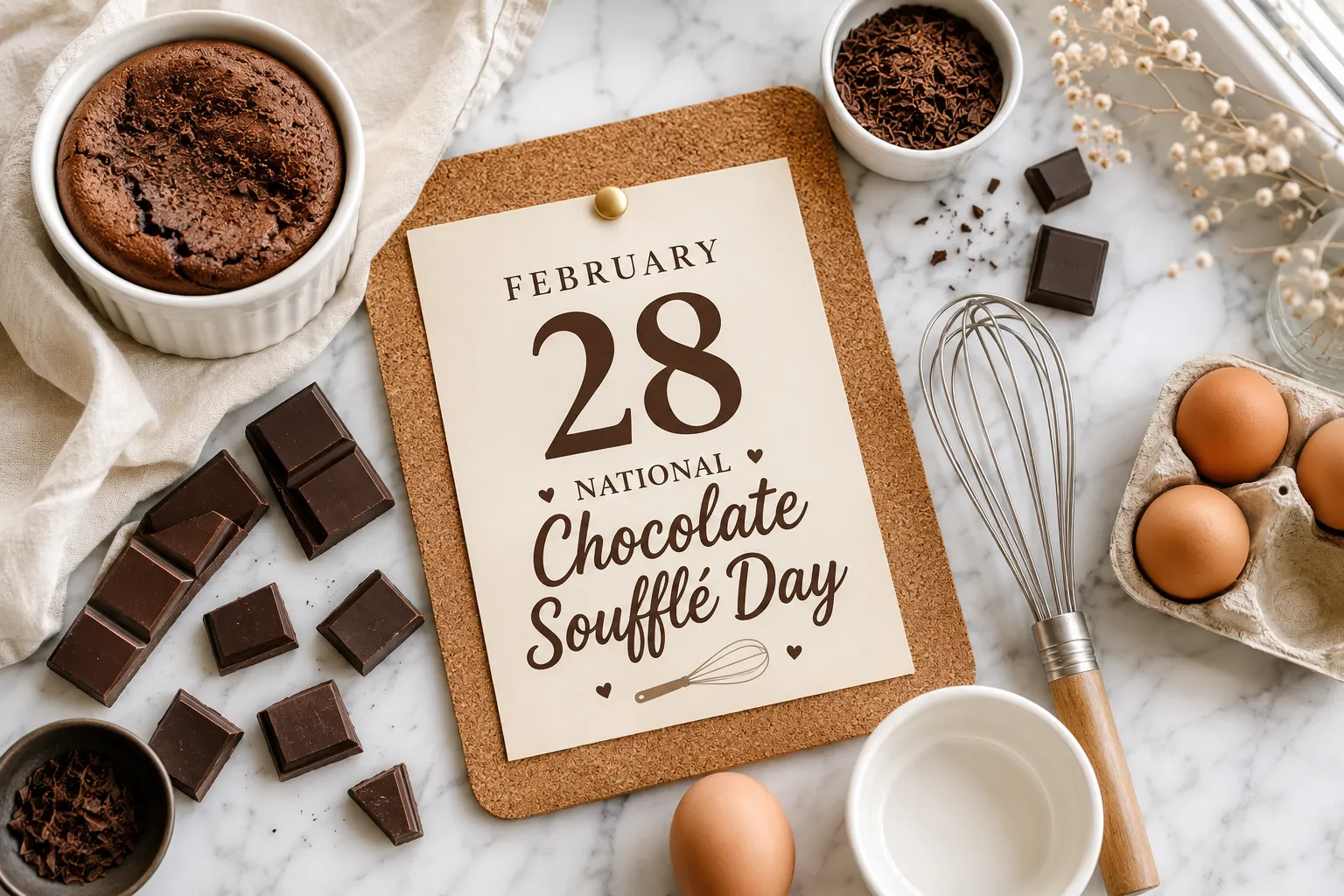
National Chocolate Soufflé Day is a U.S.-based food observance dedicated to celebrating the chocolate soufflé, a baked French dessert known for its light, airy texture and rich chocolate flavor. It is classified as a culinary holiday rather than a public or federal holiday, meaning businesses and schools do not close in observance. [1][2]
The day encourages home cooks, professional chefs, and dessert lovers to bake, order, or simply appreciate the chocolate soufflé. Holiday calendar sites consistently list it as one of February’s most distinctive food celebrations, sitting alongside other chocolate-themed days that make the month a standout for dessert fans. [5][8]
Who it’s for: Anyone who enjoys baking, French cuisine, or chocolate desserts. The day is equally relevant for beginners attempting their first soufflé and experienced pastry chefs showcasing their skills.
When Is National Chocolate Soufflé Day Celebrated?
National Chocolate Soufflé Day is celebrated every year on February 28. It does not shift based on the calendar, the date stays fixed regardless of whether February 28 falls on a weekday or weekend. [1][4]
Upcoming dates:
- Sunday, February 28, 2027
- Monday, February 28, 2028
- Wednesday, February 28, 2029
- Thursday, February 28, 2030
In leap years, February 28 still holds the holiday, as the observance does not move to February 29. [2][5]
Why Is February 28 Chocolate Soufflé Day?
No single founding organization or official proclamation has been publicly documented as the origin of February 28 National Chocolate Soufflé Day. This is common for many U.S. food holidays, which often emerge from food industry promotions, culinary organizations, or grassroots enthusiasm rather than government action. [8][9]
What is clear is that February makes cultural sense for a chocolate-focused holiday. The month already contains Valentine’s Day, which drives enormous interest in chocolate desserts, and the soufflé, as a showstopper dessert, fits naturally into that celebratory spirit. Placing the holiday on February 28, the month’s final day in most years, gives it a memorable anchor at the close of what many food calendars treat as “chocolate month.” [6][7]
If you enjoy exploring February’s food calendar, the month also features National Chocolate Fondue Day on February 5 and Cream Cheese Brownie Day on February 10.
Who Invented the Chocolate Soufflé?
The soufflé as a culinary form is generally credited to French chef Vincent La Chapelle, who included early soufflé recipes in his 1733 cookbook Le Cuisinier Moderne. The chocolate variation developed later as chocolate became more widely available and affordable in Europe during the 18th and 19th centuries.
The word “soufflé” comes from the French verb souffler, to breathe or to puff, a direct reference to the dish’s signature rise. By the 19th century, French haute cuisine had fully embraced the soufflé as a test of a chef’s skill, and chocolate soufflé became one of the most requested desserts in fine-dining establishments across Europe and North America.
For more on the history of chocolate-based desserts, the National Chocolate Cake Day guide covers how chocolate moved from a luxury ingredient to a kitchen staple.
What Is the Difference Between a Soufflé and a Regular Cake?
A chocolate soufflé and a chocolate cake are fundamentally different in structure, technique, and eating experience. A cake relies on flour and chemical leaveners (baking powder or baking soda) for structure and rise. A soufflé gets its lift entirely from whipped egg whites, which trap air that expands in the oven.
| Feature | Chocolate Soufflé | Chocolate Cake |
|---|---|---|
| Leavening | Whipped egg whites | Baking powder/soda |
| Flour content | Little to none | Significant |
| Texture | Airy, custard-like center | Dense to moist crumb |
| Serving window | Must be served immediately | Holds for hours or days |
| Skill level | Intermediate to advanced | Beginner-friendly |
| Temperature | Served hot | Served at room temperature |
The soufflé’s lack of structural flour means it cannot hold its shape once removed from the oven’s heat. That’s why timing and immediate service are non-negotiable.
Chocolate Soufflé vs. Chocolate Mousse: What’s the Difference?
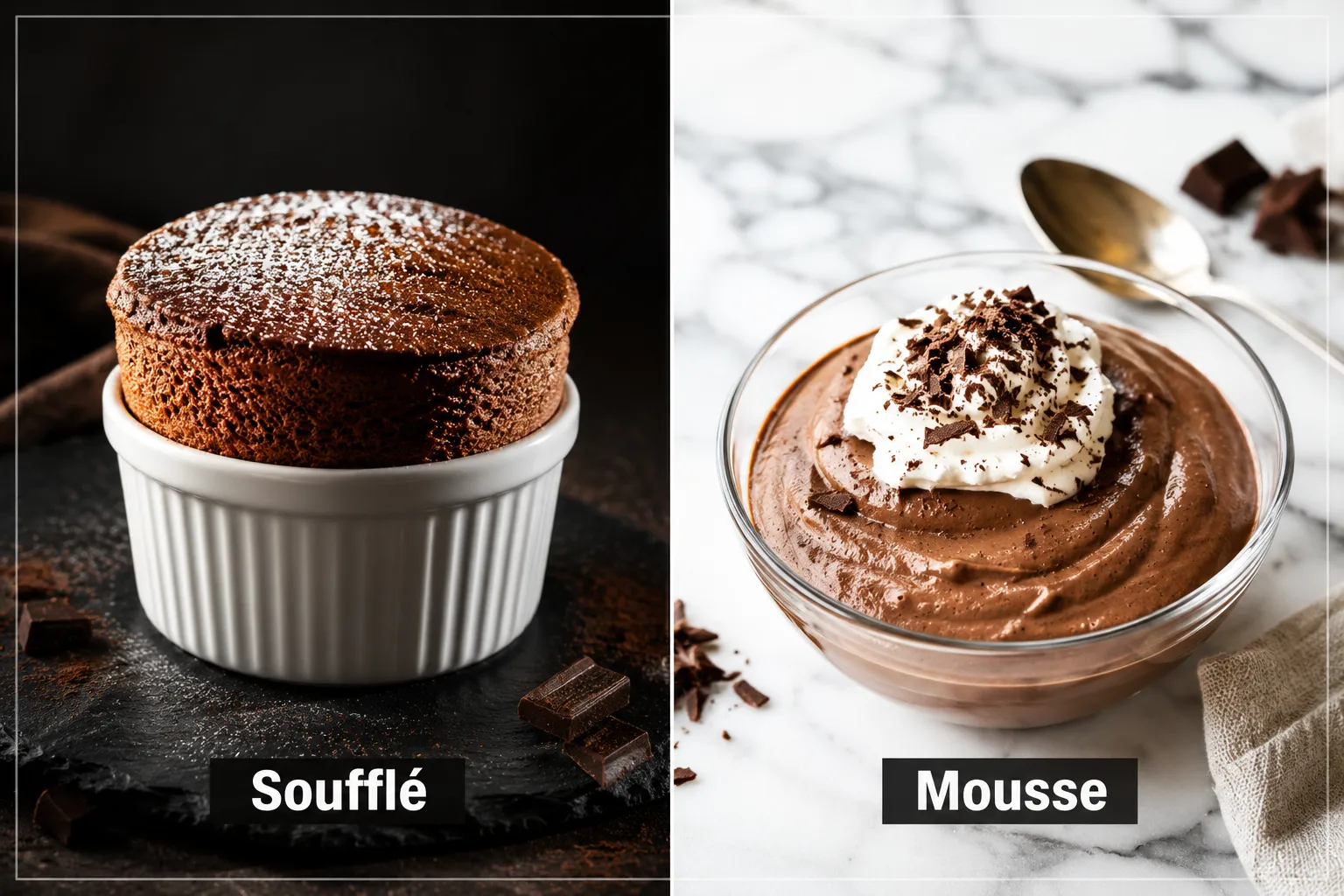
Chocolate soufflé and chocolate mousse share a key technique, both use whipped egg whites or whipped cream to create a light texture, but they are served differently and have distinct textures. A soufflé is baked and served hot, with a firm exterior and a soft, sometimes slightly liquid center. Mousse is chilled and served cold, with a uniformly creamy, set texture throughout.
Key distinctions:
- Temperature: Soufflé is hot; mousse is cold.
- Structure: Soufflé has a baked crust; mousse is fully smooth.
- Timing: Soufflé must be eaten within minutes of baking; mousse can be made hours or a day ahead.
- Complexity: Soufflé requires precise oven timing; mousse is more forgiving.
Choose mousse if you’re entertaining a crowd and need to prepare dessert in advance. Choose soufflé if you want a dramatic, restaurant-quality presentation and can manage the timing.
How to Make a Chocolate Soufflé: Best Beginner Recipe
A basic chocolate soufflé requires fewer than ten ingredients and takes about 40 minutes from start to finish. The process is straightforward once you understand the two core steps: building a chocolate base and folding in properly whipped egg whites.
Ingredients (serves 4):
- 4 oz (115g) dark chocolate (70% cacao or higher), chopped
- 3 tablespoons unsalted butter, plus extra for ramekins
- 3 tablespoons granulated sugar, plus extra for ramekins
- 3 large egg yolks
- 4 large egg whites
- 1 pinch cream of tartar
- 1 teaspoon vanilla extract
- Powdered sugar for dusting (optional)
Step-by-step instructions:
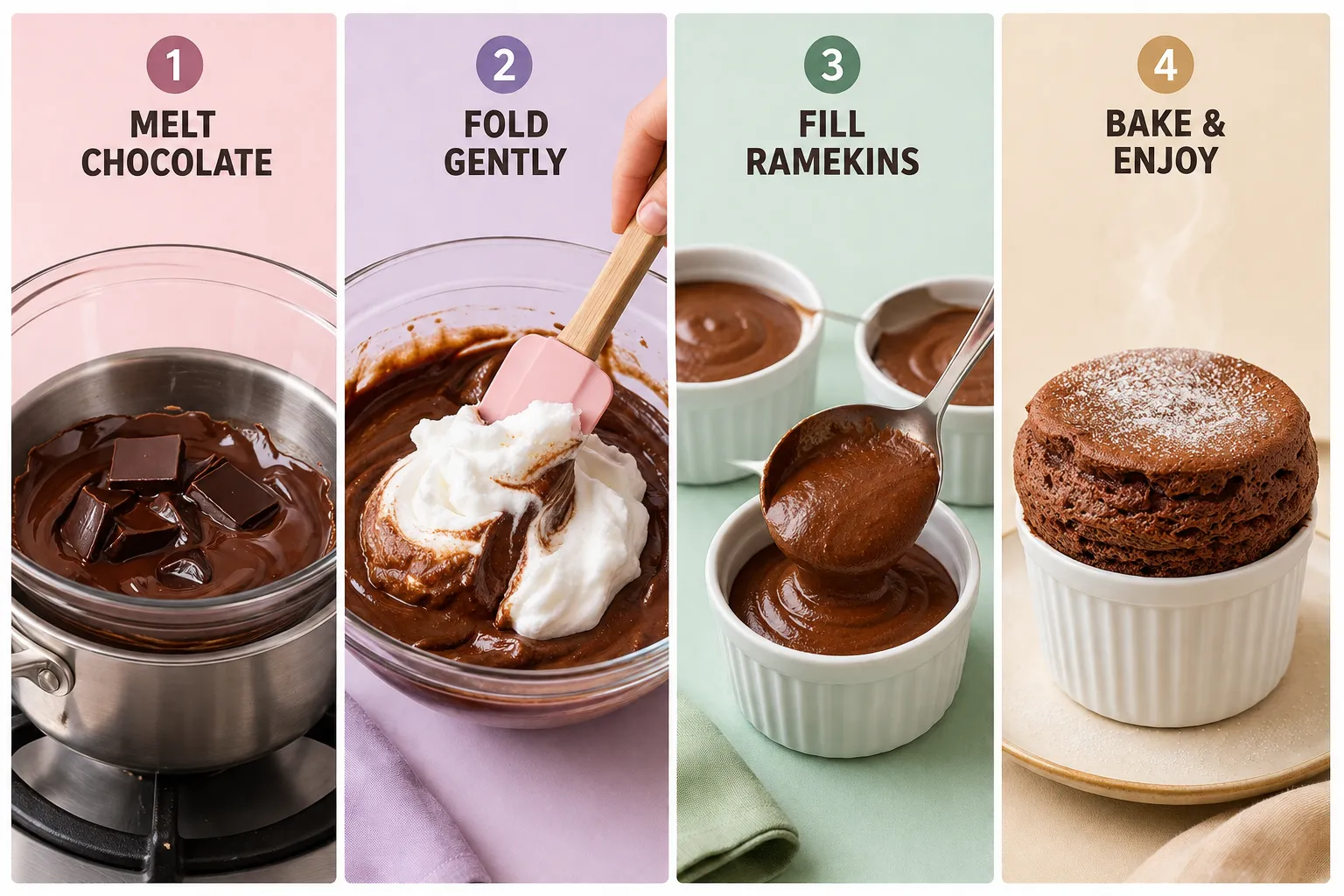
- Preheat oven to 375°F (190°C). Butter four 6-oz ramekins thoroughly, then coat with sugar, tapping out the excess. This step is critical, it helps the soufflé climb the walls evenly.
- Melt chocolate and butter together in a double boiler or microwave in 30-second bursts, stirring until smooth. Let cool slightly.
- Whisk egg yolks and 2 tablespoons of sugar into the chocolate mixture. Add vanilla extract. Set aside.
- In a clean bowl, beat egg whites with cream of tartar until foamy. Gradually add the remaining sugar and beat to stiff, glossy peaks. Do not over-beat.
- Fold one-third of the egg whites into the chocolate base to lighten it. Then gently fold in the remaining whites in two additions, using a large spatula with a light hand. Stop as soon as no white streaks remain.
- Divide the batter evenly among the prepared ramekins. Run a thumb around the inside rim of each ramekin to create a slight groove, this helps the soufflé rise straight.
- Bake for 12 to 14 minutes until risen and the top is set but the center still jiggles slightly.
- Serve immediately.
How long does a chocolate soufflé take to make? Total time is approximately 35 to 45 minutes: 15 to 20 minutes of prep and 12 to 15 minutes of baking. The window between “ready” and “collapsed” is roughly 5 minutes, so have your guests seated before the soufflés go in the oven.
Common Mistakes When Making Chocolate Soufflé
Most soufflé failures come down to a handful of predictable errors. Knowing them in advance removes most of the risk.
Mistake 1: Skipping ramekin preparation. Unbuttered or uncoated ramekins cause the soufflé to stick and tear instead of rising freely. Butter generously, then coat with sugar.
Mistake 2: Under- or over-whipping egg whites. Under-whipped whites lack the air needed for rise. Over-whipped whites become dry and break down when folded. Aim for stiff, glossy peaks that hold their shape but aren’t grainy.
Mistake 3: Deflating the batter during folding. Use a large rubber spatula and fold, don’t stir. Work quickly and stop as soon as the mixture is uniform.
Mistake 4: Opening the oven door early. The sudden temperature drop collapses the structure. Set a timer and resist the urge to peek until the minimum bake time has passed.
Mistake 5: Letting the batter sit. Once folded, soufflé batter loses volume over time. Get it into the ramekins and into the oven within a few minutes.
Why Do Soufflés Fall or Collapse?
Soufflés fall because the air bubbles trapped in the egg whites contract as the dessert cools. In the oven, heat causes those bubbles to expand, pushing the batter upward. Once the soufflé leaves the oven, cooling begins immediately and the structure, which has no flour scaffold to hold it, deflates within minutes.
This is not a failure. A slight fall after removal from the oven is completely normal. A soufflé that collapses before it reaches the table, however, usually means it was under-baked, the egg whites were not whipped properly, or the oven temperature was too low.
Edge case: High-altitude baking (above 3,500 feet) causes soufflés to rise faster and fall more dramatically. At altitude, reduce sugar slightly and increase baking time by 2 to 3 minutes.
Can You Make Chocolate Soufflé Ahead of Time?
The baked soufflé cannot be made ahead, it must go from oven to table immediately. However, the chocolate base can be prepared up to 24 hours in advance and stored covered in the refrigerator. Bring it back to room temperature before folding in the egg whites.
Some chefs also prepare filled, unbaked ramekins and refrigerate them for up to 2 hours before baking. This method works but may require an extra minute or two of baking time since the batter starts cold.
What you can do ahead:
- Make the chocolate base (up to 24 hours ahead)
- Butter and sugar the ramekins (up to 8 hours ahead)
- Fill ramekins with batter (up to 2 hours ahead, refrigerated)
What you cannot do ahead: Bake and hold the soufflé. It will not survive.
Where Can You Get Chocolate Soufflé Near Me?
Chocolate soufflé is a staple dessert at French bistros, upscale American restaurants, and hotel dining rooms. Because it requires precise timing and individual preparation, it’s most commonly found at restaurants with experienced pastry teams.
How to find it:
- Search “chocolate soufflé near me” on Google Maps or Yelp, filtering for French cuisine or fine dining.
- Call ahead, many restaurants require soufflé orders to be placed at the start of the meal due to the 20-to-30-minute preparation time.
- Check OpenTable or Resy for restaurants listing soufflé on their dessert menus.
For February 28 National Chocolate Soufflé Day in 2026: Some restaurants and bakeries run limited-time promotions or special menus on food holidays. Follow local restaurant social media accounts in the week leading up to February 28 to catch any deals or special offerings. [9]
If dining out isn’t an option, making a soufflé at home is a rewarding alternative, and the recipe above is designed specifically for beginners.
For more February chocolate celebrations to explore, see the National Dark Chocolate Day guide and browse the full range of chocolate holidays throughout the year.
FAQ: February 28 National Chocolate Soufflé Day
Q: Is National Chocolate Soufflé Day an official U.S. holiday? No. It is an informal food observance with no government recognition. Businesses and schools remain open. [1][8]
Q: Does National Chocolate Soufflé Day change dates in leap years? No. It stays on February 28 every year, even in leap years when February has 29 days. [2][5]
Q: What chocolate is best for a soufflé? Dark chocolate with 60% to 72% cacao content gives the best balance of deep flavor and workable consistency. Avoid milk chocolate, which is too sweet and too soft for a proper soufflé base.
Q: How do I know when a soufflé is done? The top should be set and risen above the ramekin rim. Gently shake the ramekin, a slight jiggle in the center is correct. A fully firm soufflé is over-baked and will have a dry texture.
Q: Can I make a gluten-free chocolate soufflé? Yes. Classic soufflé recipes use little to no flour, making them naturally close to gluten-free. Verify that your chocolate and any other ingredients carry no gluten cross-contamination warnings.
Q: What can I serve with a chocolate soufflé? Vanilla ice cream, crème anglaise (a thin vanilla custard sauce), or lightly whipped cream all complement the rich chocolate flavor without overpowering it.
Q: Can I double the recipe for a crowd? Yes, but bake in individual ramekins rather than one large dish. A large soufflé is much harder to bake evenly and will fall before it can be portioned.
Q: What’s the difference between a fallen soufflé and a lava cake? A lava cake (molten chocolate cake) is intentionally under-baked to create a liquid center and is structurally stable because it contains flour. A fallen soufflé is a baking mishap with a collapsed structure. They taste different and are made differently.
Q: Is February 28 always the last day of February? In most years, yes. In leap years, February 29 is the last day, but the holiday remains on February 28. [4]
Q: Are there other chocolate food holidays in February? Yes. February is rich with chocolate observances. National Hot Chocolate Day is January 31, and February includes National Dark Chocolate Day (Feb. 1) and National Chocolate Fondue Day (Feb. 5), among others.
Conclusion
February 28 National Chocolate Soufflé Day is a fitting close to one of the most chocolate-rich months on the food calendar. Whether the goal is to attempt a first soufflé at home, visit a French bistro, or simply learn more about a dish that has challenged and delighted cooks for centuries, the day offers a genuine reason to engage with one of pastry’s most respected techniques.
Actionable next steps for 2026:
- Plan ahead: Soufflés require timing. If baking at home, read the full recipe the day before and gather all ingredients.
- Prep your ramekins: Butter and sugar them in the morning so they’re ready when you need them.
- Practice the egg white technique: If you’ve never whipped egg whites to stiff peaks, do a test run before the holiday.
- Book a restaurant early: If dining out, call ahead to confirm the soufflé is on the menu and reserve your table.
- Share the experience: Post your results, success or collapse, and tag the holiday. The soufflé’s dramatic nature makes it one of the most shareable desserts in home baking.
For more February food holidays and chocolate inspiration, explore National Chocolate Fondue Day and the full archive of national food days.
References
[1] National Chocolate Souffle Day – https://nationaltoday.com/national-chocolate-souffle-day/ [2] National Chocolate Souffle Day – https://www.calendarr.com/united-states/national-chocolate-souffle-day/ [4] dayspedia – https://dayspedia.com/us/calendar/holiday/1152/ [5] National Chocolate Souffle Day – https://www.holidaycalendar.io/holiday/national-chocolate-souffle-day [6] diffordsguide – https://www.diffordsguide.com/on-this-day/february/28 [7] anydayguide – https://anydayguide.com/calendar/145 [8] National Chocolate Souffle Day – https://www.checkiday.com/c11b429a23a7ca1da4daa82a91daeb04/national-chocolate-souffle-day [9] National Chocolate Souffle Day – https://alwaystheholidays.com/national-chocolate-souffle-day/