January 8 National English Toffee Day: History, Recipes & How to Celebrate in 2026
- 0
- 15 Min Read
Last updated: January 8, 2026
Quick Answer: January 8 National English Toffee Day is an annual American food holiday observed every January 8 that honors the rich, buttery, crunchy confection known as English toffee. It is a day to eat, make, share, and celebrate one of the most beloved candy traditions with roots tracing back to 19th-century England. The observance appears on the national day calendar and is recognized by food enthusiasts, candy brands, and confectionery organizations across the country.
Key Takeaways
- National English Toffee Day falls on January 8 every year, including Jan 8, 2026, and Jan 8, 2027.
- English toffee is made by cooking sugar and butter to the hard-crack stage (300-310°F), then typically coating the result in chocolate and nuts.
- The word “toffee” first appeared in The Oxford English Dictionary around 1825, with origins tied to England and British candy-making traditions.
- Top brands to celebrate with include See’s Candies, Enstrom Candies, Almond Roca, Harry & David, Godiva, Ghirardelli Chocolate Company, and Rocky Mountain Chocolate Factory.
- The National Confectioners Association (NCA) supports confectionery holidays, lending industry legitimacy to toffee day observances.
- You can celebrate National English Toffee Day by eating store-bought toffee, making a homemade batch, or sharing toffee-themed content using #NationalEnglishToffeeDay and #EnglishToffeeDay on social media.
- National English Toffee Day is listed as a recurring observance through at least 2031 on major food holiday tracking sites.
- January is packed with food holidays, from National Shortbread Day on January 6 to National Popcorn Day on January 19.
What Is English Toffee Exactly?
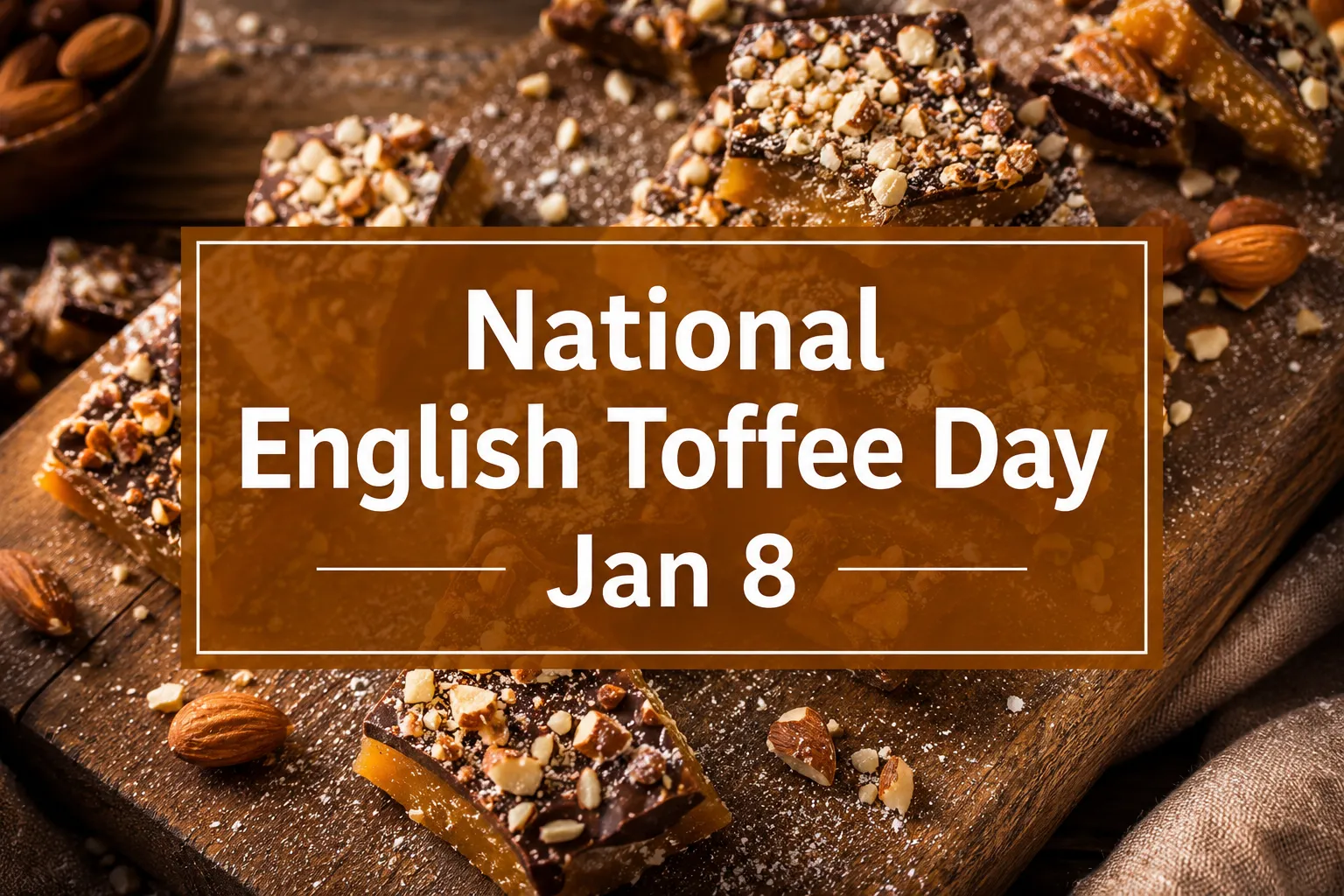
English toffee is a hard, buttery candy made by cooking sugar and butter together to the hard-crack stage, typically between 300°F and 310°F. The result is a crisp, amber-colored confection that is almost always finished with a coating of chocolate and a layer of chopped nuts such as almonds. It differs from softer toffee varieties in its firm, snappable texture.
The candy’s name has British roots. The Oxford English Dictionary traces the word “toffee” to approximately 1825, when it appeared in English writing as a term for a boiled sugar-and-butter sweet made in England. Although the treat originated in England, American candy makers adopted and popularized it throughout the 20th century, adding the chocolate and almond coating that most Americans associate with the candy today. Even today, the “English” label signals a specific style: harder, more buttery, and more richly flavored than generic candy toffee.
Core ingredients in English toffee:
- Granulated sugar
- Unsalted butter
- A pinch of salt
- Chocolate (milk or dark) for coating
- Nuts, most commonly almonds
History of National English Toffee Day and Who Invented Toffee
National English Toffee Day has been observed on January 8 in the United States for many years, though its exact founding origin is not officially documented by a government body. The day is part of the broader American tradition of unofficial food holidays that celebrate specific ingredients, dishes, or candy types throughout the year.
The history of toffee itself stretches back further. British confectioner Joseph Fry is often cited in candy history discussions as a pioneer of chocolate-based confections in England during the early 19th century, and the broader culture of boiled sugar sweets in England helped give rise to toffee as a distinct candy category. Although toffee made with sugar butter combinations was common in England by the mid-1800s, the chocolate-coated, almond-studded version most Americans recognize today was largely refined and commercialized in the United States.
The National Confectioners Association has long supported confectionery observances, and National English Toffee Day aligns with the NCA’s broader mission to celebrate candy culture in America. The day is now listed on major food holiday platforms including National Today, Days of the Year, and Holidays Calendar, confirming it as an active, recurring observance.
A brief English toffee timeline:
| Year | Milestone |
|---|---|
| ~1825 | “Toffee” first recorded in The Oxford English Dictionary in England |
| Mid-1800s | Sugar butter toffee becomes popular British candy |
| Early 1900s | American candy makers add chocolate and almond coatings |
| 1927 | Almond Roca launched by Brown & Haley, becoming an iconic American English toffee brand |
| 2026 | National English Toffee Day observed Jan 8, 2026; next observance Jan 8, 2027 (January 2027) |
How to Make Homemade English Toffee: Easy Recipes and Ingredients
Homemade English toffee requires just a few ingredients but demands attention to temperature. The key is cooking the sugar butter mixture to exactly 300-310°F, the hard-crack stage, before pouring it out to set.
Basic homemade English toffee recipe:
- Line a baking sheet with parchment paper and scatter 1 cup of chopped almonds across it.
- Combine 1 cup (2 sticks) of unsalted butter and 1 cup of granulated sugar in a heavy saucepan over medium heat.
- Stir constantly until the mixture reaches 300°F on a candy thermometer (hard-crack stage).
- Pour the hot toffee over the almonds on the prepared sheet.
- Immediately sprinkle 1 cup of chocolate chips over the hot toffee surface; let them melt for 2 minutes, then spread evenly.
- Add another handful of chopped nuts on top of the chocolate layer.
- Let the toffee cool completely at room temperature (about 1 hour), then break it into pieces.
Can you make English toffee without a thermometer? Yes, though it is trickier. Drop a small amount of the hot mixture into cold water, if it forms a hard, brittle thread that snaps cleanly, it has reached the hard-crack stage. A thermometer is strongly recommended for consistent results.
Why does English toffee get grainy? Graininess happens when sugar crystals form during cooking. To prevent this, avoid stirring once the mixture reaches a boil, use a clean pan, and add a small amount of corn syrup to inhibit crystallization. If the toffee does turn grainy, the batch is generally not salvageable, start fresh.
These recipes are a delicious way to celebrate the day at home. For more baking inspiration, check out the food holiday celebrations archive.
Best English Toffee Brands and Where to Buy English Toffee
Several well-known brands make exceptional English toffee that you can order online or find in stores, making it easy to celebrate National English Toffee Day without making a batch from scratch.
Top brands for National English Toffee Day:
- Enstrom Candies (Grand Junction, Colorado): Widely regarded as one of the finest American English toffee producers, Enstrom’s almond toffee is hand-crafted and available at enstrom.com.
- Almond Roca by Brown & Haley: The iconic pink tin of butter crunch toffee coated in chocolate and almonds has been an American classic since 1927. Available at most grocery stores and at brown-haley.com.
- See’s Candies: See’s offers English toffee-style pieces in its seasonal and year-round candy assortments. Find them at sees.com or at See’s retail locations.
- Harry & David: Known for premium gift food amp beverage boxes, Harry & David carries toffee assortments ideal for gifting. Visit harryanddavid.com.
- Godiva: The Belgian-American chocolate brand includes toffee pieces in several of its chocolate assortments, available at godiva.com and major retailers.
- Ghirardelli Chocolate Company: Ghirardelli produces chocolate-covered toffee and English toffee bits used in baking, sold widely in grocery stores and at ghirardelli.com.
- Rocky Mountain Chocolate Factory: This Colorado-based chain offers handmade toffee at its retail locations across the country.
English toffee gifts: All of the brands above ship nationally, making them excellent sources for toffee gifts. Enstrom and Harry & David both offer gift tins and boxes suited to the January holidays season.
Is English toffee gluten free? Traditional English toffee made from sugar, butter, chocolate, and almonds contains no gluten-containing ingredients. However, cross-contamination in manufacturing facilities is possible, so those with celiac disease should check each brand’s labeling carefully. Enstrom and several other brands note gluten-free status on their packaging.
English Toffee vs. Buttercrunch: What’s the Difference?
English toffee and buttercrunch are closely related but not identical. English toffee is the broader category, a hard, butter-and-sugar candy cooked to the hard-crack stage, typically coated in chocolate and nuts. Buttercrunch is an American variation that is generally slightly softer and chewier, often made with a higher butter ratio and sometimes without a chocolate coating.
The difference between toffee and brittle is also worth noting. Brittle (such as peanut brittle) is made with sugar cooked to a similar temperature but without butter, resulting in a thinner, more glass-like texture. English toffee’s butter content gives it a richer flavor and a slightly less brittle snap compared to traditional brittle candy.
English toffee calories and nutrition: A typical 1-ounce (28g) serving of chocolate-covered English toffee contains approximately 150-170 calories, 10-12g of fat (mostly from butter and chocolate), and 15-18g of sugar. Exact figures vary by brand and recipe. The USDA FoodData Central database lists nutritional data for multiple toffee candy products.
National English Toffee Day Activities: How to Celebrate Today
National English Toffee Day on Jan 8 offers several fun ways to celebrate, whether you prefer eating, making, or sharing the candy. The day is one of many January national days that give food lovers a reason to indulge mid-winter.
Three core ways to celebrate:
- Eat some English toffee today. Buy a tin of Almond Roca, a box from See’s Candies, or a bag of Ghirardelli English toffee bits. Even adding toffee bits into cookies or brownies counts as a delicious celebration.
- Make toffee from scratch. Use the recipe above to make a homemade batch. It takes about 30 minutes of active cooking and makes a great gift for neighbors or coworkers.
- Share on social media. Post a photo of your toffee using the hashtags #NationalEnglishToffeeDay and #EnglishToffeeDay. Tag brands like Enstrom or See’s Candies for a chance to be featured. The National Day Calendar encourages social sharing as part of how food holidays grow in visibility.
For businesses and brands: Candy shops, bakeries, and food amp beverage retailers can celebrate National English Toffee Day by offering toffee samples, running a day-long discount, or creating a limited-edition toffee product. Brands that share original content on this day often see strong engagement because the audience is already primed to celebrate.
Social Media and Platform Guide for National English Toffee Day
Social media is one of the most effective ways to celebrate and amplify National English Toffee Day, both for individuals and for brands. Each platform has its own strengths for toffee day content.
Instagram: Visual platforms like Instagram are ideal for English toffee content. Post a close-up photo of toffee shards, a reel of the candy-making process, or a flat-lay of your favorite brands. Use hashtags #NationalEnglishToffeeDay, #EnglishToffeeDay, and #ToffeeDay to reach the broadest audience. Stories with polls (“Dark chocolate or milk chocolate toffee?”) drive strong engagement.
TikTok: Short cooking videos showing the toffee-making process perform exceptionally well on TikTok. The visual drama of pouring hot amber toffee and watching chocolate melt across the surface is highly shareable. Creators who make candy content report strong view counts on food holiday videos tied to specific dates like Jan 8.
Facebook: Facebook groups dedicated to baking, candy making, and food holidays are active communities for National English Toffee Day. Share recipes, tag friends, and post in national food holidays groups to celebrate with a wider community.
For creators and individuals: Even a simple photo of a store-bought toffee tin with a caption about the day’s history can generate meaningful engagement. The key is posting on January 8 itself, when the hashtag is most active.
For brands: Schedule posts in advance, offer a toffee-day discount code, and consider partnering with a food creator to amplify reach. Brands that engage authentically on food holidays consistently outperform generic promotional content.
Expected National English Toffee Day Deals and When to Find Them
National English Toffee Day on January 8 falls shortly after the winter holidays, making it a natural moment for candy brands to clear holiday inventory and offer deals. Many toffee brands and retailers discount their products in early January as post-holiday promotions.
Where to find deals:
- Check the websites of Enstrom Candies, See’s Candies, Almond Roca, and Harry & David directly on or around Jan 8 for limited-time promotions.
- Amazon often features lightning deals on candy brands around food holidays.
- Specialty grocery stores and chocolate shops may offer in-store samples or discounts on the day itself.
- Sign up for email lists from your favorite toffee brands before January 8 to receive exclusive discount codes.
The next major observance after Jan 8, 2026 is January 8, 2027 (January 2027), so marking the date on your calendar now ensures you never miss a deal. The observance is confirmed as a recurring annual event through at least 2031 according to National Today.
January also sits within a broader calendar of food observances. After toffee day, food lovers can look forward to January 19 (National Popcorn Day) and National Nothing Day on January 16. Earlier in the month, National Shortbread Day on January 6 and National Whipped Cream Day on January 5 round out the first week of food holidays. The full calendar runs from january february march through april june july, august september october, and into october november december, with a national day or food observance nearly every day of the year.
FAQ: National English Toffee Day
What is National English Toffee Day?
National English Toffee Day is an annual American food holiday observed on January 8 that celebrates English toffee, a hard, buttery candy made from sugar and butter cooked to the hard-crack stage and typically coated in chocolate and almonds. It is recognized by food holiday platforms including National Today and the National Day Calendar and is aligned with the National Confectioners Association’s broader promotion of candy culture. The day encourages people to eat, make, and share English toffee.
What national food day is January 8th?
January 8 is National English Toffee Day in the United States. It is the primary food holiday listed for that date on major food holiday tracking sites including National Today and Days of the Year. The day is dedicated to celebrating English toffee, the buttery, chocolate-coated candy with roots in 19th-century England.
Why do they call it English toffee?
The “English” in English toffee refers to its origins in England, where boiled sugar-and-butter sweets became popular in the early 19th century. The Oxford English Dictionary first recorded the word “toffee” around 1825 in British English. Although American candy makers later refined the recipe by adding chocolate coatings and almond toppings, the “English” label stuck to distinguish this harder, butterier style from softer or chewier toffee varieties made elsewhere.
What is January 8th National Day?
January 8 is National English Toffee Day. It is the most widely recognized food holiday for that date in the United States. The day is listed on the National Day Calendar and National Today as a recurring annual observance, confirmed through at least 2031. January 8 also marks the birthday of Elvis Presley and the anniversary of the Battle of New Orleans, but in the food world, it is toffee day.
What is English toffee made of?
English toffee is made from four core ingredients: granulated sugar, unsalted butter, chocolate (usually milk or dark), and nuts (most commonly almonds). The sugar and butter are cooked together to the hard-crack stage (300-310°F), poured onto a flat surface, then topped with melted chocolate and chopped nuts before cooling and breaking into pieces. Some recipes add a pinch of salt or a small amount of corn syrup to prevent graininess.
How popular is English toffee?
English toffee is one of the most popular hard candy types in the United States. The National Confectioners Association reports that the U.S. candy industry generates over $36 billion in annual sales, with toffee and butter crunch candies representing a consistent segment of that market. Brands like Almond Roca have been sold continuously since 1927, and Enstrom Candies ships millions of pounds of toffee annually, reflecting the candy’s enduring popularity across generations.
What is the difference between toffee and brittle?
Toffee and brittle are both hard candies cooked to similar temperatures, but the key difference is butter. English toffee is made with a significant amount of butter, giving it a rich, creamy flavor and a slightly softer snap. Brittle, such as peanut brittle, contains little or no butter, resulting in a thinner, glassier texture and a more neutral sweetness. English toffee is also almost always coated in chocolate, while brittle is typically left plain.
Conclusion
January 8 National English Toffee Day is a genuinely delicious reason to celebrate mid-winter. Whether you buy a tin of Almond Roca, order from Enstrom Candies, or make a homemade batch using the sugar butter recipe above, the day offers a concrete and enjoyable way to connect with a candy tradition that stretches back nearly 200 years to England.
Actionable next steps for today:
- Mark Jan 8, 2027 (January 2027) on your calendar now so you never miss the next National English Toffee Day.
- Try making homemade English toffee using the four-step recipe in this guide, it takes under an hour and makes an impressive edible gift.
- Share a photo of your toffee on Instagram or TikTok using #NationalEnglishToffeeDay and #EnglishToffeeDay to join the national conversation.
- Explore other January food holidays to keep the celebrations going all month long.
The history of this candy, from its origins in England to its place on the American national day calendar, makes toffee day about more than just candy, it’s about food amp culture, tradition, and the simple pleasure of sharing something delicious with the people around you.
References
[1] National English Toffee Day – https://nationaltoday.com/national-english-toffee-day/ [2] dayspedia – https://dayspedia.com/us/calendar/holiday/1088/ [3] anydayguide – https://anydayguide.com/calendar/428 [4] Its National English Toffee Day January 8 2025 1d7b9705dd63 – https://medium.com/@checkiday/its-national-english-toffee-day-january-8-2025-1d7b9705dd63 [5] Its National English Toffee Day – https://theculinarycellar.com/its-national-english-toffee-day/ [6] National English Toffee Day – https://www.holidayscalendar.com/event/national-english-toffee-day/ [7] Dtp7nu0cphc – https://www.instagram.com/p/DTP7nU0CPHc/ [8] Watch – https://www.youtube.com/watch?v=qJJYapEb3tc [9] National English Toffee Day – https://www.daysoftheyear.com/days/national-english-toffee-day/ [10] January 8 – https://nationaltoday.com/january-8/