
Last updated: November 8, 2026
Quick Answer
November 8 National Cappuccino Day is an unofficial annual observance celebrated every year on November 8 in the United States and recognized in many other countries. The day encourages coffee lovers to enjoy, make, and share cappuccinos while honoring the Italian origins of one of the world’s most popular espresso-based drinks. No single governing body created it; it grew organically through media coverage, coffee industry promotion, and social sharing. [1][2]
Key Takeaways
- November 8 is National Cappuccino Day, observed annually in the United States and widely recognized internationally.
- The day is unofficial, no legislation created it, but it is consistently listed on major food and holiday calendars. [3][4]
- A cappuccino is traditionally one-third espresso, one-third steamed milk, and one-third dense microfoam.
- Cappuccino vs. latte: a cappuccino has less steamed milk and much more foam; a latte is creamier and larger.
- Cappuccino vs. flat white: a flat white uses microfoam throughout with no dry foam layer, and is typically served in a smaller cup.
- You can make a respectable cappuccino at home without a full espresso machine using a Moka pot and a handheld frother.
- Many coffee chains and independent cafés run November 8 deals and free-drink promotions each year.
- The name “cappuccino” comes from the Capuchin friars, whose brown robes matched the color of the drink. [5][6]
- Celebrating can be as simple as ordering a cappuccino at a local café, making one at home, or hosting a coffee tasting.
When Is National Cappuccino Day?
November 8 National Cappuccino Day falls on November 8 every year. The date does not shift or rotate, it is a fixed calendar observance, not tied to a weekday or a floating formula. [1][4]
In 2026, November 8 falls on a Sunday, making it a natural day for a slow-morning cappuccino ritual at home or a café visit with friends. The observance has appeared consistently on holiday calendars for over a decade, and media coverage tends to spike on and around November 8 each year. [2]
Why Is November 8 Cappuccino Day? The History Behind the Date
The exact origin of November 8 as the chosen date is not formally documented, which is common for many unofficial American food holidays. The day appears to have emerged through the food media and coffee industry ecosystem rather than from a single founding event. [3][7]
What is documented is the drink’s deeper history. The cappuccino takes its name from the Capuchin order of Catholic friars, whose brown habits resembled the color of espresso mixed with steamed milk. The word “cappuccino” first appeared in Italian records in the early 20th century, and espresso-machine-based versions became standard in Italy after World War II. [5][6]
By the 1980s and 1990s, cappuccinos had become a fixture in American coffee culture, driven by the growth of specialty coffee chains and independent cafés. National Cappuccino Day likely solidified as a recognized observance sometime in the 2000s or early 2010s, gaining traction as food holidays spread across social media. [2]
What Makes a Real Cappuccino?
A traditional Italian cappuccino is defined by a strict ratio: one-third espresso, one-third steamed milk, and one-third dense, dry microfoam. Total volume is typically 150-180 ml (about 5-6 oz). [6]
Key characteristics of an authentic cappuccino:
- Espresso base: One or two shots of properly extracted espresso, never over-diluted.
- Steamed milk: Whole milk heated to around 60-65°C (140-150°F) for best texture.
- Dry foam: Thicker, airier foam than a latte, it should hold a shape and sit on top.
- Temperature: Served hot, not scalding. Italian bars rarely offer “extra hot” cappuccinos.
- Size: Smaller than a latte. If it exceeds 180 ml, it is drifting toward a latte or macchiato territory.
“A proper cappuccino is a balance of three equal parts, not a large milky drink with a splash of espresso.” [6]
Cappuccino vs. Latte: What Is the Difference?
The core difference is the milk-to-foam ratio. A cappuccino has roughly equal parts espresso, steamed milk, and thick foam. A latte has the same espresso base but significantly more steamed milk and only a thin layer of microfoam on top.
| Feature | Cappuccino | Latte |
|---|---|---|
| Typical size | 5-6 oz | 8-12 oz |
| Foam layer | Thick, dry | Thin, wet microfoam |
| Espresso | 1-2 shots | 1-2 shots |
| Milk volume | Lower | Higher |
| Flavor profile | Stronger, bolder | Creamier, milder |
Choose a cappuccino if you want a stronger espresso flavor and a drier, foam-forward texture. Choose a latte if you prefer a creamier, smoother, milder drink.
Cappuccino vs. Flat White: Key Distinctions
A flat white is not simply a small latte, it uses microfoam (velvety, integrated foam) rather than a separate dry foam layer, and the espresso-to-milk ratio is higher than a latte but different from a cappuccino.
- Cappuccino: Distinct layers, dry foam sits on top, 5-6 oz.
- Flat white: No dry foam layer, fully integrated microfoam, 4-5 oz, originated in Australia and New Zealand.
- Latte: Largest of the three, most milk, least foam definition.
A flat white delivers a more intense espresso-to-milk flavor than a latte but feels smoother and less foamy than a cappuccino.
How to Make a Perfect Cappuccino at Home
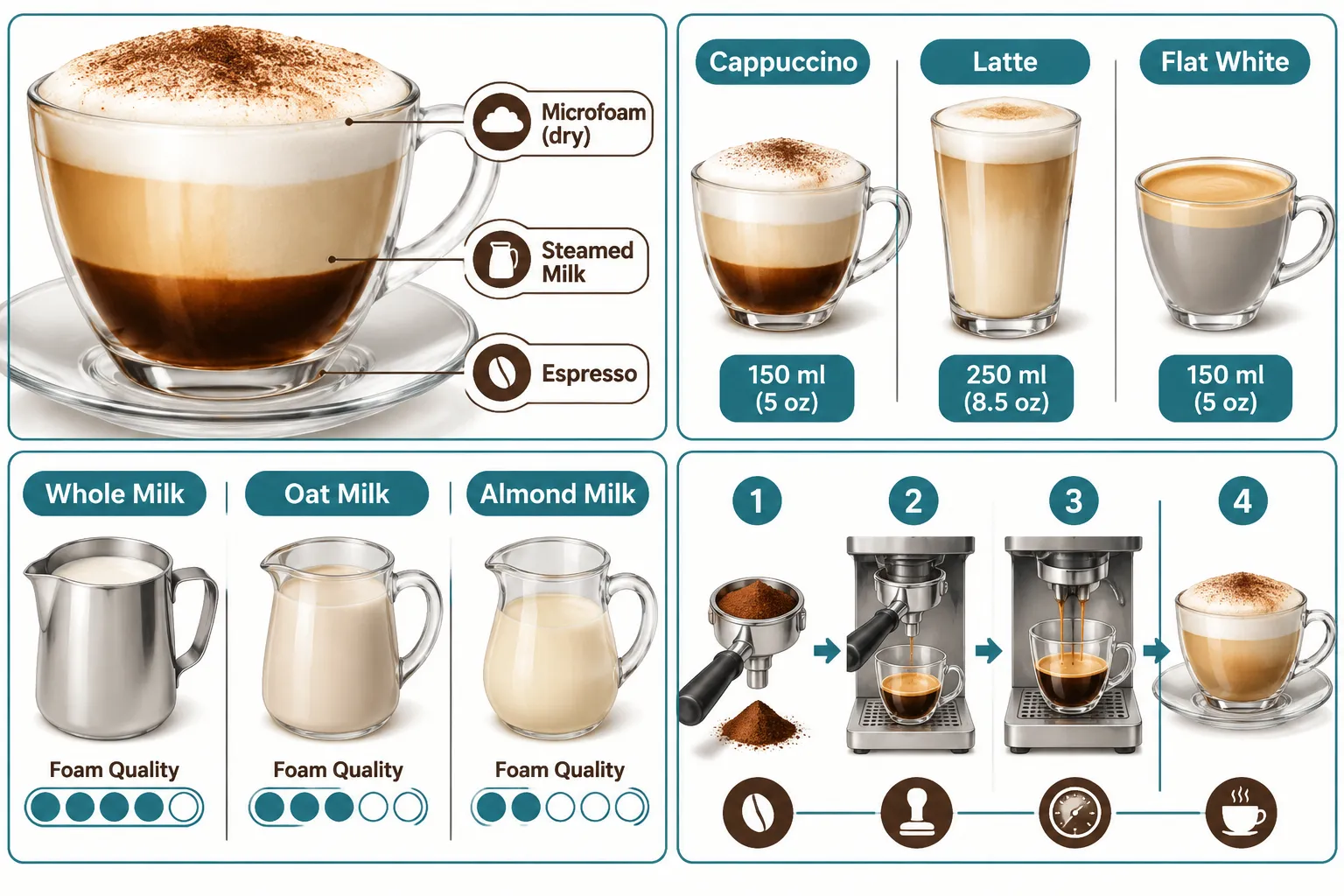
A great home cappuccino requires three things: strong espresso, properly steamed or frothed milk, and the right ratio. The process takes about five minutes once you have the equipment set up.
Step-by-step process:
- Brew the espresso. Use a home espresso machine, a Moka pot, or a pressurized pod machine. Aim for a concentrated, 1-2 oz shot.
- Heat the milk. Warm whole milk to roughly 140-150°F (60-65°C). Do not boil it, boiling kills the sweetness and texture.
- Froth the milk. Use a steam wand, handheld frother, or French press to create thick foam. For a cappuccino, you want more air than you would for a latte.
- Combine. Pour the espresso into a preheated cup. Spoon or pour the foamed milk over it, holding back the foam with a spoon to let steamed milk flow first, then cap with the foam.
- Finish. Optionally dust with cocoa powder or cinnamon.
Common mistakes to avoid:
- Using milk that is too cold (foam will not form properly) or too hot (foam becomes watery).
- Overfilling the cup, a cappuccino should not exceed 6 oz.
- Using pre-ground stale coffee. Freshly ground beans make a significant difference.
- Frothing skim milk expecting the same foam as whole milk, skim can foam but produces thinner, less stable bubbles.
Do You Need an Espresso Machine to Make a Cappuccino?
No, a full espresso machine is not required. A Moka pot produces a concentrated coffee that is close enough in strength to work as a cappuccino base, especially for home use. [4]
Equipment alternatives:
- Moka pot + handheld frother: The most affordable home setup, under $30 combined for basic models.
- Aeropress + frother: Produces a concentrated shot and pairs well with frothed milk.
- Pod/capsule machine (e.g., Nespresso): Espresso-strength pods work well; use the steam wand attachment or a separate frother.
- French press frothing method: Heat milk, pour into a French press, and pump the plunger rapidly for 30-60 seconds to create foam.
A proper espresso machine with a steam wand gives the best results, but it is not the only path to a good cappuccino at home.
What Kind of Milk Should You Use for a Cappuccino?
Whole milk is the standard choice for cappuccinos because its fat content produces stable, creamy foam with a naturally sweet flavor. [6]
Milk comparison for cappuccino:
- Whole milk: Best foam stability and sweetness. The traditional choice.
- 2% milk: Slightly thinner foam, still workable.
- Oat milk: The most popular non-dairy option; foams reasonably well and adds a mild sweetness. Barista-formula versions perform best.
- Almond milk: Thinner foam, can separate more easily. Works but requires care with temperature.
- Soy milk: Foams well but can curdle if the espresso is too acidic. Use fresh, barista-grade soy milk.
- Coconut milk: Rich flavor but inconsistent foam; better for blended drinks.
Rule of thumb: Choose barista-edition plant milks if going dairy-free. They are formulated specifically to foam and behave like dairy milk under heat.
Where to Get Free Cappuccino on November 8 and National Cappuccino Day Deals
Many coffee chains and independent cafés offer November 8 deals and promotions to mark National Cappuccino Day. Offers vary by year and location, so the best approach is to check directly with your preferred café in the days before November 8. [2][8]
Strategies for finding 2026 National Cappuccino Day deals:
- Check the apps and loyalty programs for major chains (Starbucks, Dunkin’, Peet’s Coffee, Tim Hortons), these chains frequently run limited-time beverage promotions tied to food holidays.
- Follow local independent cafés on social media. Many post same-day specials or “buy one, get one” offers on November 8.
- Search “[your city] + National Cappuccino Day deals” on the week of November 8 for local press coverage.
- Coffee subscription services sometimes offer free or discounted bags of espresso-roast beans around the holiday.
Deals are not guaranteed and differ every year. Chains do not always advertise far in advance, so checking apps on November 8 itself often surfaces flash offers.
How to Celebrate November 8 National Cappuccino Day
Celebrating November 8 National Cappuccino Day does not require elaborate planning. The day is designed to be casual, community-driven, and centered on the pleasure of a good cup of coffee. [3][8]
Ideas for celebrating in 2026:
- Visit a local independent coffee shop and try a traditional Italian-style cappuccino.
- Host a home cappuccino bar for friends or family, experimenting with different milk types and toppings.
- Share a photo of your cappuccino on social media with the hashtag #NationalCappuccinoDay.
- Try making a National Hazelnut Cake Day pairing, hazelnut and cappuccino are a classic Italian flavor combination.
- Explore a flavored cappuccino variation, such as vanilla, cinnamon, or cardamom.
- Gift a bag of quality espresso beans to a coffee-loving friend.
- Some communities and cafés have used the day for charitable fundraisers, donating a portion of cappuccino sales to local causes, a trend worth supporting if one occurs near you in 2026. [8]
For those who enjoy pairing coffee with sweet treats, consider browsing ideas on National Fudge Day or checking out what other food holidays are celebrated in autumn alongside your cappuccino. The National Almond Buttercrunch Day page is also worth a look for chocolate-and-coffee pairing inspiration.
Best Cappuccino Recipes and Variations to Try
The classic dry cappuccino is just the starting point. Several popular variations are worth trying on National Cappuccino Day or any time of year.
Popular cappuccino variations:
- Wet cappuccino: More steamed milk, less dry foam, closer to a latte. Good for those who find the standard version too strong.
- Bone dry cappuccino: All foam, no steamed milk added beyond the espresso. Very intense.
- Iced cappuccino: Espresso poured over ice, topped with cold foam. Best made with a cold foam attachment or blender.
- Flavored cappuccino: Add a pump of vanilla, hazelnut, or caramel syrup to the espresso before adding milk.
- Spiced cappuccino: Dust with cinnamon, nutmeg, or cardamom for a warm-spiced version popular in autumn.
- Mocha cappuccino: Stir a small amount of chocolate syrup or cocoa into the espresso base before frothing.
Each variation maintains the fundamental cappuccino structure, the changes come in milk volume, foam density, or added flavoring, not in the espresso foundation.
FAQ
What day is National Cappuccino Day? National Cappuccino Day is observed every year on November 8. The date is fixed and does not change. [1]
Is National Cappuccino Day an official holiday? No. It is an unofficial food holiday not backed by federal or state legislation. It is recognized by food calendars, media outlets, and coffee industry organizations. [3][7]
Where did the word “cappuccino” come from? The word comes from the Capuchin friars, a Catholic religious order. The drink’s brown color matched the color of their robes. [5][6]
How is a cappuccino different from a macchiato? A macchiato is a shot of espresso “stained” with just a small amount of milk or foam, far less than a cappuccino. A cappuccino has equal parts espresso, steamed milk, and foam.
Can you make a cappuccino without a steam wand? Yes. A handheld electric frother, a French press, or a jar-shaking method can all produce enough foam for a home cappuccino. Results improve with practice.
How many calories are in a cappuccino? A standard 6 oz cappuccino made with whole milk contains roughly 60-80 calories, making it one of the lower-calorie espresso drinks. Using plant milks can alter that figure.
What is the best espresso roast for cappuccino? Medium to dark roasts generally work best because their bold, slightly bitter flavor holds up against the sweetness of steamed milk. Very light roasts can taste sour or weak in a milk-based drink.
Is National Cappuccino Day celebrated outside the United States? Yes. While it originated in the U.S. context, it is recognized and celebrated in Canada, the UK, Australia, and other countries, though it carries different names in some markets. [1][6]
Conclusion
November 8 National Cappuccino Day is a straightforward celebration with real cultural weight. It connects the daily coffee ritual to a centuries-old Italian tradition, gives coffee lovers a reason to explore the craft of the drink, and drives genuine community participation through café promotions and social sharing.
Actionable next steps for 2026:
- Mark November 8 on your calendar and check your favorite café’s app or social pages for deals in the week leading up to the day.
- If you have never made a cappuccino at home, pick up a Moka pot and a handheld frother, you can produce a solid result for under $30 in equipment.
- Experiment with one new variation this year, whether that is an iced cappuccino, a spiced version, or a plant-milk alternative.
- Pair your cappuccino with a complementary treat, the National Raspberry Cake Day page has dessert ideas that work beautifully with espresso drinks.
- Share the experience. Post a photo, bring a colleague a cappuccino, or introduce someone to the difference between a cappuccino and a latte, that kind of word-of-mouth is exactly what keeps food holidays alive and meaningful.
References
- National Cappuccino Day. calendarr.com.
- National Cappuccino Day. nationaltoday.com.
- Cappuccino Day. daysoftheyear.com.
- National Cappuccino Day. holidayscalendar.com.
- National Cappuccino Day and Origin of the Drinks Name. wtvr.com.
- Cappuccino Day Celebrating Italys Beloved Brew and the Global Coffee Culture. emiliadelizia.com.
- National Cappuccino Day. nationaldayarchives.com.
- National Cappuccino Day. celebrationnation.com.