Last updated: September 2, 2026
Quick Answer
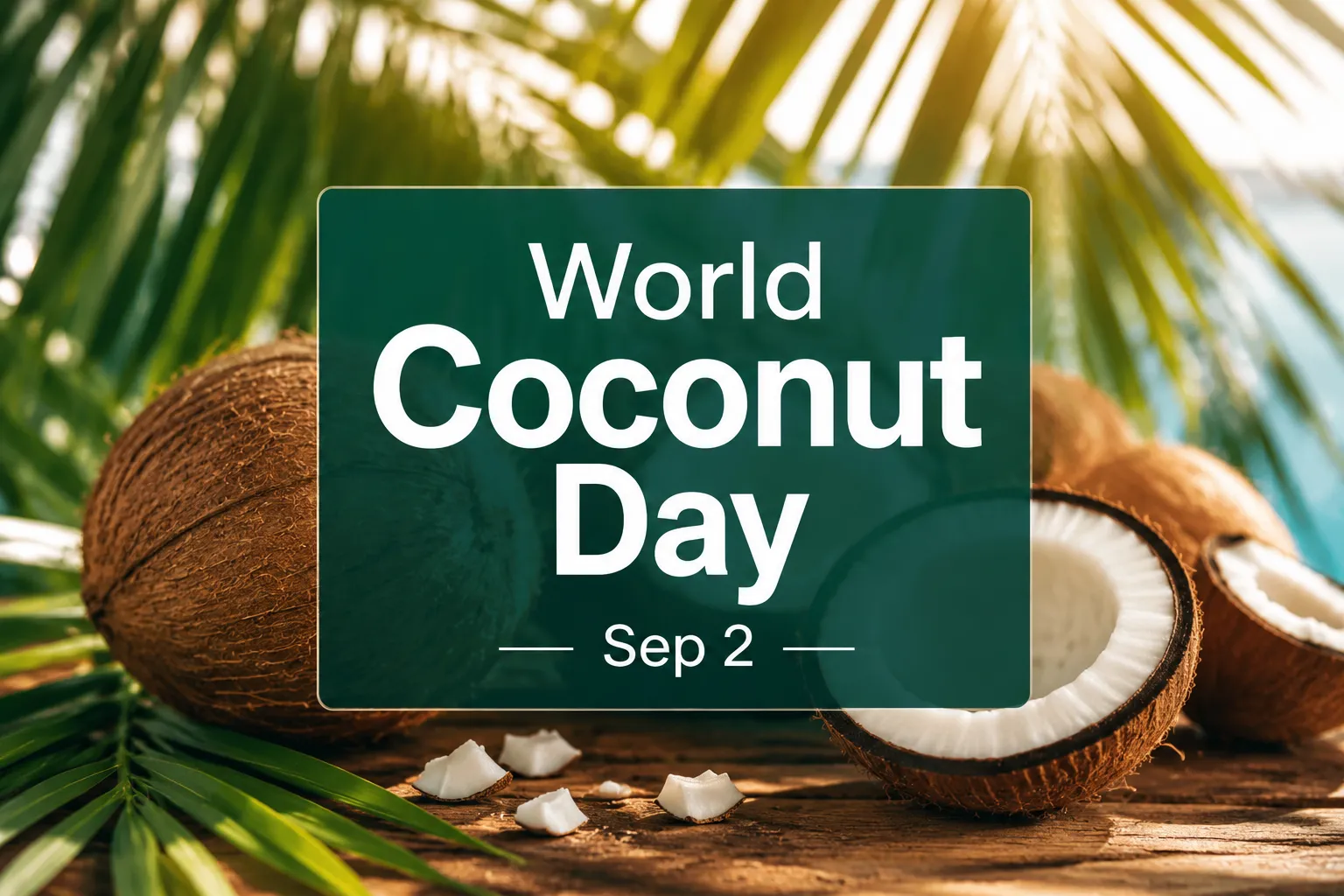
September 2 World Coconut Day is an annual international observance held every September 2 to mark the founding anniversary of the International Coconut Community (ICC), the intergovernmental body that coordinates the global coconut industry. The day is celebrated by coconut-producing nations, farming communities, food businesses, and consumers worldwide to recognize the coconut’s cultural, nutritional, and economic importance. In 2026, the official celebration is hosted in Manado, North Sulawesi, Indonesia. [1][2][10]
Key Takeaways
- September 2 World Coconut Day falls every year on September 2, the founding date of the International Coconut Community.
- The ICC established the observance in 2009 to unite coconut-growing nations under a shared global platform. [3]
- The 2026 theme is “Coconut for a Circular Economy: Building Partnership for Maximum Value.” [7]
- The 2025 theme was “Uncovering Coconut’s Power, Inspiring Global Action,” with events focused on food security and climate resilience. [4]
- The ICC currently represents 21 member nations across Asia, the Pacific, and beyond.
- India, Indonesia, and the Philippines are among the largest participants, with national-level government events each year.
- Coconuts support the livelihoods of an estimated tens of millions of smallholder farmers in tropical regions.
- Every part of the coconut, from husk to water, has commercial or practical uses, making it a model crop for circular-economy thinking.
- Anyone can participate by cooking with coconut, sharing awareness on social media, or supporting coconut farmers directly.
What Is World Coconut Day and Why Is It Celebrated on September 2
World Coconut Day is an annual global observance dedicated to recognizing the coconut palm’s role in food, culture, industry, and sustainable farming. It is celebrated on September 2 because that date marks the founding anniversary of the International Coconut Community, the intergovernmental organization that administers the day. [1][2]
The coconut palm is often called the “tree of life” in tropical cultures because virtually every part of the plant serves a purpose: the fruit provides food and drink, the shell becomes charcoal or craft material, the husk yields coir fiber, the leaves are used in construction, and the trunk serves as timber. World Coconut Day exists to draw global attention to this versatility and to advocate for the farmers and communities whose livelihoods depend on it.
The day is not a public holiday in most countries, but it functions as an awareness and advocacy platform, similar to other internationally recognized food observances. For more examples of how food holidays build awareness around agricultural products, see this guide to National Food Observances.
History of World Coconut Day: When Did It Start
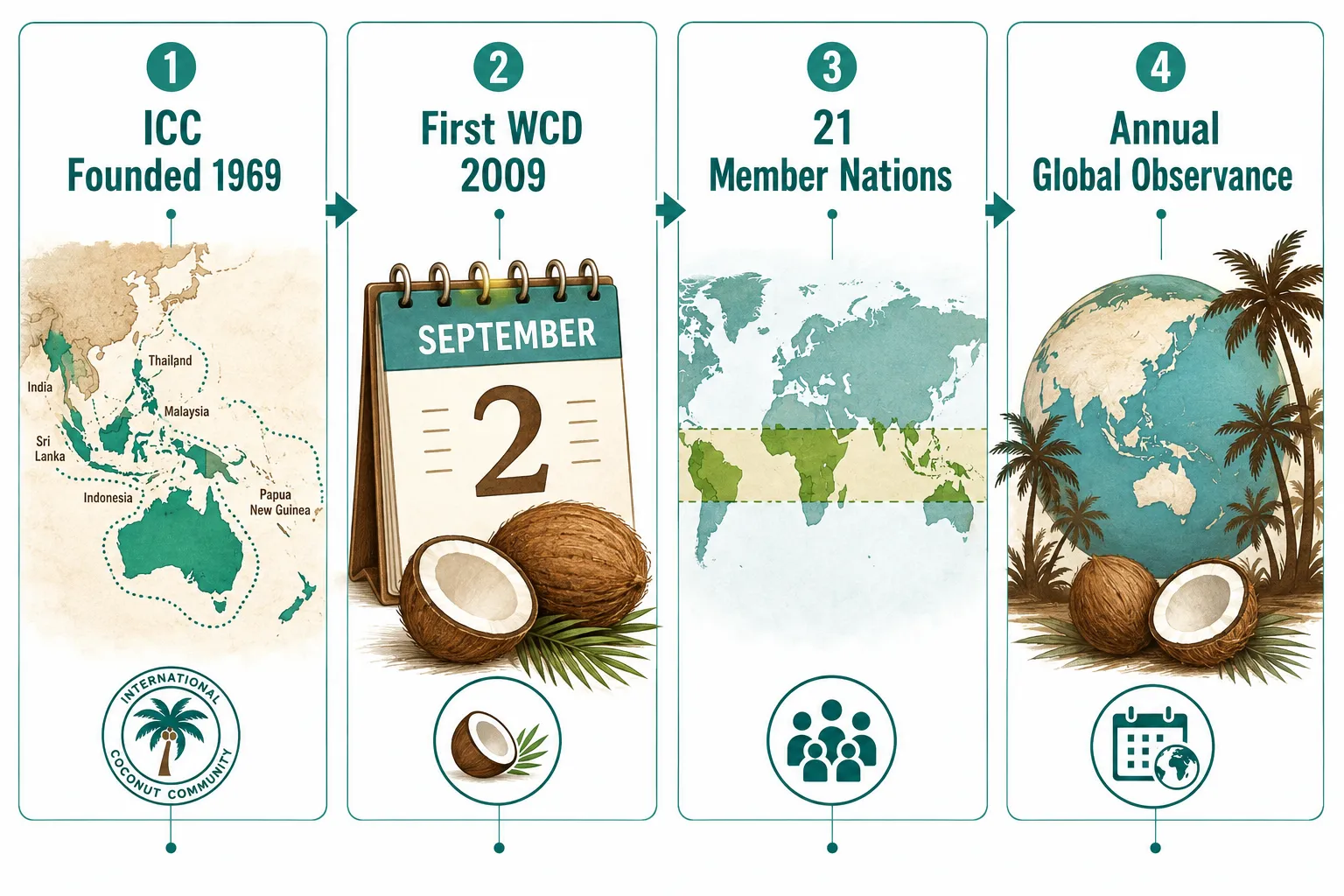
World Coconut Day was formally established in 2009 by the International Coconut Community, which itself was originally founded on September 2, 1969, as the Asian and Pacific Coconut Community (APCC). [3] The date was chosen specifically to honor that founding moment.
Key milestones in the history of the observance:
- 1969: The Asian and Pacific Coconut Community is established on September 2, providing the first intergovernmental platform for coconut-producing nations.
- 2009: The ICC launches World Coconut Day as an annual observance, aligning it with the organization’s 40th anniversary.
- 2014: The APCC is renamed the International Coconut Community to reflect its expanding global membership.
- 2025: Celebrations are held globally under the theme “Uncovering Coconut’s Power, Inspiring Global Action,” with India hosting a major national event in Kerala. [6]
- 2026: North Sulawesi, Indonesia, is selected as the host location, with the ICC framing it as a strategic push to position the region as a central axis of the global coconut industry. [10]
The ICC’s decision to anchor the day to its own founding date gives September 2 World Coconut Day both institutional legitimacy and historical continuity.
How Many Countries Celebrate World Coconut Day
World Coconut Day is observed across all 21 member nations of the International Coconut Community, which span the tropical belt of Asia and the Pacific. [3] Beyond formal ICC membership, the day is also acknowledged in non-member countries with significant coconut consumption or diaspora communities, including the Netherlands and other parts of Europe. [9]
Top participating countries include:
- Indonesia (world’s largest coconut producer)
- India (second-largest producer, with government-led national events)
- Philippines
- Sri Lanka
- Papua New Guinea
- Vanuatu
- Samoa
- Thailand
- Malaysia
In India specifically, the Coconut Development Board (CDB) organizes a national-level celebration each year. In 2025, Union Agriculture Minister Shivraj Singh Chouhan virtually inaugurated the national event held at Angamaly, Kerala. [6] The CDB also used the occasion to launch revised subsidy schemes aimed at boosting sustainability and export capacity. [8]
World Coconut Day 2026 Theme and Events
The 2026 theme for September 2 World Coconut Day is “Coconut for a Circular Economy: Building Partnership for Maximum Value.” [7] This theme reflects a growing industry push to extract value from every part of the coconut while reducing waste and environmental impact.
The flagship 2026 event is hosted in Manado, North Sulawesi, Indonesia. The ICC has described the hosting choice as a deliberate strategy to position North Sulawesi as a central axis of the global coconut world, given the region’s deep production history and export infrastructure. [10]
What the circular economy theme means in practice:
- Maximizing use of coconut byproducts (shell, husk, water, oil residue)
- Building supply chain partnerships between farmers, processors, and exporters
- Reducing post-harvest waste at the farm level
- Developing new markets for value-added coconut products
The 2025 theme, “Uncovering Coconut’s Power, Inspiring Global Action,” centered on food security, farmer livelihoods, and climate resilience, with events in multiple countries reinforcing those priorities. [4][5]
Coconut Health Benefits: Why Celebrate Coconuts
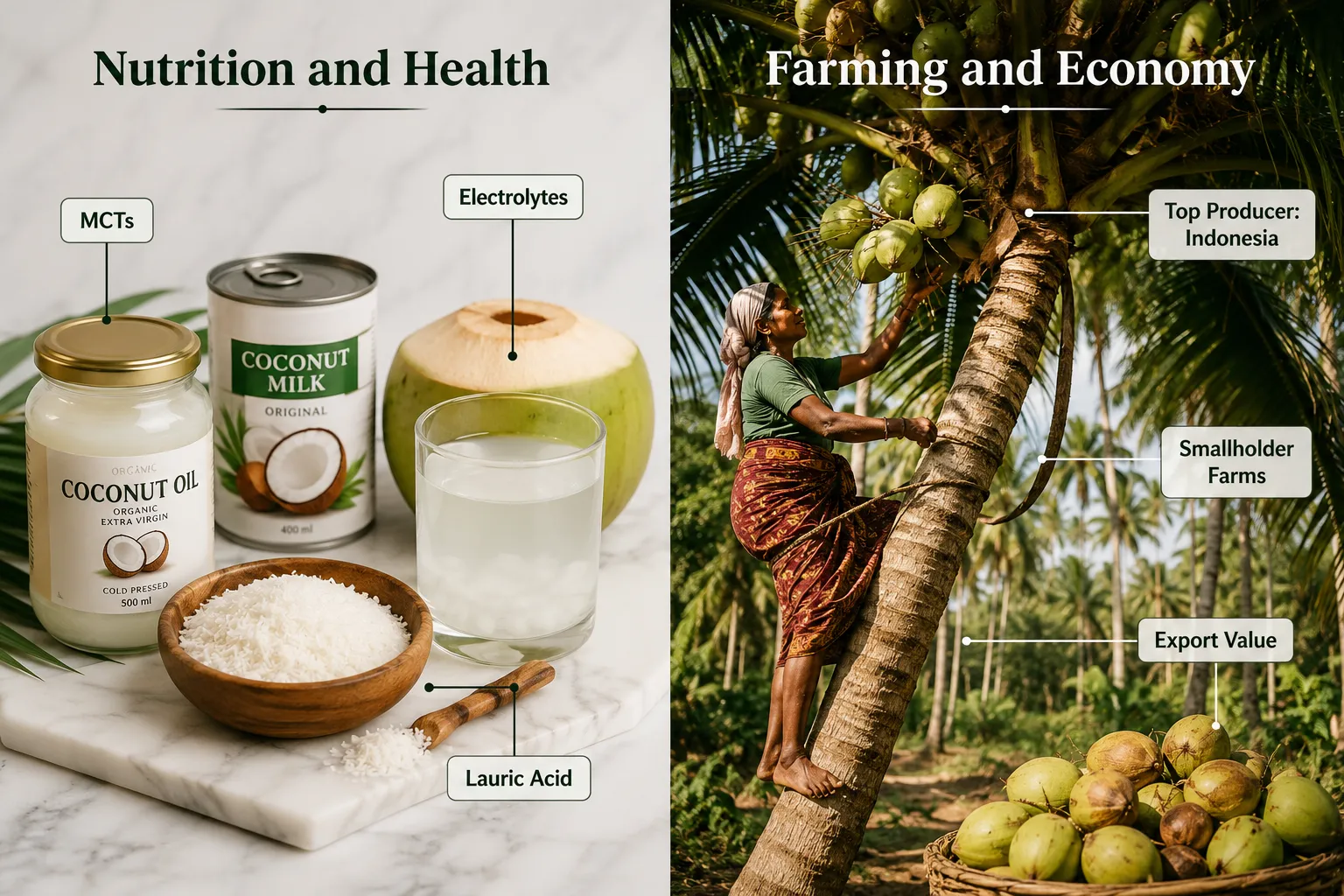
Coconuts offer a broad nutritional profile that spans hydration, healthy fats, and essential minerals. Coconut water is a natural source of electrolytes including potassium, making it a popular recovery drink. Coconut oil contains medium-chain triglycerides (MCTs), which the body metabolizes differently from long-chain fats. Coconut flesh provides dietary fiber, manganese, and copper.
Key nutritional components of the coconut:
| Component | Primary Benefit | Common Form |
|---|---|---|
| Coconut water | Electrolyte hydration | Fresh or packaged drink |
| Coconut oil | MCTs, cooking stability | Cooking, skincare |
| Coconut milk | Creaminess, fat-soluble nutrients | Curries, baked goods |
| Coconut flesh | Fiber, manganese | Fresh, desiccated, flaked |
| Coconut sugar | Lower glycemic index than cane sugar | Baking, beverages |
It is worth noting that coconut oil is high in saturated fat, and health authorities vary in their guidance on daily intake. Consumers are encouraged to use it as part of a balanced diet rather than as a wholesale replacement for other cooking fats.
For those who enjoy coconut in baked goods, the National Macaroon Day history and recipes guide offers a great starting point for coconut-forward treats.
Coconut Farming and Production Facts
The coconut industry is built almost entirely on smallholder farming. The vast majority of the world’s coconuts are grown on small family farms of fewer than four hectares, particularly in Indonesia, India, and the Philippines. This structure makes the industry both resilient at the community level and vulnerable to price volatility and climate disruption.
Production facts worth knowing:
- Indonesia, India, and the Philippines together account for the majority of global coconut production.
- The coconut palm takes four to six years to begin bearing fruit and can produce for decades afterward.
- A single mature palm can yield between 50 and 200 coconuts per year, depending on variety and growing conditions.
- Coconut products traded internationally include copra (dried coconut flesh), coconut oil, desiccated coconut, coconut water, coir fiber, and activated charcoal from shells.
- Climate change poses a direct threat to coconut farming through increased drought frequency, rising sea levels in low-lying island nations, and new pest pressures.
The CDB’s 2025 announcement of revised subsidy schemes specifically targeted these vulnerabilities, aiming to help farmers adopt more sustainable practices while improving export competitiveness. [8]
World Coconut Day vs. Other Agricultural Awareness Days
September 2 World Coconut Day sits within a broader calendar of food and agricultural observances, but it differs from most in one key way: it is administered by an intergovernmental organization rather than a national government or private advocacy group. This gives it more institutional weight than informal food holidays.
How it compares:
- World Coconut Day (Sept 2): ICC-administered, intergovernmental, tied to a founding anniversary, focused on production, trade, and sustainability.
- National food holidays (e.g., National Piña Colada Day): Informal, consumer-oriented, focused on enjoyment and product promotion.
- FAO World Food Days: UN-administered, broader in scope, focused on global hunger and food systems.
- Crop-specific days (e.g., World Nutella Day): Brand-driven or advocacy-driven, with no formal institutional backing.
The ICC’s involvement means September 2 World Coconut Day generates genuine policy action, including subsidy announcements, trade discussions, and sustainability commitments, rather than simply encouraging people to eat coconut.
How to Celebrate World Coconut Day at Home
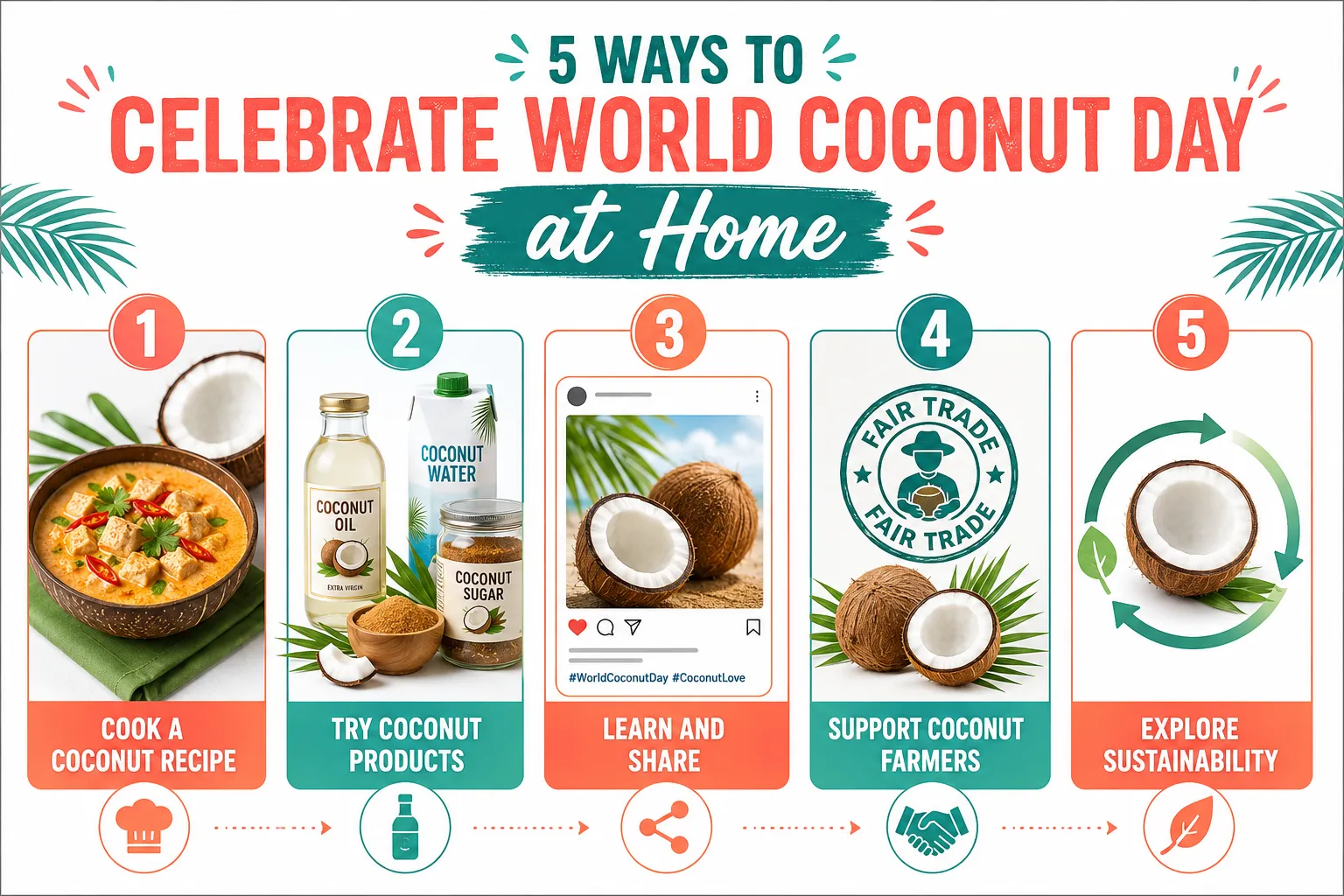
Celebrating September 2 World Coconut Day at home is straightforward and does not require travel or special equipment. The most meaningful ways to participate combine personal enjoyment with support for the broader coconut farming community.
Practical ways to celebrate:
- Cook a coconut-based recipe. Try a Thai coconut curry, coconut rice, or a classic coconut macaroon. Coconut milk and desiccated coconut are widely available in most grocery stores.
- Swap in coconut products. Use coconut oil for cooking, coconut sugar in your morning coffee, or coconut water as a post-workout drink.
- Buy fair-trade or directly sourced coconut products. Look for certifications that indicate farmers received fair compensation.
- Share on social media. Use the hashtag #WorldCoconutDay to join the global conversation and spread awareness.
- Learn about the ICC and its member nations. Understanding where your coconut products come from adds context and appreciation.
- Host a coconut tasting. Compare coconut water brands, coconut oils, or coconut-based snacks with friends or family.
If you enjoy exploring food holidays with recipes and history, the April 7 National Coffee Cake Day guide and the July 10 National Piña Colada Day guide offer similar inspiration for other dates on the calendar.
Coconut Industry Economic Importance
The coconut industry generates significant economic value for tropical nations, particularly those where it forms the backbone of rural livelihoods. While exact global trade figures shift year to year, the coconut sector consistently ranks among the top agricultural exports for Indonesia, the Philippines, and Sri Lanka.
Economic dimensions of the coconut industry:
- Smallholder dependency: The majority of coconut farmers worldwide are smallholders, meaning price stability and market access directly affect household incomes in rural tropical communities.
- Value-added products: Beyond raw copra, the industry now encompasses coconut water beverages, MCT oil, coconut flour, coconut sugar, coir products, and activated charcoal, each representing higher-margin export categories.
- Employment: Coconut farming, processing, and trade support the livelihoods of tens of millions of people across Asia and the Pacific.
- Export markets: The United States, European Union, and China are among the largest importers of coconut-derived products.
The ICC’s 2026 circular economy theme directly addresses the economic opportunity in byproduct utilization, since much of the value in a coconut is currently lost at the processing stage. [7][10]
Coconut Sustainability and Environmental Impact
Coconut farming has a relatively low environmental footprint compared to many other tropical crops. Coconut palms do not require large-scale deforestation to establish, and they grow well in coastal and marginal soils where other crops struggle. However, the industry faces sustainability challenges that September 2 World Coconut Day increasingly highlights.
Sustainability considerations:
- Circular use: The push for circular economy models means using coconut husks for coir, shells for activated charcoal, and water as a beverage rather than discarding them as waste.
- Monoculture risk: In some regions, heavy reliance on a single coconut variety creates vulnerability to pests and disease.
- Climate resilience: Low-lying Pacific island nations face existential threats from rising sea levels that could eliminate coconut-growing land entirely.
- Organic certification: Demand for certified organic coconut products has grown, incentivizing farmers to reduce chemical inputs.
The 2025 celebrations at Gamerimura on the Assam-Meghalaya border in India specifically focused on sustainable cultivation and community-driven farming, showing how the day is used to promote grassroots environmental practices. [15 – see note below]
World Coconut Day Traditions by Country
Different countries mark September 2 World Coconut Day in ways that reflect their own agricultural and cultural relationships with the coconut.
- India: The Coconut Development Board organizes a national-level event, often with ministerial participation. In 2025, the event was held in Kerala, India’s largest coconut-producing state, with new subsidy schemes announced on the day. [6][8]
- Indonesia: As host of the 2026 global event, Indonesia uses the day to showcase its position as the world’s largest coconut producer and to attract international investment in processing infrastructure. [10]
- Philippines: Local government units and agricultural agencies hold farmer recognition events and coconut product fairs.
- Pacific Island Nations: Smaller ICC member nations use the day to raise awareness about climate threats to their coconut-dependent economies.
- India (regional): Community-level events in states like Assam focus on training farmers in sustainable cultivation methods.
Best Coconut Products to Try on World Coconut Day
World Coconut Day is a natural occasion to explore the full range of what the coconut offers beyond the standard bag of desiccated flakes. The market for coconut-derived products has expanded considerably, and many are available in mainstream grocery stores.
Products worth trying:
- Coconut water: A natural electrolyte drink; look for brands with no added sugar.
- Coconut aminos: A soy sauce alternative made from coconut sap, lower in sodium and gluten-free.
- Coconut flour: A high-fiber, gluten-free baking flour that works well in pancakes and muffins.
- Coconut sugar: Less processed than refined cane sugar, with a mild caramel flavor.
- Coconut yogurt: A dairy-free alternative made from coconut milk, suitable for vegan diets.
- MCT oil: Derived from coconut oil, popular in coffee and smoothies for its fast-metabolizing fat content.
- Coir products: Non-food items like doormats, brushes, and garden mulch made from coconut husk fiber.
For readers who enjoy nut-forward baked goods alongside coconut treats, the July 12 National Pecan Pie Day guide offers complementary recipe inspiration.
Fun Facts About Coconuts You Should Know
- The word “coconut” comes from the Portuguese and Spanish word “coco,” meaning skull or head, a reference to the three indentations on the coconut shell that resemble a face.
- Botanically, the coconut is classified as a fruit, a nut, and a seed simultaneously, making it one of the most versatile botanical specimens.
- Coconut water was reportedly used as an emergency intravenous hydration fluid during World War II when medical saline was scarce, due to its sterility and electrolyte content.
- The coconut palm can live for up to 100 years and typically begins producing fruit between its fourth and sixth year.
- Coconut shell charcoal is one of the most effective materials used in water filtration and air purification systems.
- A single coconut palm can produce between 50 and 200 coconuts per year depending on the variety, soil, and climate.
- The Philippines is the world’s largest exporter of coconut oil, even though Indonesia produces more coconuts overall.
FAQ
What date is World Coconut Day? World Coconut Day is observed every year on September 2. The date marks the founding anniversary of the International Coconut Community, originally established on September 2, 1969. [1]
Who created World Coconut Day? The International Coconut Community (ICC), an intergovernmental organization, established World Coconut Day in 2009. [3]
What is the theme for World Coconut Day 2026? The 2026 theme is “Coconut for a Circular Economy: Building Partnership for Maximum Value,” emphasizing sustainable use of all coconut parts and stronger supply chain partnerships. [7]
What was the theme for World Coconut Day 2025? The 2025 theme was “Uncovering Coconut’s Power, Inspiring Global Action,” with a focus on food security, farmer livelihoods, and climate resilience. [4]
Where is World Coconut Day 2026 being held? The 2026 global celebration is hosted in Manado, North Sulawesi, Indonesia. The ICC selected the location to position the region as a key hub in the global coconut industry. [10]
How many countries are members of the ICC? The ICC has 21 member nations, primarily from Asia and the Pacific. [3]
Is World Coconut Day a public holiday? No. World Coconut Day is an international awareness observance, not a public holiday. Schools, businesses, and government offices remain open in all participating countries.
How can I participate in World Coconut Day from home? Cook a coconut recipe, try a new coconut product, share awareness on social media using #WorldCoconutDay, or purchase fair-trade coconut goods to support farming communities.
What is the International Coconut Community? The ICC is an intergovernmental organization that coordinates policy, trade, and development for the global coconut industry. It was founded in 1969 as the Asian and Pacific Coconut Community and renamed in 2014.
Why is the coconut called the “tree of life”? The coconut palm earns this title because every part of the plant has a practical use: fruit for food and drink, husk for fiber, shell for charcoal and crafts, leaves for construction, and trunk for timber.
What country produces the most coconuts? Indonesia is the world’s largest coconut producer, followed by India and the Philippines.
Is coconut water healthy? Coconut water is a low-calorie, naturally occurring source of potassium and other electrolytes. It is a suitable hydration option for most people, though those monitoring potassium intake should consult a healthcare provider.
Conclusion
September 2 World Coconut Day is more than a food celebration. It is an intergovernmental platform that connects farmers, policymakers, businesses, and consumers around one of the world’s most versatile crops. In 2026, the observance carries added weight with its circular economy theme and a flagship event in Manado, Indonesia, signaling a clear industry direction toward maximum value extraction and reduced waste.
Actionable next steps for 2026:
- Mark September 2 on your calendar and plan at least one coconut-based meal or recipe.
- Follow the ICC’s official channels for updates on the Manado event and global celebrations.
- Choose fair-trade or certified coconut products when shopping to support smallholder farmers.
- Share the day on social media using #WorldCoconutDay to help grow awareness.
- Explore the full range of coconut products beyond coconut oil, including coconut flour, coconut aminos, and coir goods.
The coconut’s story is one of remarkable utility, deep cultural roots, and growing economic significance. Recognizing September 2 World Coconut Day is a small but meaningful way to connect with that story.
References
[1] World Coconut Day – https://www.wikidates.org/holiday/world-coconut-day_2720.html
[2] World Coconut Day – https://nationaltoday.com/world-coconut-day/
[3] Wereld Kokosnootdag – https://www.beleven.org/feest/wereld_kokosnootdag
[4] World Coconut Day 2025 Celebrated Globally With Renewed Commitment To A Resilient Coconut Sector – https://mail.coconutcommunity.org/news-page/world-coconut-day-2025-celebrated-globally-with-renewed-commitment-to-a-resilient-coconut-sector
[5] World Coconut Day 2025 Celebrated Globally With Renewed Commitment To A Resilient Coconut Sector – https://mail.coconutcommunity.org/index.php/news-page/world-coconut-day-2025-celebrated-globally-with-renewed-commitment-to-a-resilient-coconut-sector
[6] Union Minister Shivraj Singh Chouhan to inaugurate World Coconut Day celebrations – http://www.uniindia.com/union-minister-shivraj-singh-chouhan-to-inaugurate-world-coconut-day-celebrations/south/news/3563382.html
[7] World Coconut Day 2026 – https://www.oneworldnews.com/lifestyle/world-coconut-day-2026/
[8] World Coconut Day 2025: CDB Launches Revised Schemes, Higher Subsidies To Boost Sustainability Exports – https://krishijagran.com/news/world-coconut-day-2025-cdb-launches-revised-schemes-higher-subsidies-to-boost-sustainability-exports/
[9] Kalender – https://www.beleven.org/feesten/kalender.php?dag=2&maand=9&jaar=2026
[10] North Sulawesi Set To Host World Coconut Day 2026: A Strategic Push For The Global Coconut Industry – https://coconutcommunity.org/news/north-sulawesi-set-to-host-world-coconut-day-2026-a-strategic-push-for-the-global-coconut-industry