Last updated: June 28, 2026
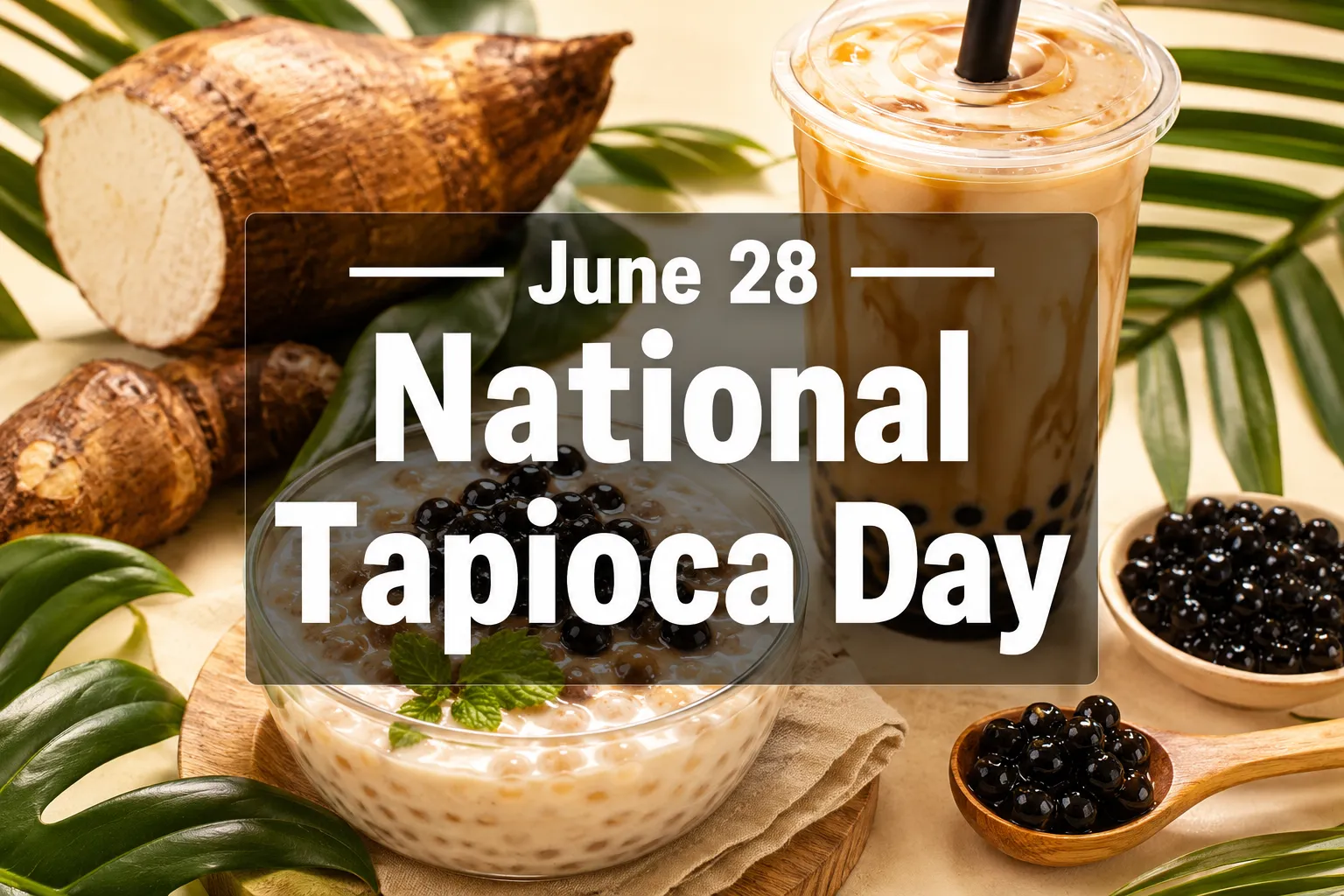
Quick Answer: June 28 National Tapioca Day is an annual American food holiday observed every June 28 that celebrates tapioca in all its forms, from creamy pudding to chewy bubble tea pearls to gluten-free baking starch. It is an informal observance with no official government backing, but it is widely recognized in U.S. food calendars and gives home cooks, restaurants, and boba shops a reason to highlight one of the world’s most versatile starches. In 2026, the day falls on a Sunday.
Key Takeaways
- June 28 is National Tapioca Day in the United States, observed annually as an informal food holiday.
- Tapioca comes from the cassava root (also called yuca or manioc), a plant native to northern Brazil and South America.
- The word “tapioca” traces back to the Tupí word “tipi’óka,” reflecting its Indigenous South American roots.
- National Tapioca Day has no confirmed founder or sponsoring organization; it appears in U.S. food calendars from the early 2000s onward.
- June 28 National Tapioca Day is distinct from National Tapioca Pudding Day, which falls on July 15.
- Tapioca comes in several forms: pearls (small and large), flour/starch, flakes, and granules, each with different culinary uses.
- Bubble tea (boba) made with large tapioca pearls is one of the most popular ways people celebrate the day.
- Tapioca is naturally gluten-free, making it a popular ingredient for people with celiac disease or gluten sensitivity.
- Common cooking mistakes include under-soaking pearls, using too high a heat, and confusing tapioca starch with tapioca flour (they are the same product).
- The best way to celebrate is to cook a tapioca recipe at home, visit a bubble tea shop, or share tapioca creations on social media.
What Is National Tapioca Day?
National Tapioca Day is an annual American food observance dedicated to celebrating tapioca in every form it takes, including pudding, bubble tea pearls, and cooking starch. It is an informal holiday, meaning it carries no legal status and requires no official proclamation to participate. [1][3]
The day encourages people to cook with tapioca, try boba drinks, and learn about the ingredient’s global story. It sits alongside dozens of other summer food days in the U.S. calendar, all designed to spotlight a single ingredient or dish and give food lovers a fun, low-stakes reason to get into the kitchen. [6][8]
Who it is for: Anyone who enjoys desserts, bubble tea, or gluten-free cooking. It is equally relevant for home cooks, food bloggers, boba shop owners, and restaurants looking for a timely social media hook.
Why Is June 28 National Tapioca Day?
June 28 is the fixed, recurring date for National Tapioca Day in the United States, observed every year on that calendar date regardless of what day of the week it falls on. In 2026, June 28 lands on a Sunday. [3][4]
No documented reason explains why June 28 was chosen over any other date. The holiday appears in U.S. food calendars from the early 2000s and is described as having been “invented in the United States” around the turn of the 21st century, but no founding organization or individual has been publicly credited. [9][10] This is common for informal American food holidays, many of which emerged from food industry promotions, regional traditions, or simply enthusiastic food fans who wanted to mark a favorite ingredient.
Key distinction: June 28 National Tapioca Day celebrates tapioca broadly, while National Tapioca Pudding Day on July 15 focuses specifically on the pudding form. That gives tapioca fans two separate occasions each summer. [3]
Where Did Tapioca Originate?
Tapioca is a starch extracted from the cassava root, a plant native to northern Brazil and parts of South America and the West Indies. Cassava (also called yuca or manioc) has been cultivated by Indigenous peoples in South America for thousands of years. [6][7]
The word “tapioca” comes from the Tupí word “tipi’óka,” which refers to the process of making the starch edible by removing its naturally occurring toxins through soaking, pressing, and heating. Portuguese and Spanish colonizers brought cassava cultivation to Africa, Asia, and the Caribbean, where it became a dietary staple in many countries. Today, cassava is grown widely across South and Central America, the Caribbean, sub-Saharan Africa, and South and Southeast Asia. [7]
Why this matters for the holiday: Understanding tapioca’s Indigenous South American roots adds cultural depth to June 28 National Tapioca Day. It is not just an American dessert ingredient; it is a global staple with a history stretching back millennia.
The History of Tapioca Day and How It Became a Food Holiday
National Tapioca Day has no clearly documented founder, sponsoring organization, or government proclamation. It appears in food holiday calendars from the early 2000s and is consistently listed as an informal observance. [9][10]
This pattern is typical of American food holidays. Many began as marketing initiatives by food brands or trade associations, while others grew organically from regional food cultures and food blogger communities. Over time, social media amplified these informal days, turning them into widely recognized annual events even without any official backing.
Tapioca itself has a long history in American kitchens. Tapioca pudding became a popular American comfort food in the late 19th and early 20th centuries, partly because cassava starch was shelf-stable and affordable. The Minute Tapioca brand, founded in the 1890s, helped make the ingredient a household staple in the United States. The rise of bubble tea from Taiwan in the 1980s and its global spread through the 1990s and 2000s introduced a new generation to tapioca pearls, broadening the ingredient’s cultural footprint well beyond pudding.
For more food holiday history and how these observances are celebrated, see the May 22 National Vanilla Pudding Day guide and the National Bread Pudding Day article for context on how similar pudding-focused food days are observed.
The Difference Between Tapioca Pearls and Tapioca Flour
Tapioca pearls and tapioca flour (also called tapioca starch) are both made from cassava root, but they look different, behave differently in cooking, and are used for entirely different purposes. [7]
| Form | Appearance | Primary Use | Cooking Method |
|---|---|---|---|
| Small tapioca pearls | Tiny white or translucent spheres | Classic tapioca pudding | Soak then simmer in liquid |
| Large tapioca pearls (boba) | Marble-sized, often black | Bubble tea | Boil 20-45 min, then soak in syrup |
| Tapioca flour/starch | Fine white powder | Thickening sauces, gluten-free baking | Add to liquids or doughs directly |
| Tapioca flakes | Flat, irregular flakes | Puddings, thickening | Soak then cook |
Common mistake: Many cooks use the terms “tapioca flour” and “tapioca starch” interchangeably, which is correct. They are the same product. However, confusing tapioca starch with cassava flour is a real error. Cassava flour is made from the whole dried cassava root and has a different texture and absorption rate, so they are not interchangeable in recipes.
Tapioca Health Benefits and Nutrition
Tapioca is primarily a source of carbohydrates and is naturally gluten-free, making it a useful ingredient for people with celiac disease or non-celiac gluten sensitivity. [6][7]
Key nutritional points:
- Gluten-free: Tapioca starch contains no gluten, which is why it is widely used in gluten-free baking as a binding and thickening agent.
- Low in protein and fat: Tapioca is almost pure starch, so it contributes minimal protein, fat, fiber, or micronutrients on its own.
- Easily digestible: Because it is a refined starch, tapioca is gentle on the digestive system and is sometimes recommended for people recovering from digestive illness.
- High glycemic index: Tapioca has a high glycemic index, so people managing blood sugar levels should consume it in moderation.
Who benefits most: People following gluten-free diets, those with digestive sensitivities, and anyone looking for a neutral-tasting thickener that does not alter the flavor of a dish.
Why Is Tapioca Popular in Asian Cuisine?
Tapioca is deeply embedded in Asian food culture because cassava cultivation spread to Southeast Asia and South Asia centuries ago, and the starch became a key ingredient in both savory and sweet dishes. [7]
In Southeast Asia, tapioca pearls appear in dessert soups, coconut milk puddings, and cold sweet drinks. In Taiwan, the invention of bubble tea (boba) in the 1980s transformed large black tapioca pearls into a global phenomenon. Boba tea shops now operate in virtually every major city worldwide, and the chewy texture of cooked tapioca pearls, known as “QQ” in Taiwanese food culture, is considered a desirable quality in its own right.
In South Asia, tapioca (called “sabudana” in Hindi) is used in fasting foods, porridges, and fried snacks. In parts of Africa, cassava-derived products including tapioca are daily staples rather than specialty ingredients.
The global popularity of bubble tea has been the single biggest driver of tapioca’s mainstream recognition in Western markets over the past two decades.
How to Cook Tapioca Pearls Perfectly
Perfectly cooked tapioca pearls are translucent, uniformly soft, and chewy without being mushy or hard in the center. The process takes patience but is straightforward. [7][8]
Step-by-step for large boba pearls:
- Bring a large pot of water to a rolling boil. Use at least 8 cups of water per 1 cup of dry pearls. Do not skimp on water.
- Add the dry pearls and stir immediately to prevent sticking. Do not soak large pearls before boiling.
- Cook on medium-high heat for 20 to 30 minutes, stirring occasionally, until the pearls are mostly translucent with a very small opaque dot in the center.
- Turn off the heat, cover, and let sit for 15 to 20 minutes. The residual heat finishes cooking the center without overcooking the outside.
- Drain and rinse briefly with warm water.
- Transfer to a simple syrup (equal parts sugar and water, heated until dissolved) and let the pearls soak for at least 15 minutes before serving.
For small tapioca pearls (pudding-style): Soak in cold water for 30 minutes first, then simmer in milk or a milk-and-water mixture over low heat, stirring frequently, until the pearls are fully translucent and the liquid has thickened.
Common mistakes:
- Using too little water, which causes uneven cooking and sticking.
- Skipping the resting step, which leaves a hard center.
- Letting cooked pearls sit too long without syrup, causing them to harden and clump.
Best Tapioca Recipes for June 28 National Tapioca Day
June 28 National Tapioca Day is best celebrated by making something with tapioca at home. The recipes below cover the full range of what the ingredient can do. [3][6][8]
Classic Tapioca Pudding Combine small tapioca pearls (pre-soaked 30 minutes), whole milk, sugar, a pinch of salt, and a beaten egg in a saucepan. Cook over medium-low heat, stirring constantly, until thickened and pearls are fully translucent. Remove from heat, stir in vanilla extract, and chill before serving. For a richer version, substitute coconut milk for half the dairy milk.
Brown Sugar Boba Milk Tea Brew strong black tea and let it cool. Cook large tapioca pearls using the method above and coat them in brown sugar syrup. Layer the pearls in a tall glass, add ice, pour over fresh whole milk, and finish with the cooled tea. Stir before drinking.
Tapioca-Thickened Fruit Pie Replace cornstarch with an equal amount of tapioca starch as the thickener in any fruit pie filling. Tapioca starch produces a clearer, glossier gel than cornstarch and has a more neutral flavor. It works especially well in berry and peach pies.
Coconut Tapioca Pudding with Mango Cook small pearls in a mixture of coconut milk and water with sugar and a pandan leaf (or vanilla bean). Serve chilled, topped with fresh diced mango and a drizzle of condensed milk.
For more dessert inspiration around food holidays, the March 2 National Banana Creme Pie Day guide and April 3 National Chocolate Mousse Day article offer similarly detailed recipe walkthroughs.
How Do People Celebrate June 28 National Tapioca Day?
Most people celebrate June 28 National Tapioca Day informally, either at home or by visiting a local bubble tea shop or restaurant. [3][6][8]
Popular ways to celebrate:
- Make a batch of classic tapioca pudding from scratch using small pearls.
- Visit a boba shop and try a new bubble tea flavor.
- Host a DIY boba bar at home where guests can customize their drinks with different teas, milks, and toppings.
- Bake a fruit pie or tart using tapioca starch as the thickener.
- Share photos of tapioca dishes on social media using hashtags like #NationalTapiocaDay or #TapiocaDay.
- Try a tapioca dish from a cuisine outside your usual cooking, such as Thai tapioca pudding, Brazilian tapioca crepes, or Indian sabudana khichdi.
Restaurants and bubble tea chains sometimes run promotions or limited-edition flavors around the day, so checking local listings on June 28 is worthwhile. [8]
Best Bubble Tea Brands for Tapioca Day
Several well-known bubble tea chains are worth visiting on June 28 National Tapioca Day, particularly for those who want to experience high-quality tapioca pearls without making them from scratch.
Notable chains with wide U.S. presence (as of 2026):
- Gong Cha – Known for consistent pearl texture and a wide range of tea bases.
- Tiger Sugar – Famous for its brown sugar boba milk tea with a distinctive striped presentation.
- Kung Fu Tea – One of the largest U.S. boba chains, with customizable sweetness and ice levels.
- Boba Guys – A premium chain focused on high-quality tea sourcing and fresh ingredients.
- Sharetea – A Taiwanese chain with a broad menu including fruit teas and milk teas.
Choose a chain if: You want a quick, reliable boba experience with minimal effort. Make pearls at home if: You want full control over sweetness, pearl size, and tea quality, or if you are cooking for a group.
Tapioca vs. Other Pudding Desserts
Tapioca pudding has a unique texture that sets it apart from other creamy desserts. Understanding the differences helps when deciding what to make for National Tapioca Day.
| Dessert | Base Thickener | Texture | Flavor Profile |
|---|---|---|---|
| Tapioca pudding | Tapioca pearls | Creamy with chewy pearls | Mild, neutral, slightly sweet |
| Rice pudding | Starchy rice | Thick, soft, grainy | Mild, slightly nutty |
| Vanilla pudding | Cornstarch | Smooth, uniform | Vanilla-forward, rich |
| Panna cotta | Gelatin | Silky, firm, jiggly | Neutral, takes on added flavors |
| Chia pudding | Chia seeds | Gel-like, seedy | Neutral, slightly earthy |
The defining quality of tapioca pudding is the textural contrast between the smooth custard base and the soft, chewy pearls. This is what makes it distinct from a smooth cornstarch pudding. For a comparison of how vanilla pudding is celebrated as its own food holiday, see the May 22 National Vanilla Pudding Day guide.
Common Mistakes When Cooking Tapioca
Even experienced cooks make avoidable errors with tapioca. Here are the most frequent problems and how to fix them.
Mistake 1: Not using enough water when boiling pearls. Fix: Use a minimum 8:1 water-to-pearl ratio. Crowded pearls stick together and cook unevenly.
Mistake 2: Skipping the resting period after boiling. Fix: Always cover the pot and let pearls rest off the heat for 15 to 20 minutes. This finishes the center without turning the outside mushy.
Mistake 3: Adding tapioca starch directly to hot liquid without mixing it first. Fix: Always mix tapioca starch with a small amount of cold liquid to form a slurry before adding it to hot dishes. Adding dry starch to hot liquid causes lumps.
Mistake 4: Confusing tapioca starch with cassava flour. Fix: Check the label. Tapioca starch is a refined, very fine white powder. Cassava flour is coarser and made from the whole root. They behave very differently in recipes.
Mistake 5: Storing cooked pearls in plain water. Fix: Store cooked pearls in sugar syrup at room temperature and use within 4 to 6 hours. Refrigerating cooked pearls causes them to harden.
FAQ: June 28 National Tapioca Day
What date is National Tapioca Day? National Tapioca Day is observed every year on June 28. In 2026, it falls on a Sunday.
Is National Tapioca Day an official public holiday? No. It is an informal food observance with no legal status, government proclamation, or official sponsoring organization. [9][10]
Who created National Tapioca Day? No confirmed founder or organization has been publicly credited. The holiday appears in U.S. food calendars from the early 2000s onward. [9]
Is there a difference between National Tapioca Day and National Tapioca Pudding Day? Yes. National Tapioca Day on June 28 celebrates tapioca broadly (pudding, boba, baking starch). National Tapioca Pudding Day on July 15 focuses specifically on the pudding form. [3]
What is tapioca made from? Tapioca is a starch extracted from the cassava root (also called yuca or manioc), a plant native to northern Brazil and South America. [7]
Is tapioca gluten-free? Yes. Tapioca starch contains no gluten and is widely used in gluten-free baking and cooking.
What is the difference between small and large tapioca pearls? Small pearls are used in classic tapioca pudding and cook relatively quickly. Large pearls (boba) are used in bubble tea and require longer cooking, typically 20 to 45 minutes plus a resting period.
Can tapioca starch replace cornstarch? Yes, in most applications. Use an equal amount of tapioca starch in place of cornstarch for thickening sauces, soups, and pie fillings. Tapioca starch produces a slightly clearer, glossier result.
Why are boba pearls black? Most commercial large tapioca pearls are colored black or dark brown with brown sugar, caramel, or food coloring added during manufacturing. Plain tapioca pearls are white or translucent when cooked.
How long do cooked tapioca pearls last? Cooked pearls are best used within 4 to 6 hours. Store them at room temperature in sugar syrup, not in the refrigerator, as cold temperatures cause them to harden.
Is tapioca the same as sago? No, though they are often used interchangeably in recipes. Sago comes from the sago palm, while tapioca comes from cassava. They look and behave similarly but are different plants.
Where can I buy tapioca pearls? Large and small tapioca pearls are available at most Asian grocery stores, many mainstream supermarkets, and online retailers. Black boba pearls are most commonly found at Asian grocery stores or specialty food shops.
Conclusion
June 28 National Tapioca Day is a straightforward, enjoyable food holiday that requires nothing more than curiosity and a willingness to cook. Whether the goal is a bowl of classic creamy pudding, a perfectly made brown sugar boba tea, or a glossy fruit pie thickened with tapioca starch, the day offers a genuine reason to explore one of the world’s most versatile and historically rich starches.
Actionable next steps for 2026:
- Pick one tapioca recipe to make on June 28, whether a classic pudding, a boba drink, or a tapioca-thickened pie.
- If making boba pearls for the first time, follow the step-by-step method above and do not skip the resting period.
- Visit a local bubble tea shop to compare your homemade pearls with a professional result.
- Share your tapioca creation on social media with #NationalTapiocaDay to connect with other food enthusiasts.
- Note July 15 on the calendar as a second opportunity, this time focused specifically on tapioca pudding for National Tapioca Pudding Day.
For more food holiday guides in a similar spirit, explore the May 1 National Salad Day guide, the May 23 National Taffy Day article, and the April 23 National Cherry Cheesecake Day guide for more seasonal dessert celebrations.
References
[1] National Tapioca Day – https://nationaltoday.com/national-tapioca-day/ [2] National Tapioca Day – https://days.fead.co/en/united-states/national-tapioca-day [3] National Tapioca Day – https://www.awarenessdays.com/awareness-days-calendar/national-tapioca-day/ [4] National Tapioca Day 2121 – https://www.wikidates.org/holiday/national-tapioca-day_2121.html [5] anydayguide – https://anydayguide.com/calendar/1115 [6] National Tapioca Day – https://daysofobservance.com/national-tapioca-day/ [7] National Tapioca Day – https://www.checkiday.com/a64102528997bd4d8d4fee5d6adc9daf/national-tapioca-day [8] National Tapioca Day – https://www.obscureholidaycalendar.com/holiday/national-tapioca-day/ [9] Tapioca Day – https://www.cooksinfo.com/tapioca-day [10] National Tapioca Day – https://www.holidaycalendar.io/holiday/national-tapioca-day
Leave a Reply