
Last updated: November 17, 2026
Quick Answer
Ash gourd (Benincasa hispida) is a large, mild-flavored cucurbit vegetable native to South and Southeast Asia. It is widely used in Indian, Chinese, and Southeast Asian cooking, valued for its high water content, long shelf life, and therapeutic properties documented in Ayurvedic and traditional Chinese medicine. It is the same vegetable as winter melon, wax gourd, and white gourd.
Key Takeaways
- Ash gourd and winter melon are the same vegetable, different regional names for Benincasa hispida
- The flesh is mild, slightly sweet, and absorbs surrounding flavors well, making it ideal for curries, soups, and stews
- A mature ash gourd can be stored uncut for up to 12 months in a cool, dry place
- It is approximately 96% water by weight, making it one of the lowest-calorie vegetables available
- Traditional Ayurvedic practice uses ash gourd juice as a digestive tonic and cooling agent
- Ash gourd is not the same as bottle gourd, though both belong to the cucurbit family
- It grows best in warm climates with full sun and well-drained, fertile soil
- The vegetable is sold fresh at South Asian, East Asian, and Latin grocery stores in most major cities
What Is Ash Gourd and Where Does It Come From?
Ash gourd is a climbing vine vegetable in the gourd family (Cucurbitaceae), scientifically called Benincasa hispida. It likely originated in Java, Indonesia, and spread across Asia over several millennia. Today it is cultivated extensively across India, China, the Philippines, Sri Lanka, and parts of Southeast Asia.
The name “ash gourd” comes from the powdery white, ash-like coating that develops on the outer skin as the fruit matures. Other common names include:
- Winter melon (China, Taiwan, Southeast Asia)
- Wax gourd (referencing the waxy surface coating)
- White gourd or Chinese preserving melon
- Petha in North Indian culinary contexts, though this term more precisely refers to the candied sweet made from it
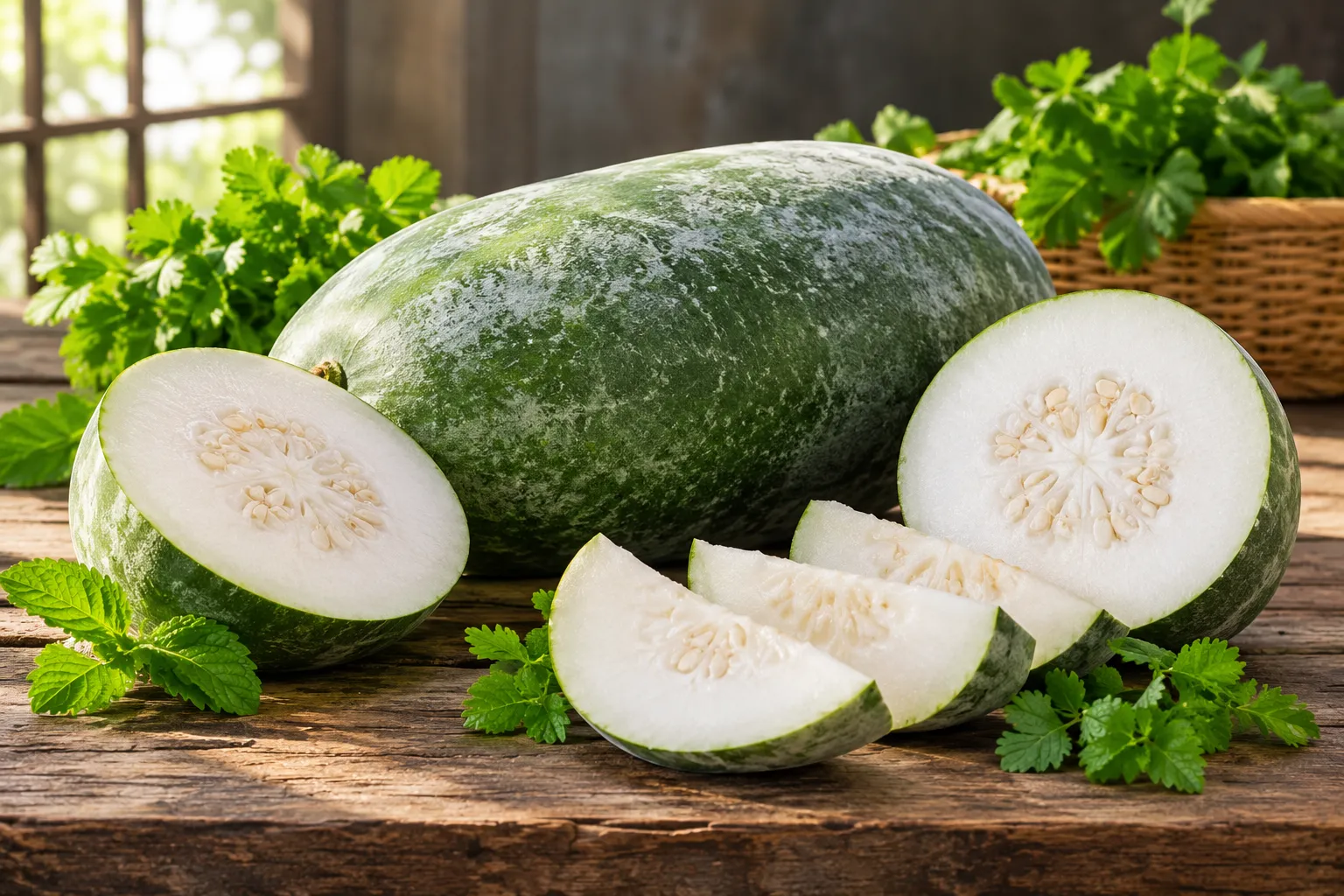
The vegetable can grow to an impressive size, mature specimens commonly reach 12 to 18 inches in length and weigh between 15 and 40 pounds. The flesh is white, firm, and dense, with a central seed cavity similar to a cucumber. It has been cultivated for over 2,000 years and holds a prominent place in both Ayurvedic medicine and traditional Chinese medicine.
Is Ash Gourd the Same as Winter Melon?
Yes. Ash gourd and winter melon are the same vegetable. The name “winter melon” is dominant in Chinese culinary traditions, while “ash gourd” is the standard term in South Asian and botanical contexts. Both refer to Benincasa hispida.
The confusion arises because regional markets often label the same vegetable differently. In a Chinese grocery, you will find it labeled “winter melon” or “dong gua.” In an Indian grocery, the same vegetable may be labeled “ash gourd,” “petha kaddu,” or “kumbalanga.” A Latin American market may carry it under the name “chancle” or not at all.
There is no meaningful culinary difference between the product sold under these names, the flavor, texture, and cooking behavior are identical.
Ash Gourd vs Bottle Gourd: What Is the Difference?
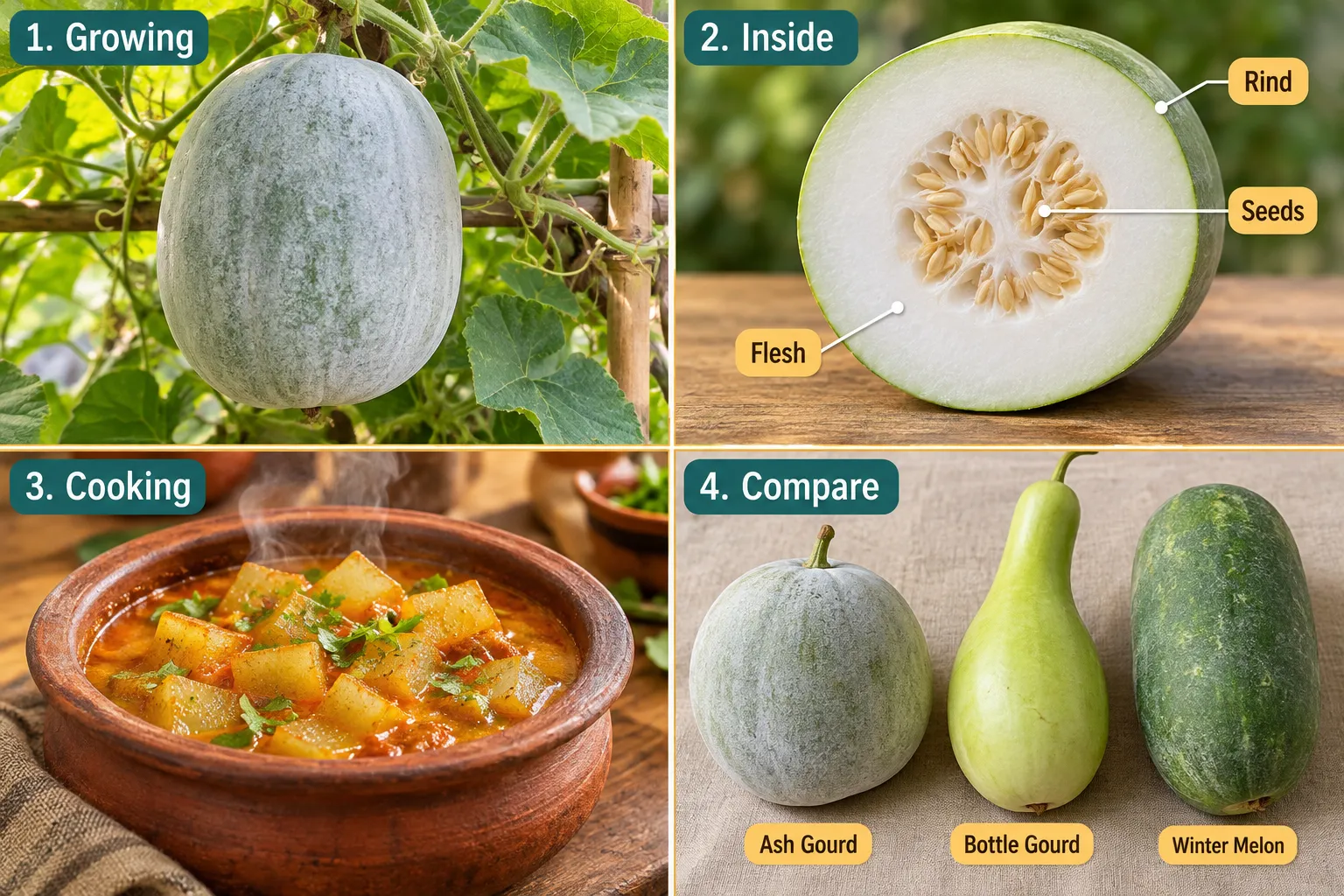
Ash gourd and bottle gourd are related but distinct vegetables. Bottle gourd (Lagenaria siceraria), called “lauki” or “dudhi” in South Asian kitchens, has a smoother, lighter green skin and a more elongated, often bottle-shaped form. Ash gourd has a larger, rounder or oblong shape with a characteristic waxy or dusty coating on the rind.
Key differences at a glance:
| Feature | Ash Gourd | Bottle Gourd |
|---|---|---|
| Scientific name | Benincasa hispida | Lagenaria siceraria |
| Skin appearance | Waxy, pale grey-green | Smooth, light green |
| Typical size | 15-40 lbs at maturity | 1-5 lbs typically |
| Shelf life (whole) | Up to 12 months | 1-2 weeks |
| Primary uses | Curries, soups, candy, juice | Curries, stir-fries, juice |
Both vegetables are high in water content and low in calories, but ash gourd’s exceptional shelf life is a distinguishing practical advantage.
Health Benefits of Ash Gourd
Ash gourd is approximately 96% water by weight and provides a meaningful supply of vitamin C, B-complex vitamins, calcium, and iron with very few calories. Research published between 2015 and 2026 has documented several areas of therapeutic interest, though most robust human trial data remains limited.
Documented and credible properties:
- Digestive support: The high fiber and water content supports bowel regularity and gut motility
- Cooling and hydration: Ayurvedic practice classifies ash gourd as a “cooling” food, appropriate for managing heat-related discomfort and supporting hydration
- Blood sugar modulation (preliminary): Animal studies using lyophilized ash gourd juice have shown antidiabetic and organ-protective effects in prediabetic models. Human trials are small but suggest a signal worth further investigation
- Anti-inflammatory compounds: Phytochemical evaluations have identified flavonoids, saponins, and phenolic acids in both the flesh and peel
- Weight management: At roughly 13 calories per 100 grams of cooked flesh, ash gourd is an effective high-volume, low-calorie food
Important caveat: The 2026 health-communication literature specifically cautions against overstating ash gourd juice benefits based on marketing claims. The evidence is promising but not conclusive enough to position it as a clinical treatment for any condition.
If you enjoy exploring functional ingredient options, 232 Curry Recipes features several preparations where vegetables like ash gourd take center stage in nutritionally balanced dishes.
Is Ash Gourd Good for Weight Loss?
Ash gourd can support a weight-management diet. At approximately 13 calories per 100 grams and high water volume, it creates satiety without significant caloric load.
Practical guidance:
- Use ash gourd as a base for soups and stews in place of starchier vegetables
- Ash gourd juice, consumed plain without added sugar, provides hydration and mild appetite suppression
- It pairs well with lean proteins, making it useful in calorie-controlled meal planning
The vegetable itself does not cause weight loss, but it fits well into a reduced-calorie eating pattern. Avoid adding heavy coconut cream or large amounts of oil in preparations if the goal is caloric control.
Can You Eat Ash Gourd Raw?
Technically yes, but it is rarely eaten raw. The raw flesh is firm, bland, and slightly astringent. It does not have the pleasant crunch of cucumber or the sweetness of raw melon. Most culinary traditions cook ash gourd before eating it, which softens the texture and allows it to absorb seasonings effectively.
The one common exception is ash gourd juice, extracted from raw peeled flesh and consumed as a health tonic. This practice is widespread in Ayurvedic wellness contexts. If consuming raw juice, peel the gourd thoroughly, remove seeds, blend, and strain. Add a small amount of ginger or black pepper to improve palatability.
How to Tell If Ash Gourd Is Ripe
A mature ash gourd ready for harvest will show a fully developed waxy or powdery white coating across the skin, this ash-like bloom is the most reliable indicator of ripeness. Under-ripe gourds have a smooth, dark green skin with no powdery coating.
Additional signs of ripeness:
- The stem connecting the gourd to the vine begins to dry and cork
- The skin resists puncture when pressed firmly with a fingernail
- The gourd sounds hollow when tapped
At market, choose specimens with an even coating, no soft spots, and an intact stem end. Avoid any gourd with cracks, dark discoloration, or a fermented odor.
How Do You Cook Ash Gourd?
Ash gourd cooks well using four primary methods: simmering, stir-frying, steaming, and slow braising. The flesh becomes translucent and tender when cooked, absorbing the flavors of broth, spice, and aromatics with excellent efficiency.
Step-by-step basic preparation:
- Wash the exterior and cut the gourd in half lengthwise using a heavy chef’s knife
- Scoop out the seed cavity with a large spoon and discard seeds (or save for roasting)
- Peel the thick rind with a sturdy vegetable peeler or paring knife
- Cut the flesh into uniform cubes, 1-inch pieces work well for curries and soups
- Rinse once and pat dry before adding to the cooking vessel
Ash gourd needs 15 to 25 minutes of simmering to become fully tender. It does not hold its shape as firmly as potato, so avoid overcooking in liquid-based dishes. If stir-frying, cut thinner (3mm slices) and cook over high heat for 6 to 8 minutes.
Best Ash Gourd Recipes
The most popular and reliable ash gourd preparations across culinary traditions include:
Indian / South Asian:
- Ash gourd curry (Kumbalanga curry): Simmered with coconut milk, mustard seeds, and curry leaves, a Kerala classic
- Petha (Agra sweet): Ash gourd cubes candied in sugar syrup, the famous confection from Agra, India
- Ash gourd sambar: Added to the South Indian lentil stew
Chinese / East Asian:
- Winter melon soup (Dong Gua Tang): A clear broth with pork ribs, dried shrimp, and ginger, served at banquets and family meals alike
- Stuffed winter melon: The whole gourd carved and filled with broth, seafood, and mushrooms, then steamed
Southeast Asian:
- Ash gourd added to Vietnamese and Thai soups as a mild, cooling bulk ingredient
For those who enjoy Asian-influenced curry preparations, the 232 Curry Cookbook is a useful companion resource with detailed spice guidance applicable to ash gourd dishes.
What Can You Use Instead of Ash Gourd?
The best substitutes for ash gourd in cooked dishes are zucchini, chayote (mirliton), or daikon radish. Each replicates different aspects of ash gourd’s character.
- Zucchini: Best for stir-fries and quick-cooked dishes. It has a similar mild flavor but softer texture and shorter cooking time
- Chayote: Best for curries and soups requiring a firmer texture. It holds shape well under heat
- Daikon radish: Best in Chinese-style clear soups. It becomes translucent and mild when simmered
- Bottle gourd (lauki): The closest botanical relative and the most accurate culinary substitute in Indian preparations
None of these will exactly replicate ash gourd’s specific flavor or its long shelf life, but all perform well in cooked preparations.
Where to Buy Ash Gourd
Ash gourd is sold at South Asian grocery stores (Indian, Sri Lankan, Bangladeshi), East Asian grocery stores (Chinese, Vietnamese, Filipino), and large international supermarkets in major metropolitan areas. It is typically available year-round in markets serving large immigrant communities.
Where to look specifically:
- Indian grocery stores (labeled “ash gourd,” “petha kaddu,” or “kumbalanga”)
- Chinese supermarkets (labeled “winter melon” or “dong gua”)
- Vietnamese and Filipino markets
- Online specialty grocers (whole gourds and pre-cut sections)
In smaller cities with limited international grocery access, pre-cut frozen winter melon is widely available in the frozen vegetable section of Asian markets and is a fully acceptable substitute for fresh.
How Long Can You Store Ash Gourd?
A whole, uncut ash gourd stored in a cool, dry, well-ventilated location will keep for up to 12 months. This exceptional shelf life is one of its most practical agricultural advantages and the reason it has historically been valued as a food security crop in tropical regions.
Storage guidelines:
- Whole, uncut: Up to 12 months in a cool, dry place (50-60°F ideal)
- Cut, uncooked: Wrap tightly in plastic wrap and refrigerate; use within 5 to 7 days
- Cooked: Refrigerate in an airtight container and consume within 3 to 4 days
- Frozen (blanched): Up to 6 months in a sealed freezer bag
Once the waxy rind is broken, storage time drops sharply. Never store cut ash gourd at room temperature.
How to Grow Ash Gourd at Home
Ash gourd grows well in USDA hardiness zones 9 through 12 and can be grown as an annual in cooler climates during summer months. It requires full sun, warm soil temperatures above 65°F, and a sturdy trellis or fence to support the heavy fruit.
Basic growing steps:
- Start seeds indoors 3 to 4 weeks before the last frost date
- Transplant seedlings to a prepared bed with well-drained, compost-enriched soil
- Space plants 4 to 6 feet apart; provide a trellis at least 6 feet tall
- Water consistently, ash gourd prefers even moisture but not waterlogged roots
- Fertilize with a balanced vegetable fertilizer at planting, then switch to a low-nitrogen formula once flowering begins
- Fruit typically matures 90 to 120 days after transplanting
- Harvest when the waxy coating is fully developed and the stem begins to dry
Ash gourd vines are vigorous and can extend 15 to 20 feet in a single growing season. Plan space accordingly.
Common Mistakes When Cooking Ash Gourd
Mistake 1: Not peeling deeply enough. The rind of a mature ash gourd is thick and tough. A single pass with a standard peeler often leaves a fibrous green layer that does not soften during cooking. Use a heavy vegetable peeler or a paring knife and remove at least 3mm of rind to reach the clean white flesh.
Mistake 2: Overcooking. Ash gourd turns mushy if simmered too long. Add it to curries and soups in the last 15 to 20 minutes of cooking. For stir-fries, pre-salt the sliced flesh for 10 minutes to draw out excess water, then pat dry before adding to the hot pan.
Mistake 3: Under-seasoning. The flesh is naturally very bland and requires assertive seasoning. Ash gourd does not have the natural sweetness of pumpkin or the sharpness of daikon. Use bold spice bases, mustard seeds, cumin, ginger, garlic, or dried shrimp in Chinese preparations, to bring the dish to life.
Mistake 4: Discarding the seeds. The seeds are edible and nutritious. Clean, dry, and roast them with salt and spices as you would pumpkin seeds. If you enjoy exploring seed-to-table preparation, 630 Pumpkin Recipes offers excellent guidance on cucurbit seed preparation applicable to ash gourd.
Recipe: Classic Ash Gourd Coconut Curry
Recipe Subtitle: A fragrant, coconut-enriched South Indian curry that showcases the delicate flavor of ash gourd.
Recipe Description: This traditional Kerala-style curry pairs mild ash gourd cubes with a rich coconut milk base, tempered with mustard seeds, curry leaves, and dried red chilies. The result is a comforting, lightly spiced dish appropriate for a weeknight dinner or as part of a larger Indian-inspired spread. It is naturally gluten-free, plant-based, and low in calories.
Recipe Keywords: ash gourd curry, kumbalanga curry, winter melon coconut curry, South Indian vegetable curry, gluten-free Indian recipe
Difficulty Level: Easy
Preparation Time: 20 minutes
Cooking Time: 25 minutes
Rest Time: 5 minutes
Cooking Temperature: 350°F (stovetop medium heat equivalent)
Calories: Approximately 140 calories per serving
Best Season: Year-round; particularly well-suited to summer and early autumn
Cooking Methods: Simmering, tempering, sauteing, braising
Cuisines: South Indian, Sri Lankan, Malaysian
Recipe Badges: Gluten-Free, Plant-Based, Low-Calorie
Recipe Keys:
- Peel the rind deeply to avoid fibrous texture in the finished dish
- Add coconut milk off full heat to prevent curdling
- Temper mustard seeds in hot oil until they pop before adding aromatics
Ingredients
- 2 lbs ash gourd, peeled, seeded, cut into 1-inch cubes
- 1 cup full-fat coconut milk
- 1 cup water
- 2 tablespoons coconut oil
- 1 teaspoon black mustard seeds
- 10 to 12 fresh curry leaves
- 2 dried red chilies
- 1 medium yellow onion, finely diced
- 4 cloves garlic, minced
- 1 teaspoon fresh ginger, grated
- 1/2 teaspoon ground turmeric
- 1 teaspoon ground coriander
- 1/2 teaspoon ground cumin
- 1 teaspoon kosher salt, plus more to taste
- 1/2 teaspoon black pepper
- Juice of half a lime
- Fresh cilantro leaves, for garnish
Instructions
- Peel and cube the ash gourd as described in the preparation section above. Set aside.
- Heat coconut oil in a heavy-bottomed pot or Dutch oven over medium heat until shimmering.
- Add mustard seeds and cook until they begin to pop, approximately 30 seconds.
- Add dried red chilies and curry leaves; stand back as the leaves will spatter. Cook 20 seconds.
- Add diced onion and cook, stirring occasionally, until translucent and lightly golden, about 6 minutes.
- Add garlic and ginger; cook 1 minute until fragrant.
- Add turmeric, coriander, and cumin; stir to coat the onion mixture and cook 30 seconds to bloom the spices.
- Add ash gourd cubes and stir to coat with the spice base.
- Pour in 1 cup water and bring to a gentle simmer. Season with salt and pepper.
- Cover and cook 15 minutes until the ash gourd is just tender when pierced with a fork.
- Reduce heat to low. Stir in coconut milk and simmer uncovered for 5 minutes. Do not boil.
- Adjust salt. Finish with lime juice and garnish with fresh cilantro.
- Rest 5 minutes before serving with steamed rice or flatbread.
Equipment
- Heavy-bottomed pot or Dutch oven (4-quart minimum)
- Heavy chef’s knife and sturdy cutting board
- Vegetable peeler or paring knife
- Wooden spoon or silicone spatula
- Measuring cups and spoons
Nutrition Per Serving (based on 4 servings)
| Nutrient | Amount per Serving |
|---|---|
| Calories | ~140 kcal |
| Protein | 2 g |
| Total Fat | 11 g |
| Carbohydrates | 10 g |
| Dietary Fiber | 2 g |
| Sodium | ~380 mg |
Notes
- If ash gourd is unavailable, chayote squash is the best substitute for this recipe. Use the same weight and identical preparation steps.
- For a thicker sauce, mash 4 to 5 cubes of cooked ash gourd against the pot wall and stir back into the curry before adding coconut milk.
- This curry improves with an overnight rest in the refrigerator. The ash gourd absorbs the spiced coconut base and the flavor deepens considerably by day two.
FAQs
Q: Can this curry be made with canned winter melon instead of fresh ash gourd? Canned winter melon (packed in water, not syrup) is an acceptable substitute when fresh is unavailable. Drain and rinse the canned product, then reduce the simmering time in step 10 to 5 minutes, as it is already cooked and will fall apart if overdone.
Q: Is this recipe suitable for a low-sodium diet? The recipe as written contains approximately 380 mg of sodium per serving, primarily from the kosher salt. Reduce salt to 1/2 teaspoon and omit any salted additions to bring sodium closer to 180 to 200 mg per serving without significantly affecting flavor, as the spice base is robust enough to compensate.
Q: Can ash gourd juice be made from the same vegetable used in this recipe? Yes. Before cubing the peeled flesh for the curry, reserve an equal-weight piece, blend it raw with a small amount of water, and strain through a fine-mesh sieve. The resulting juice can be consumed fresh. Add ginger and black pepper if desired.
Q: How does this dish fit into a broader Indian-inspired meal? Ash gourd curry pairs naturally with dal (lentil soup), steamed basmati rice, and a simple raita. For those building out a full Indian-inspired menu, the 232 Curry Cookbook provides structured menu pairings for a range of regional curry styles.
Q: Can the seeds from the ash gourd be used in this recipe? The seeds are not used in this preparation, but they should not be discarded. Clean, dry, and roast them separately at 325°F with salt, cumin, and chili powder for 15 to 20 minutes as a nutritious snack. If you enjoy working with seeds from cucurbit vegetables, the guidance in 630 Pumpkin Recipes applies directly.
Q: Is ash gourd juice safe during pregnancy? Traditional use suggests ash gourd juice is a mild, cooling tonic, but pregnant individuals should consult a physician before introducing medicinal quantities of any plant-based supplement. As a cooked food in normal culinary portions, ash gourd is considered safe and nutritious for most people, including during pregnancy.
Conclusion
Ash gourd is one of the most versatile, nutritionally sound, and underutilized vegetables available to home cooks in 2026. Its exceptional shelf life, mild flavor, and proven adaptability across Indian, Chinese, and Southeast Asian cooking traditions make it a genuinely practical addition to any kitchen.
Actionable next steps:
- Source a fresh ash gourd at the nearest South Asian or East Asian grocery store. If fresh is unavailable, purchase frozen pre-cut winter melon as a starting point.
- Prepare the coconut curry recipe above using the step-by-step instructions. It is an accessible entry point that demonstrates ash gourd’s capacity to absorb and amplify bold flavors.
- Reserve the seeds from the gourd and roast them as a snack, zero-waste cooking at its most practical.
- Explore ash gourd juice as a morning tonic: peel, blend, strain, and consume with fresh ginger. Assess how it fits a personal wellness routine over two to four weeks before drawing conclusions.
- For a broader context in Indian-spiced cooking, the 232 Curry Cookbook and 22 Gluten Free Recipes both provide frameworks well-suited to ash gourd preparations.
The vegetable rewards those who take the time to prepare it properly. Start with one dish, master the peeling technique, and the rest follows naturally.