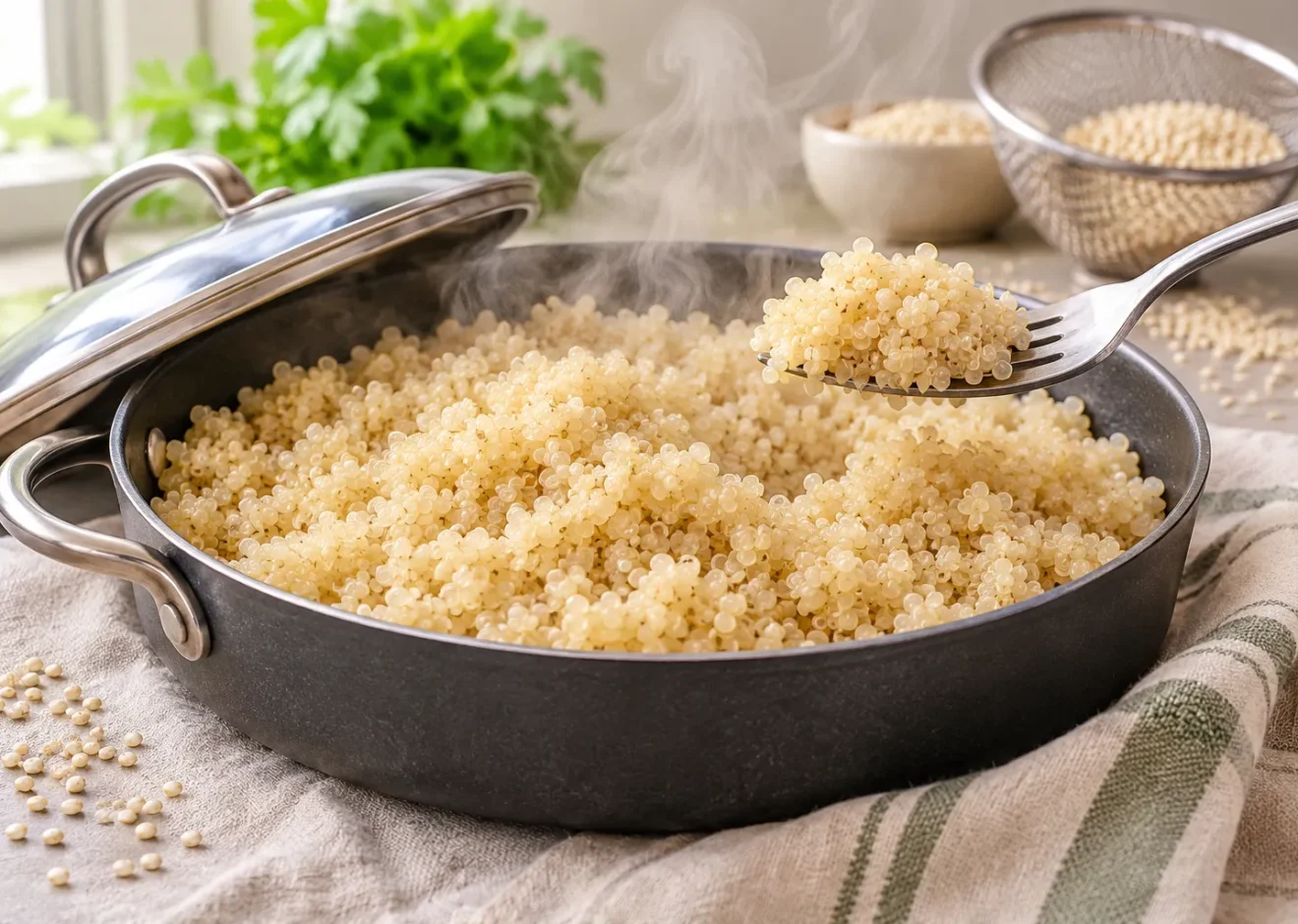
Last updated: November 22, 2026
Quick Answer
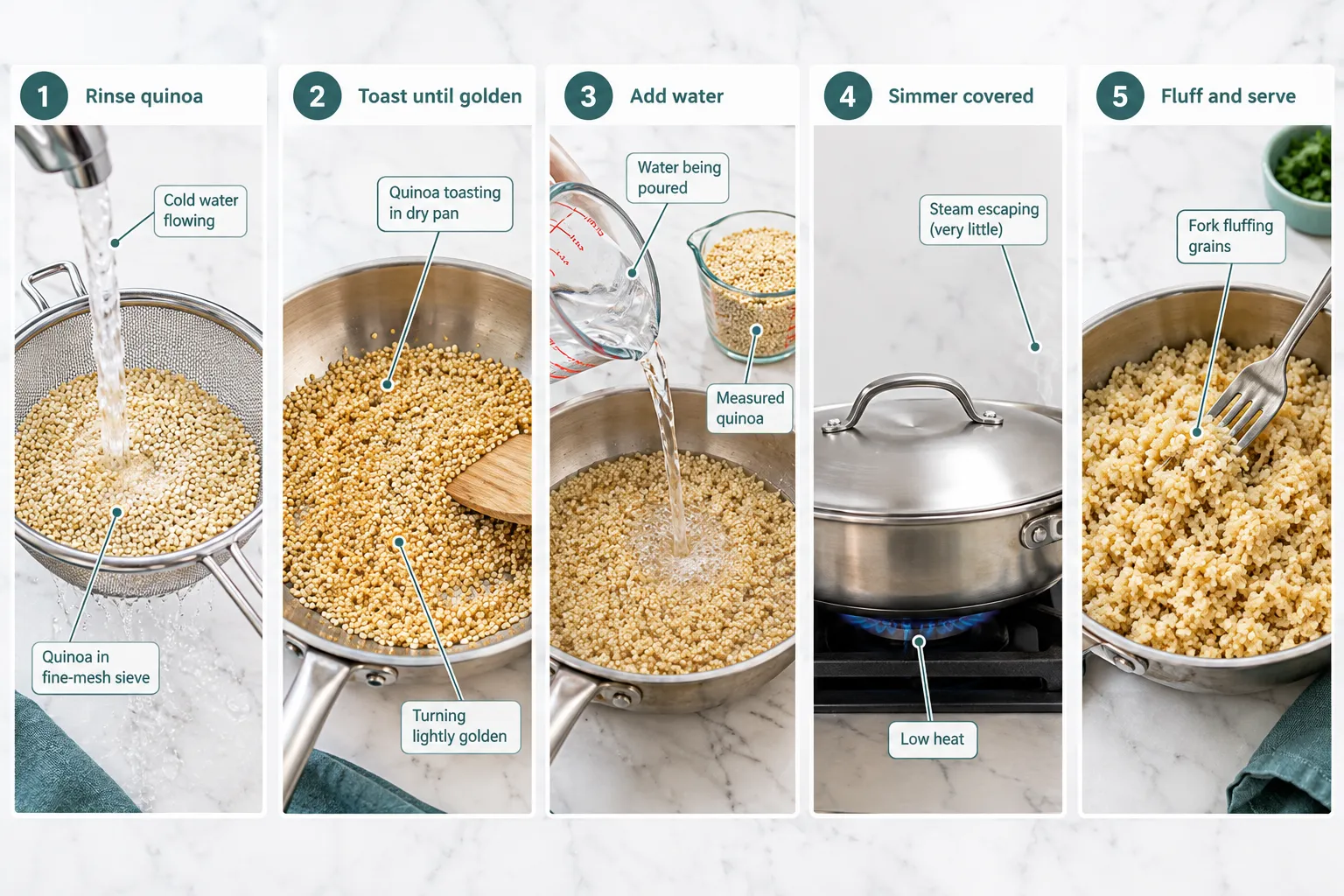
The reliable method for how to cook quinoa so it turns out fluffy every time is less water than the old 1:2 rule: use 1 cup quinoa to 1½,1¾ cups water, rinse the grains in a fine-mesh sieve for about 30 seconds, simmer covered on low for 12-16 minutes without stirring, then rest the pan off heat, still covered, for 10 minutes before fluffing with a fork. The Kitchn revised its ratio to 1:1¾ in 2026 after readers reported gummy results, and NYT Cooking uses 1:1½ for grains that stay distinct [1][2]. The rest is not optional. It’s what turns wet grains into light ones.
Key Takeaways
- Use 1 cup quinoa to 1½,1¾ cups water, not 1:2, unless you want softer grains.
- Rinse for 30 seconds in a fine-mesh sieve to strip bitter saponin coating [3][4].
- Toasting rinsed quinoa for 2-5 minutes in a dry pan adds nutty flavor and helps grains stay separate.
- Simmer on the lowest heat, covered, and do not stir, agitation breaks grains and releases starch [5][6].
- White quinoa needs 12-16 minutes; red and black need 18-22 minutes [7].
- Rest covered off heat for 5-10 minutes, then fluff with a fork, not a spoon [6].
- Doneness cue: a tiny white germ tail curls free from each seed [1][2][3].
- Quinoa is naturally gluten-free and cooks in roughly half the time of brown rice.
- Plan on ¼ cup dry quinoa per person as a side, ½ cup as a main.
What’s the perfect water to quinoa ratio?
Use 1 cup quinoa to 1½ cups water for salad-ready grains with bite, or up to 1¾ cups for a softer, pilaf-style texture. The old 1:2 ratio still appears on packages and on sites like Food & Wine, but it leaves extra moisture that the grains absorb as they sit, which is the main cause of gumminess [6]. The Kitchn specifically dropped from 2 cups to 1¾ cups after reader complaints [1].
)
| Target texture | Water per 1 cup quinoa | Best for |
|---|---|---|
| Firm, separate grains | 1½ cups | Salads, grain bowls, meal prep |
| Medium, slightly soft | 1¾ cups | Side dishes, pilafs |
| Soft and creamy | 2 cups | Breakfast porridge, baby food |
In metric, 200 ml water per 100 g quinoa tracks closely with the 1:1¾ range [7]. Choose 1:1.5 if you’re cooking ahead and the grains will sit in dressing; choose 1:1.75 if you’re serving straight from the pan.
There’s also a method that sidesteps ratios entirely. Simply Recipes tested three approaches in April 2026 and found that boiling quinoa like pasta in plenty of salted water, draining it, then returning it to the dry pot covered for 10 minutes gave the lightest result of the three [8]. Worth using when you’re cooking a large batch and don’t want to measure.
Do you have to rinse quinoa before cooking?
Yes, unless the bag says pre-rinsed, and even then a quick rinse costs nothing. Quinoa seeds carry saponin, a natural bitter coating that protects the plant from birds and insects. Thirty seconds in a fine-mesh sieve under cold running water, agitating the grains with your fingers, removes it [3][4].
Common mistake: rinsing in a colander with holes big enough for the seeds to escape. Use a fine-mesh sieve. If you only own a coarse colander, line it with a clean thin kitchen towel.
Shake the sieve hard afterward. Carrying 2 tablespoons of clinging rinse water into the pot throws off the ratio you just measured carefully.
Should you toast quinoa, and what other flavor upgrades work?
Toasting rinsed quinoa in a dry or lightly oiled pan for 2-5 minutes, until it smells nutty and looks faintly golden, improves flavor and helps the grains hold their shape. The moisture from rinsing cooks off first, then the seeds begin to pop and crackle. That’s your cue to add liquid.
Flavor upgrades, in order of payoff:
- Salt the water, ½ teaspoon per cup of dry quinoa. Unsalted quinoa tastes like cardboard.
- Swap water for broth, chicken or vegetable stock, same volume.
- Add aromatics to the pot, a smashed garlic clove, a bay leaf, a strip of lemon peel. Remove before fluffing.
- Finish with acid and fat, lemon juice and olive oil stirred in after fluffing, while the grains are still warm.
- Fold in greens off heat, residual steam wilts them perfectly; see the spinach cookbook collection for pairings.
How long should quinoa actually cook?
White quinoa needs 12-16 minutes at a bare simmer; red and black quinoa need 18-22 minutes because their seed coats are denser [7]. Add 5-10 minutes of covered resting off heat to every version. NYT Cooking cooks covered on low for about 15 minutes, then rests for 10 [2].
Time is a guide, not the test. Pull the pan when:
- The water is fully absorbed (tilt the pan and check the edge).
- Grains look tender and slightly translucent.
- The tiny white germ has separated and curls around each seed like a comma [1][2][3].
Edge case: if the water is gone but the grains are still crunchy, add 2 tablespoons of hot water, cover, and give it 3 more minutes on the lowest heat.
Why does my quinoa come out mushy?
Mushy quinoa almost always traces to one of four things: too much water, heat that’s too high, stirring during the simmer, or skipping the rest. Stirring drags starch off the grains and creates the same gluey effect as over-stirred risotto, which is why both Food & Wine and EatingWell tell you to leave the pot alone [5][6].
| Problem | Cause | Fix next time |
|---|---|---|
| Gummy, clumped | Water ratio too high | Drop to 1:1.5 |
| Broken, pasty grains | Hard boil or frequent stirring | Lowest heat, lid on, no stirring |
| Wet bottom layer | No resting period | Rest covered 10 minutes |
| Bitter aftertaste | Saponin not rinsed off | Rinse 30 seconds in fine mesh |
| Crunchy centers | Lid lifted, steam lost | Keep covered the whole simmer |
Rescue for a batch that’s already wet: spread it on a sheet pan in a thin layer for 10 minutes. Surface moisture evaporates and the grains firm up noticeably.
What are the signs that quinoa is overcooked?
Overcooked quinoa loses its individual grain structure. The germ tails detach and float free instead of curling around the seed, the seeds flatten and smear when pressed, and the mass holds a spoon upright. Properly cooked quinoa separates into loose grains when you drag a fork through it.
Taste is the other tell. Overcooked quinoa tastes flat and slightly pasty; correctly cooked quinoa has a faint snap in the center. If you’ve gone too far, stop trying to save it as a side and use it as a binder in veggie burgers or stirred into soup.
Can you cook quinoa in a rice cooker?
Yes, and it’s one of the more forgiving methods. Use the same 1:1½ to 1:1¾ ratio, add rinsed quinoa and salted liquid, and run the white rice setting. Most cookers finish in 20-25 minutes and switch to warm automatically, which doubles as the resting stage.
Decision rule: use a rice cooker when you’re cooking more than 2 cups dry, or when the stove is full. Use the stovetop when you want to toast the grains first, since few rice cookers brown well. An Instant Pot works too at 1 minute high pressure with 10 minutes natural release, though the texture runs slightly softer.
White quinoa vs red quinoa: what’s the difference?
White (sometimes labeled ivory or golden) quinoa is the mildest and softest, cooking in 12-16 minutes. Red quinoa is nuttier, chewier, and holds its shape best in salads, needing 18-22 minutes. Black quinoa is the earthiest and firmest, also 18-22 minutes [7].
- White, breakfast bowls, anything where you want a soft bed under a saucy main.
- Red, cold grain salads that sit in vinaigrette for hours without going soft.
- Black, color contrast, roasted vegetable bowls.
- Tricolor blends, look good but cook unevenly; the white grains soften before the black ones finish. Treat the bag as red quinoa and accept some softness.
How is quinoa different from rice, and is couscous easier?
Quinoa is a seed, not a grain, and it’s a complete protein with roughly twice the protein of white rice per cooked cup. It cooks in about half the time of brown rice (15 minutes versus 40-45) and needs less water. Rice absorbs flavor more neutrally; quinoa brings its own grassy, nutty character.
Couscous is easier, technically. It’s small pasta, not a grain, and most instant versions need only boiling liquid poured over, a lid, and 5 minutes. But couscous contains wheat, so it’s off the table for gluten-free eaters, and it has less protein and fiber.
Choose couscous for speed. Choose quinoa when you want the dish to carry protein on its own, or when gluten is a concern.
Both work alongside the same mains, from a collection of fish recipes to grilled and pan-seared chicken dishes.
Can you make quinoa ahead of time and reheat it?
Yes. Cooked quinoa keeps 5 days refrigerated and 3 months frozen, and it reheats better than most grains because its low starch content means it doesn’t turn to paste. Cool it uncovered on a sheet pan before storing so trapped steam doesn’t soften it.
To reheat:
- Microwave, add 1 tablespoon water per cup, cover loosely, 60-90 seconds, fluff.
- Skillet, a little oil over medium heat, 3-4 minutes, which crisps the edges.
- From frozen, freeze flat in portioned bags; reheat straight from frozen in the microwave for 2-3 minutes.
For meal prep, cook it at 1:1.5 and dress it cold. Quinoa absorbs vinaigrette as it sits, so slightly firm grains on day one are right on day three.
Is quinoa good for weight loss, and does it have gluten?
Quinoa is naturally gluten-free, since it comes from a plant related to spinach and beets rather than wheat. People with celiac disease should still check for a certified gluten-free label, because quinoa is often processed in facilities that handle wheat.
On weight loss: quinoa is not a fat-burning food, but its protein and fiber content make it more filling per calorie than white rice or couscous, which helps with portion control. A cooked cup runs roughly 220 calories. Portion matters more than the swap itself.
How much quinoa should you cook per person, and where can you buy it cheap?
Plan on ¼ cup dry quinoa per person for a side dish and ½ cup dry for a main. Dry quinoa roughly triples in volume, so 1 cup dry yields about 3 cups cooked.
| Dry quinoa | Water (1:1.5) | Cooked yield | Serves (side) |
|---|---|---|---|
| ½ cup | ¾ cup | 1½ cups | 2 |
| 1 cup | 1½ cups | 3 cups | 4 |
| 2 cups | 3 cups | 6 cups | 8 |
Cheapest sources, in rough order: warehouse clubs like Costco and Sam’s Club (often under $5 per pound in 4-5 lb bags), co-op and natural grocery bulk bins where you can buy exactly what you need, online bulk retailers such as Azure Standard or Bulk Barn in Canada, and store-brand bags at Aldi or Trader Joe’s. Buy whole-seed quinoa rather than pre-seasoned pouches; the markup on those is steep. Store it airtight in a cool cupboard, where it keeps 2-3 years.
For more pantry-staple techniques, browse the cooking tag archive or the everyday easy recipe collection. Quinoa also pairs well with the dishes in the bean recipe collection.
FAQ
Can you cook quinoa without rinsing it? You can, but it may taste bitter or soapy from the saponin coating. Pre-rinsed brands are safe to use straight from the bag.
Why is my quinoa still crunchy? Either the lid was lifted and steam escaped, or the liquid ran out early. Add 2 tablespoons hot water, cover, and cook 3 more minutes on low.
Should you stir quinoa while it cooks? No. Stirring releases starch and breaks the grains, which creates a gummy texture [5][6].
Fork or spoon for fluffing? A fork. The tines separate grains; a spoon presses and compacts them [6].
What’s the quinoa to water ratio in metric? About 200 ml water per 100 g quinoa, which matches the 1:1¾ cup ratio [7].
Do red and white quinoa cook for the same time? No. White takes 12-16 minutes, red and black take 18-22 minutes [7].
Is quinoa safe for celiac disease? Quinoa contains no gluten, but choose a certified gluten-free label to rule out cross-contamination during processing.
How long does cooked quinoa keep? Five days in the refrigerator in an airtight container, or three months frozen in flat portioned bags.
Can you toast quinoa that hasn’t been rinsed? It will toast, but the bitterness stays. Rinse first, then toast off the residual water.
Conclusion
Write this on a sticky note inside your cupboard: rinse 30 seconds, 1 cup quinoa to 1½ cups salted water, lowest heat covered 15 minutes, no stirring, rest 10 minutes off heat, fluff with a fork. Those six steps handle every batch.
Next steps worth taking this week: cook one batch at 1:1.5 and one at 1:1.75 so you learn which texture you actually prefer, buy a fine-mesh sieve if you don’t own one, and pick up a bag of red quinoa to keep alongside white for cold salads. Then cook 2 cups dry on a Sunday, cool it on a sheet pan, and portion it for the week.
References
- How to Cook Quinoa Cooking Lessons From the Kitchn 63344. thekitchn.com.
- 1024861 Quinoa. cooking.nytimes.com.
- How to Cook Quinoa. simplyrecipes.com.
- How to Cook Quinoa. loveandlemons.com.
- How to Cook Quinoa. eatingwell.com.
- How to Cook Quinoa 7558012. foodandwine.com.
- How to Cook Quinoa. gourmandelle.com.
- Best Way to Cook Quinoa 11942625. simplyrecipes.com.