Last updated: November 22, 2026
Quick Answer
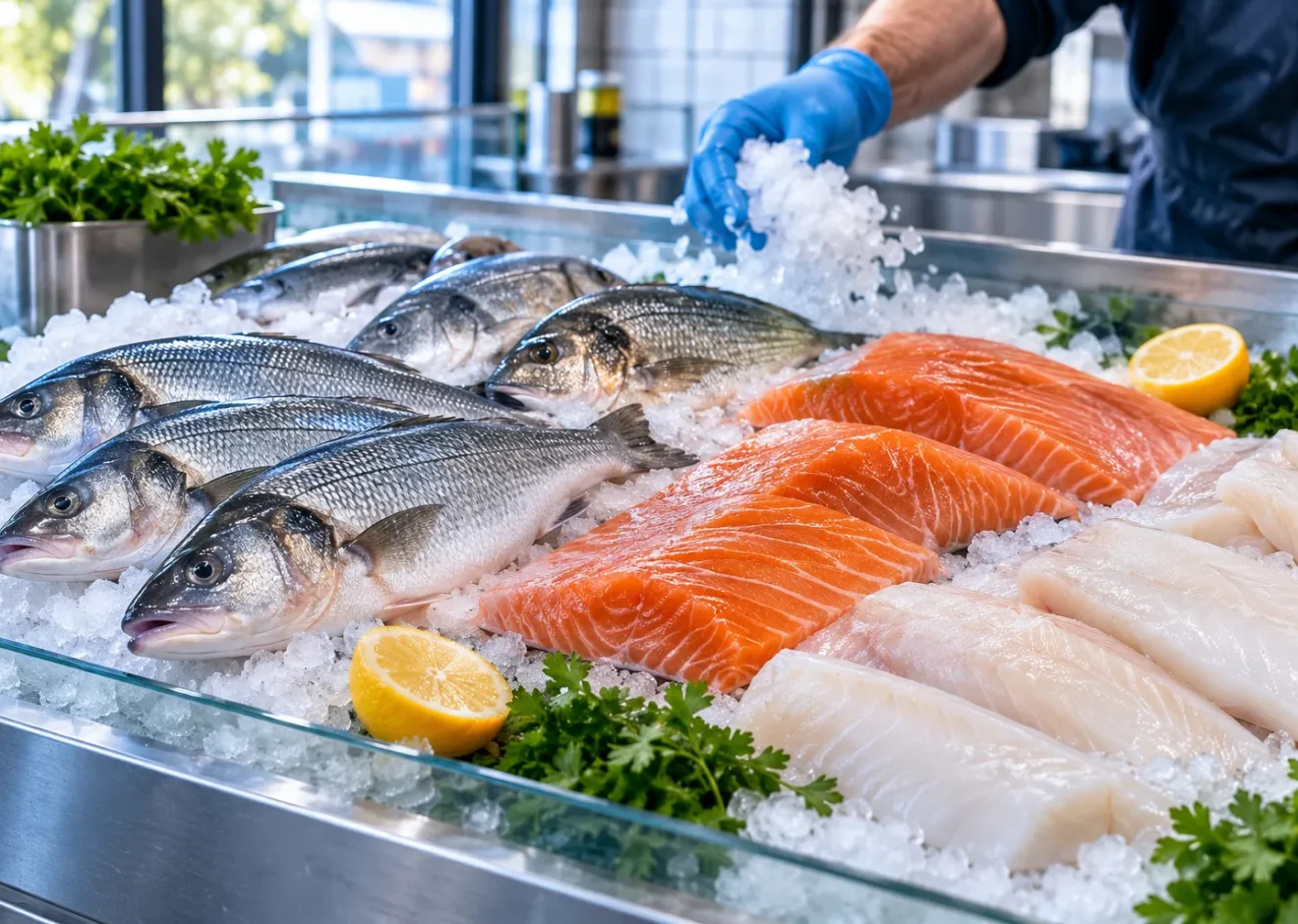
The best ways to buy fresh fish start with the counter, not the fish: shop where seafood sits on a thick bed of fresh ice in a clean, covered case, and where the air smells briny rather than sour [1][2]. Check for clear eyes, red gills, firm springy flesh and even colour, then ask the fishmonger when the fish arrived and how it was caught [1][3]. Buy seafood last on your shopping trip, carry it home in a cooler, and cook or freeze it within about two days [4]. Frozen-at-sea fillets are often fresher than “fresh” fish that has been in a display case for three days.
Key Takeaways
- Fresh fish smells mild and briny. Sour, ammonia-like or strongly fishy odours mean walk away [1][5].
- Whole fish are easier to judge than fillets because eyes, gills and skin all give independent clues [1][3].
- Fillets should look evenly coloured and glossy, with no browning, drying or gaping along the edges [2][3].
- A good fish counter has fish bedded deep in fresh ice, space between pieces, and no pooled liquid underneath [2][5].
- Wild-caught and farmed can both be good choices; the catch or farming method matters more than the label.
- Use fresh fish within about two days and store it in the coldest part of the fridge, near 32°F (0°C) [4].
- Frozen fish works in nearly every cooked recipe and often costs less.
- Cook fish to 145°F (63°C), until it’s opaque and flakes [6][7].
- Mid-week deliveries are common, so Tuesday through Thursday often beats Monday at most counters.
How do I know if fish is actually fresh at the store?
Judge freshness with your nose first, then your eyes, then your finger. Fresh fish smells clean and faintly of seawater; whole fish should have bright, clear, slightly bulging eyes, red gills with no odour, and firm flesh that springs back when pressed [1][3][5].
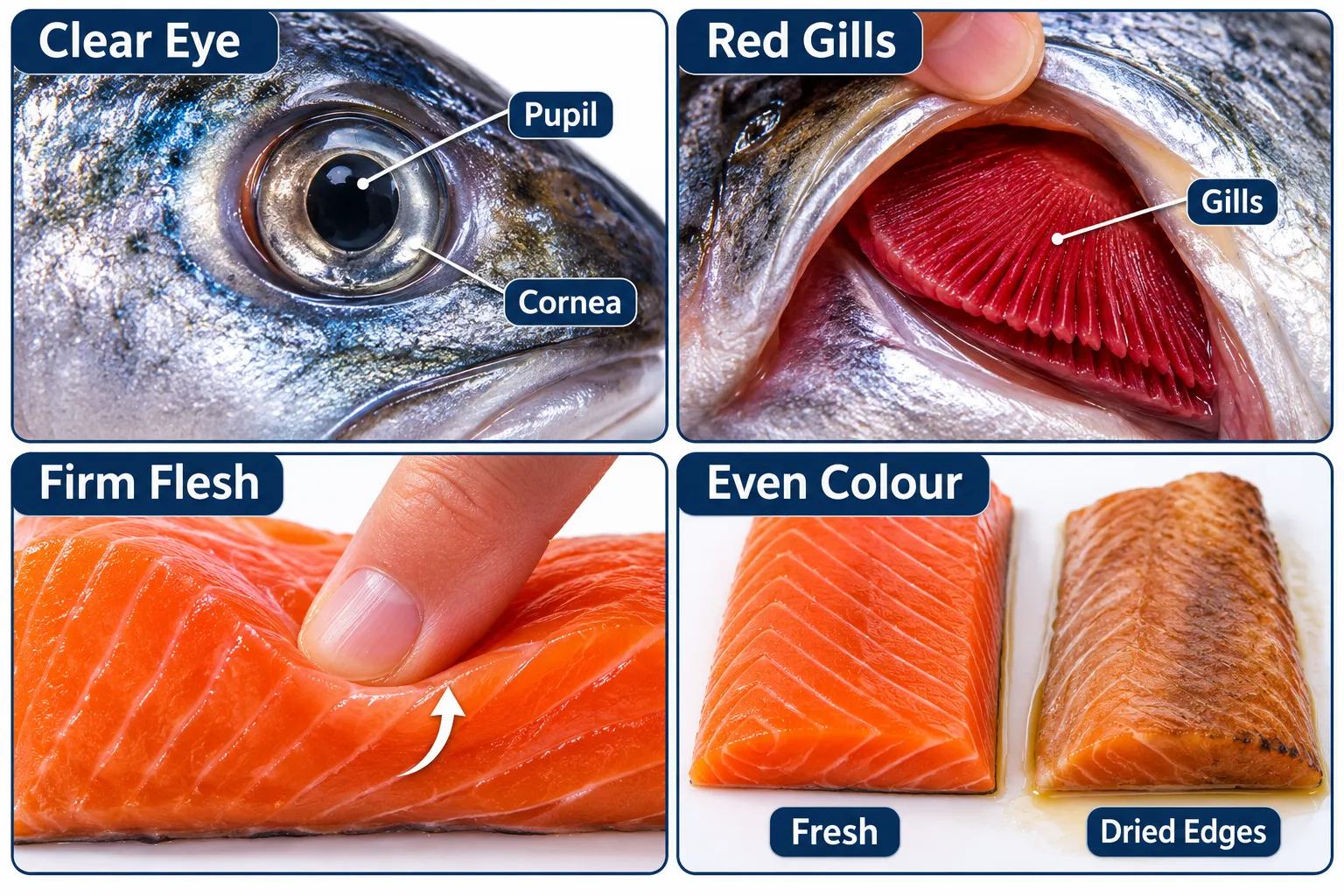
Run through this order at the counter:
- Smell the case, not just the fish. A clean briny smell is right. Ammonia or sourness is a hard no [1][5].
- Look at colour. Salmon should be bright orange, white fish bright and glowy, not dull or grey [2][3].
- Check the edges. Dark, dried or curling edges on a fillet mean it has been cut for a while [3].
- Press it (ask first). The dent should disappear. Flesh that stays indented is breaking down [2][3].
- Ask when it came in. A fishmonger who can’t answer is a reason to buy something else.
Common mistake: trusting a pretty display. Fillets fanned out on a thin, melting ice layer with liquid pooling under them have been sitting there, however nicely they’re arranged [2][5].
How to tell if a whole fish is fresh versus fillets
Whole fish give you more evidence. Eyes, gills, skin and belly cavity each spoil at different rates, so you can cross-check; a fillet only offers colour, texture and smell [1][3].
| What to check | Whole fish | Fillet |
|---|---|---|
| Eyes | Clear, shiny, domed | Not available |
| Gills | Bright red, no odour | Not available |
| Skin | Shiny, intact scales, moist sheen | Skin-on only |
| Flesh | Firm, springs back | Firm, springs back |
| Edges | Belly cavity clean, not bloated | No browning or gaping |
Choose whole fish if you want maximum confidence, better value per pound, and bones for stock. Choose fillets if you’re short on time or cooking for one. Most counters will gut, scale and fillet a whole fish free, so you get both.
Best place to buy fresh fish near me, and is a fish market better than a grocery store?
A dedicated fish market usually wins on turnover and knowledge, but a busy supermarket with a high-volume seafood counter can match it. What matters is how fast the fish moves and how well it’s handled, not the sign over the door [1].
Ranked by typical reliability:
- Independent fishmonger or market near a working port. Highest turnover, best advice, often whole fish.
- Asian and Latin American grocers. Frequently excellent whole-fish selection and fast rotation at lower prices.
- Warehouse clubs and big supermarkets. Strong on frozen-at-sea and vacuum-packed fillets.
- Mail-order shippers. Good for sushi-grade and hard-to-find species, shipped frozen or on ice [3][13-equivalent sourcing applies].
- Small-town supermarket counters with little traffic. Where “fresh” fish is most likely to be thawed and aging.
Decision rule: if the counter staff can tell you the boat, the port or the delivery day, buy there. If they shrug, buy the frozen bag instead.
How much should I expect to pay for fresh fish?
Prices vary widely by region and season, so judge value by category rather than a fixed number. In most U.S. markets, farmed tilapia, catfish, basa and pollock sit at the low end, farmed salmon, cod, haddock and rainbow trout in the middle, and wild king salmon, halibut, swordfish and tuna loin at the top.
Ways to spend less without dropping quality:
- Buy whole and have it filleted; you pay less per pound of edible meat even after yield loss.
- Choose the species that was landed in volume that week instead of the one you had in mind.
- Switch to frozen-at-sea for anything you’ll braise, bake, fry or curry.
- Use trimmings and frames for stock, which turns one purchase into two meals.
What’s the difference between wild-caught and farmed fish?
Wild-caught fish are harvested from the ocean or lakes; farmed fish are raised in pens, ponds or tanks. Neither is automatically better for taste, safety or the environment, so the useful question is how it was caught or farmed [8][9].
Ask two things at the counter: how was it caught, and where? Favour methods labelled pole and line, handline, or rod and reel, and look for Marine Stewardship Council (MSC) or Aquaculture Stewardship Council (ASC) certification [9]. Monterey Bay Aquarium’s Seafood Watch sorts species into green “best choice” and yellow “good alternative” tiers, and highlights options like U.S. pole-caught albacore, Alaskan cod and crab, and U.S. or Canadian wild salmon [9].
Flavour differences are real. Farmed salmon is fattier and more forgiving on a grill; wild sockeye is leaner and overcooks faster. For species-by-species cooking ideas, our collection of 184 fish recipes covers both.
Signs that fish has gone bad or is spoiled
Discard fish that smells sour, ammonia-like or strongly fishy, feels slimy or mushy, has dull sunken eyes or grey-brown gills, or shows browning and gaping along the fillet [1][5].
Spoilage signals, in the order they usually appear:
- Smell turns sharp or sour (earliest and most reliable sign)
- Surface gets a sticky, milky film
- Colour fades; red bloodlines go brown
- Flesh separates into gaping flakes
- Finger pressure leaves a permanent dent
For frozen packages, reject anything with rips or tears, ice crystals on the fish itself (a sign of thawing and refreezing), or dried, discoloured patches [1][5].
Smell beats every other test. If your nose objects, the fish is done, no matter how fresh the sell-by date looks.
How long can you keep fresh fish in the fridge, and how do you store it at home?
Use fresh fish within about two days of purchase, stored in the coldest part of the refrigerator as close to 32°F (0°C) as you can get [4]. Beyond that, freeze it.
NOAA’s handling guidance comes down to three habits: keep it cold, keep it moving, and keep it clean [4][15-equivalent guidance]. In practice:
- Buy seafood last on your shopping trip and bring a cooler with ice packs [1][4].
- At home, unwrap it and set the fish on a rack over a plate or shallow pan.
- Cover loosely, then pack ice or frozen gel packs around and under the plate.
- Drain melted water daily so the fish never sits in liquid.
- Store raw fish on the bottom shelf, below ready-to-eat food, to prevent drips.
To freeze: pat dry, wrap tightly in plastic then foil or vacuum-seal, label with the date, and thaw overnight in the fridge rather than on the counter.
Can I use frozen fish instead of fresh in recipes?
Yes, for almost any cooked preparation. Fish frozen at sea within hours of the catch is often higher quality than a “fresh” fillet that has been thawed and displayed for several days.
Frozen works well for baking, roasting, chowders, curries, tacos, fish cakes and anything battered. It’s less suited to raw dishes and delicate crudo, and thin fillets like sole can soften after freezing. Thaw in the fridge overnight, never in warm water, and dry the surface thoroughly before it hits a hot pan. Shellfish follows similar rules; our 114 seafood recipes include plenty that start from frozen.
Is sushi-grade fish different from regular fresh fish?
“Sushi-grade” and “sashimi-grade” are marketing terms, not regulated U.S. grades. In practice they signal a seller’s judgment that the fish was handled and frozen for raw consumption, usually frozen hard at very low temperatures to address parasites.
If you want to serve raw fish at home:
- Buy from a seller who explicitly sells for raw service and can say how the fish was frozen.
- Prefer species with strong safety records, such as farmed salmon handled for raw use and commercially frozen tuna.
- Avoid large predatory reef fish over about 5 pounds, especially barracuda, because of toxin risk [6][7].
- Keep it below 40°F until the moment you slice, and use the same day.
When in doubt, cook it to 145°F (63°C), until the flesh is opaque, flakes easily, and no longer looks gelatinous [6][7].
What types of fish are easiest for beginners to cook?
Start with firm, medium-fat fillets that tolerate slight overcooking: salmon, Arctic char, rainbow trout, mahi-mahi, cod loin and barramundi.
- Most forgiving: salmon and trout. Fat buffers timing errors.
- Firmest: mahi-mahi and swordfish. They won’t fall through a grill grate.
- Mildest: cod, haddock, tilapia. Good for picky eaters, but they flake apart if moved too soon.
- Save for later: sole, flounder, skate and whole fish over two pounds.
Buy fillets at least ¾-inch thick while you’re learning; thin pieces go from done to dry in under a minute. A sauce covers most sins, and our best dipping sauces collection pairs well with simple pan-seared fillets.
Common mistakes people make when buying fish, and the best day of the week to buy
The most common mistake is deciding what to cook before shopping, then buying whatever version of that species is in the case. Buy the best-looking fish available and choose the recipe afterward.
Other frequent errors:
- Shopping at the start of the trip so the fish warms for 40 minutes in the cart [4].
- Treating “previously frozen” as a defect; it’s usually a plus.
- Ignoring the case itself: thin ice, crowded fillets, pooled liquid [2][5].
- Not asking for the fish to be cut fresh from a loin, which most counters will do.
- Letting fish sit three or four days “because it still smells fine.”
Best day to buy: Tuesday through Thursday at most counters, because deliveries typically land mid-week and Monday stock is often left from the weekend. The real answer is whichever day your specific shop takes delivery, so ask once and shop that day from then on. Markets near a working harbour can be good any day the boats land.
Related reading
- 184 fish recipes for every species
- 114 seafood recipes for home cooks
- Food and drink awareness days calendar
FAQ
Does fresh fish ever smell fishy? No. Fresh fish smells mild and briny. A strong fishy, sour or ammonia odour means the fish is past its prime [1][5].
How cold should my fridge be for storing fish? As close to 32°F (0°C) as possible, in the coldest part of the refrigerator, with fish kept on ice [4].
Is previously frozen fish worse than fresh? Usually not. Fish frozen shortly after the catch often beats fresh fillets that have been displayed for several days.
What internal temperature should cooked fish reach? 145°F (63°C), at which point the flesh is opaque, flakes easily and is no longer gelatinous [6][7].
Should I rinse fish before cooking? No. Rinsing spreads bacteria around the sink. Pat it dry with paper towels instead.
Are ice crystals on frozen fish a problem? Ice crystals on the fish itself suggest it partially thawed and was refrozen, which hurts texture. Choose tightly sealed packages without them [1][5].
Can I refreeze fish I thawed in the fridge? You can if it stayed below 40°F and is still firm and odour-free, but texture suffers. Cooking it first, then freezing, is better.
Which fish should I avoid serving raw at home? Large predatory reef fish over about 5 pounds, especially barracuda, because of toxin risk [6][7].
How much fish should I buy per person? Plan on 6 to 8 ounces of fillet per adult, or about 1 pound of whole fish per person after head, bones and trim.
Do certifications like MSC and ASC matter? They’re a useful shortcut when you can’t ask about the specific boat or farm, covering wild fisheries (MSC) and aquaculture (ASC) [9].
Conclusion
Pick one shop and learn its delivery day. Ask the counter when the fish arrived and how it was caught; the quality of the answer tells you as much as the fish does. Bring a cooler, buy seafood last, and get it onto ice within the hour. Then cook it within two days, or freeze it the night you bring it home.
Start with a thick salmon or cod fillet this week, cook it to 145°F, and pay attention to how it looked and smelled at purchase. That comparison teaches more than any checklist.
References
- Selecting and Serving Fresh and Frozen Seafood Safely. fda.gov.
- How to Buy Fish a Chef and Dietitians Guide. healthecooks.com.
- How to Buy Fresh Fish. foodandwine.com.
- How Store and Handle Seafood. fisheries.noaa.gov.
- How to Safely Store Fish. webmd.com.
- Russo Safe Seafood. buffalo.edu.
- Russo Tipsheet Eat Seafood Safely. buffalo.edu.
- Sustainable Seafood. fisheries.noaa.gov.
- 7 Rules for Choosing Sustainable Seafood. oceanicsociety.org.