Last updated: November 22, 2026
Quick Answer
How to cook lentils comes down to three decisions: pick the variety that matches your dish, simmer in 2½ to 3 cups of liquid per cup of dry lentils, and taste early. Red and yellow lentils collapse into soup in 10 to 20 minutes; brown and green hold their shape at 20 to 30 minutes; French Puy and black beluga need 25 to 45 minutes and stay firmest [1][2]. No soaking required. Salt near the end if you want them very tender.
Key Takeaways
- Match the lentil to the dish. Red and yellow for soups and dals, brown and green for stews and sides, French and black for salads.
- Liquid ratio: 2½ to 3 cups water or broth per 1 cup dry lentils for stovetop simmering [2][3].
- Timing by type: red/yellow 10-20 min, brown/green 20-30 min, black 20-30 min, French Puy 25-45 min [1][4].
- Skip the soak. Lentils cook fine dry; a short soak shaves a few minutes but is never required [4].
- Rinse and sort first. Spread them in a colander, pick out stones and shriveled bits, rinse under cold water.
- Aim for al dente. Tender with slight resistance in the center is the target for anything that isn’t a purée [5].
- Old lentils cook slower. Published times are approximations; a bag two years old can take twice as long [6].
- Instant Pot: 1-2 minutes for red/yellow, 6-7 for black, 8-10 for brown/green at high pressure [1].
- Storage: 4 to 5 days refrigerated, up to 6 months frozen in portioned bags.
What are the different types of lentils and how do they taste?
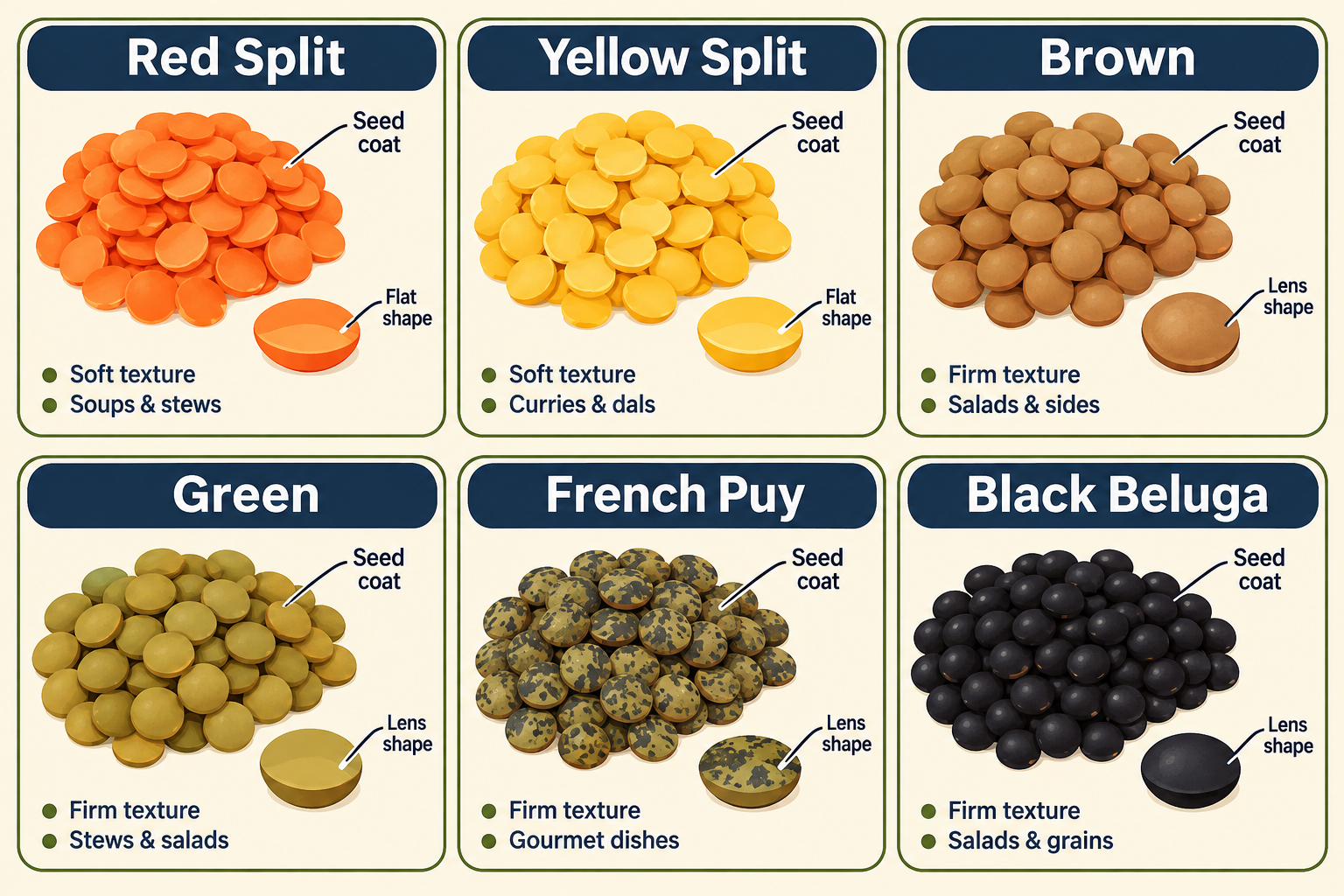
Lentils fall into roughly five categories, and the dividing line is whether the seed coat is intact. Split red and yellow lentils have had theirs removed, so they break down fast and taste mild and slightly sweet. Whole lentils keep their skins, hold their shape, and taste earthier.
| Lentil | Flavor | Texture when cooked | Best for |
|---|---|---|---|
| Red / yellow (split) | Mild, sweet, nutty | Collapses to purée | Dal, soup, thickening stews [7] |
| Brown | Earthy, mushroomy | Soft, mostly intact | Stews, meatless loaves, tacos |
| Green (whole) | Peppery, firm | Chewy, holds shape | Salads, grain bowls |
| French (Puy) | Mineral, peppery | Firm with bite | Cold salads, plated sides |
| Black beluga | Rich, slightly sweet | Firmest, glossy | Salads, garnish, warm sides |
Decision rule: if the lentils need to be visible as individual pieces on the plate, buy French or black. If they’re disappearing into liquid, buy red.
What’s the difference between red, brown, and green lentils?
Red lentils are split and skinless, so they cook in about 10 to 20 minutes and fall apart completely [1][6]. Brown lentils keep their skins and cook in 20 to 25 minutes, ending soft but still recognizable. Green lentils are the firmest of the three and can take 20 to 30 minutes on the stove, sometimes closer to 45 for older or larger varieties [6][8].
A practical consequence: you can’t swap them one-for-one. Substituting red lentils in a lentil salad gives you mush. Substituting green in a dal leaves you with soup full of pebbles. Brown is the compromise if you only keep one bag, which is why it’s the standard supermarket default.
Do you need to soak lentils before cooking them?
No. Lentils are small and thin-skinned enough to hydrate as they simmer, unlike dried beans [4]. Rinsing and sorting is the only prep that matters.
- Spread the dry lentils in a sieve or on a baking sheet and scan for small stones, clumps of dirt, or broken shells [4].
- Rinse under cold running water until the water runs clear.
- Skip soaking entirely unless you want to trim 5 to 10 minutes off older green or Puy lentils.
Edge case: if you’re cooking a very large batch of French lentils that have been in the pantry a long time, a 30-minute soak helps them cook evenly instead of leaving a few stubborn hard ones.
How long does it take to cook lentils on the stove?
Between 10 and 45 minutes, depending entirely on type and age. Bring the pot to a boil, drop to a gentle simmer, cover, and start tasting about five minutes before the low end of the range.
Stovetop reference times
| Type | Simmer time |
|---|---|
| Red or yellow, split | 10-20 min [1][2] |
| Brown | 20-25 min [4] |
| Green | 20-30 min [1] |
| Black beluga | 20-30 min [1][4] |
| French / Puy | 25-45 min [4] |
Two things shift these numbers. Age is the big one: a bag bought last month cooks near the low end, a forgotten bag from two years ago can run well past the high end [6]. Hard water and acidic liquid (tomato, vinegar, wine) also slow softening, so add acid after the lentils are tender.
Skim the gray foam in the first few minutes of simmering and stir occasionally so the bottom layer doesn’t overcook while the top stays firm [1][2].
What’s the ratio of water to lentils when cooking?
Use 2½ to 3 cups of liquid per 1 cup of dry lentils for a covered stovetop simmer [2][3]. Drain any excess at the end.
- 2½ cups per cup works for whole brown or green lentils you plan to drain [7][9].
- 3 cups per cup is the standard foodservice ratio and gives more room for error in bigger batches [3].
- 1½ cups per cup suits red or yellow lentils when you want a thick, scoopable dal rather than soup [7].
- 4 cups per cup is the boil-and-drain approach, like pasta, which is the most forgiving if you’re new to this.
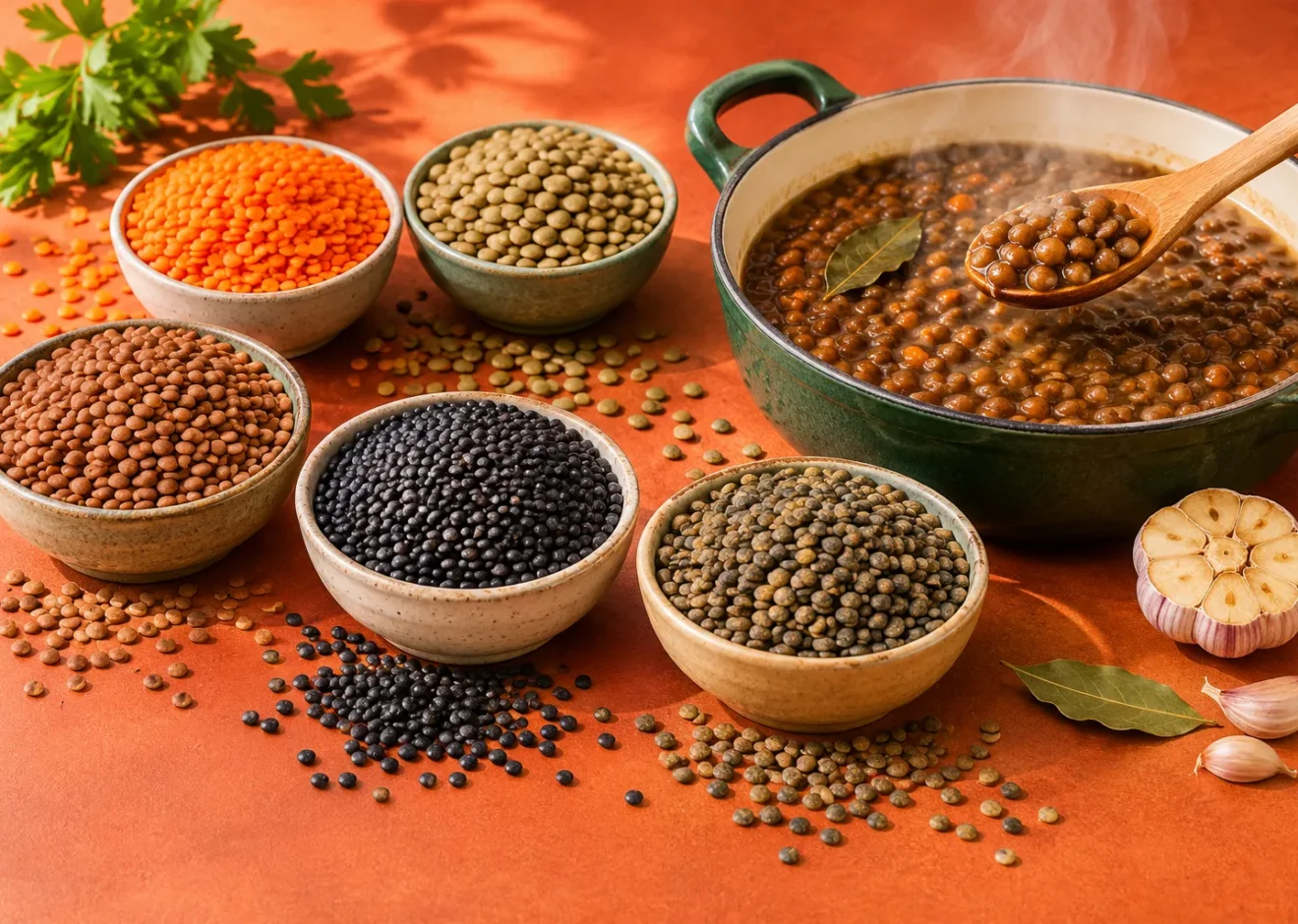
Cook in vegetable or chicken broth instead of water when the lentils are the main event. Onion, a halved garlic head, and a bay leaf dropped into the pot do more for flavor than anything you add afterward [10]. If you’re building a spiced lentil dish from here, the 232 Curry Cookbook covers the aromatic combinations that suit red lentils particularly well.
Salt early firms the skins slightly. For the softest result, salt in the last five minutes. For salads where you want each lentil distinct, salt the cooking water from the start [9].
How do you get lentils soft but not mushy?
Target the texture of al dente pasta: fully softened on the outside with a faint resistance in the center [5]. Reaching it reliably takes four habits.
- Simmer, never boil. A rolling boil knocks the lentils against each other and splits the skins. Bubbles should barely break the surface [2].
- Start tasting early. Pull five lentils at the low end of the time range and bite one. Lentils go from firm to soft in a three-minute window near the end.
- Drain the moment they’re right. Leaving them in hot liquid keeps cooking them. Spread drained lentils on a sheet pan if you want them to stop fast.
- Add acid last. Lemon juice, vinegar, or tomatoes stirred in at the start will keep the centers chalky.
For salads, cook about 30 minutes to a firm texture; for dips and spreads, let them run 45 minutes or longer until they break down willingly.
Why are my lentils coming out mushy or undercooked?
Mushy usually means wrong variety or too much heat. Undercooked usually means old lentils or acid in the pot.
Mushy lentils
- Used red or yellow where the recipe wanted whole green or brown.
- Boiled hard instead of simmering.
- Left sitting in hot cooking liquid after reaching doneness.
- Stirred aggressively, which shears the skins.
Undercooked or chalky lentils
- Lentils older than about a year; buy from a store with turnover.
- Tomatoes, wine, or vinegar added before the lentils softened.
- Not enough liquid, so the top layer steamed instead of simmering.
- Very hard tap water.
If a batch is uneven, add half a cup of hot water and simmer five more minutes covered. If it’s already mush, stop fighting it and turn it into soup or a spread.
Can you cook lentils in an Instant Pot or slow cooker?
Both work, with different tradeoffs. Pressure cooking is fastest but gives no chance to taste mid-cook; a slow cooker is nearly impossible to burn but tends toward softer results.
Instant Pot (high pressure, natural release 5 minutes)
- Red or yellow: 1-2 minutes [1]
- Black beluga: 6-7 minutes [1]
- Brown or green: 8-10 minutes [1]
- Use 2 cups liquid per cup of lentils and don’t fill past the half mark; lentils foam.
Slow cooker
- About 4 hours on high, or 7 to 9 hours on low.
- Use whole brown, green, or French lentils. Red lentils disintegrate.
- Add 3 cups liquid per cup of lentils since less evaporates.
A slow-cooked lentil stew with carrots, celery, and smoked paprika is close to foolproof. For more hands-off ideas in this format, browse the 980 Slow Cooker Recipes collection.
How to store cooked lentils, and can you freeze them?
Cooked lentils keep 4 to 5 days in an airtight container in the refrigerator and up to 6 months in the freezer. Cool them within two hours of cooking.
- Refrigerator: drain well, cool uncovered for 20 minutes, then seal. A splash of olive oil keeps them from clumping.
- Freezer: portion into 1- or 2-cup flat freezer bags with a little cooking liquid, press flat, and stack. Flat bags thaw in minutes under cool water.
- Reheat: a pan with 2 tablespoons of water over medium heat, or 60 seconds in the microwave with a damp paper towel over the bowl.
Toss them if they smell sour, feel slimy, or show any film. Red lentil purées sour faster than whole lentils because of their higher surface area, so use those within three days.
What can you make with cooked lentils?
Cooked lentils are a protein base, not a dish. Keep a container in the fridge and they slot into meals all week.
- Salads: French or black lentils with roasted beets, feta, and a sharp mustard vinaigrette.
- Soups: red lentils simmered with coconut milk, ginger, and turmeric.
- Meat extender: half brown lentils, half ground beef in bolognese, tacos, or shepherd’s pie.
- Dips: blend soft red lentils with tahini, lemon, and cumin. Pair with ideas from the 739 Dip Cookbook.
- Breakfast: warm brown lentils under a fried egg with chili oil. See the 212 Eggs Cookbook for variations.
- Swaps: lentils stand in for chickpeas in most warm salads; the 101 Chickpea Cookbook recipes adapt directly.
FAQ
Do lentils need to be soaked overnight? No. Lentils cook from dry in 10 to 45 minutes and never need an overnight soak [4].
How much dry lentils per person? About 1/3 cup dry per person, which yields roughly 3/4 cup cooked.
Do lentils double in volume? Yes, roughly. One cup dry gives about 2 to 2½ cups cooked.
Should you salt lentil cooking water? Salt at the end for the softest texture, or at the start if you want them firm for salads [9].
Can you overcook lentils? Easily. Red lentils can go from done to purée in three minutes of extra simmering.
Why do lentils foam while cooking? Natural starches and saponins release into the water. Skim the foam in the first few minutes [1].
Are canned lentils as good as dried? Convenient but softer and saltier. Rinse them and use in soups rather than salads.
Can you cook lentils and rice together? Yes, with brown lentils and brown rice, which share a roughly 25-minute window. Use 2 cups liquid per cup of combined dry ingredients.
Conclusion
Start with one bag of brown lentils and one bag of red. Rinse a cup, simmer it in 2½ cups of broth with a bay leaf, and taste at 18 minutes to learn where your preferred texture sits. Keep a note of the time that worked, because your stove and your lentils are the variables no published chart can account for. Once drained lentils live in your fridge each week, dinner planning gets noticeably simpler. For more weeknight ideas, see the recipes tagged cooking.
References
- How to Cook Lentils. allrecipes.com.
- How to Cook Lentils. bhg.com.
- Foodservice Recipes Booklet. lentils.org.
- How to Cook Lentils Guide. today.com.
- 1026121 Lentils. cooking.nytimes.com.
- What Are Lentils. allrecipes.com.
- Lentils. wicworks.fna.usda.gov.
- Lentils Glossary. bbcgoodfood.com.
- Cook Lentils. evernote.com.
- How to Cook Lentils. billyparisi.com.