Last updated: November 27, 2026
Quick Answer
November 27 National Bavarian Cream Pie Day is an informal U.S. food holiday celebrating a pie made with Bavarian cream, a custard set with gelatin and lightened with whipped cream, poured into a baked crust [1][2]. It falls on the same date every year, which in 2026 is a Friday, and it has no official government proclamation or known founder [3][4]. People mark it by baking a pie at home, buying a slice from a bakery, or ordering a Bavarian cream doughnut as a shortcut.
Key Takeaways
- The date is fixed: November 27, every year, regardless of weekday [5].
- Bavarian cream pie uses crème anglaise set with gelatin, then folded with whipped cream, which is what separates it from a cornstarch-thickened cream pie.
- The custard base traces to crème bavaroise, a French technique codified in 19th-century haute cuisine, not a rustic Bavarian farmhouse dessert.
- Most American “Bavarian cream” in supermarket doughnuts and cakes is a sweetened pastry cream, not the gelatin-set original.
- A homemade pie costs roughly $8 to $14 in ingredients; a bakery pie typically runs $18 to $35.
- Runny filling almost always traces back to one of three things: too little gelatin, under-cooked custard, or folding whipped cream into warm base.
- It keeps 3 to 4 days refrigerated. Freezing works but the texture suffers.
- Egg-free and vegan versions are possible with cornstarch, coconut cream, and agar instead of gelatin.
- No major brand campaigns, retail promotions, or official recognition have been documented for 2025 or 2026 [3][4].
What exactly is Bavarian cream pie?
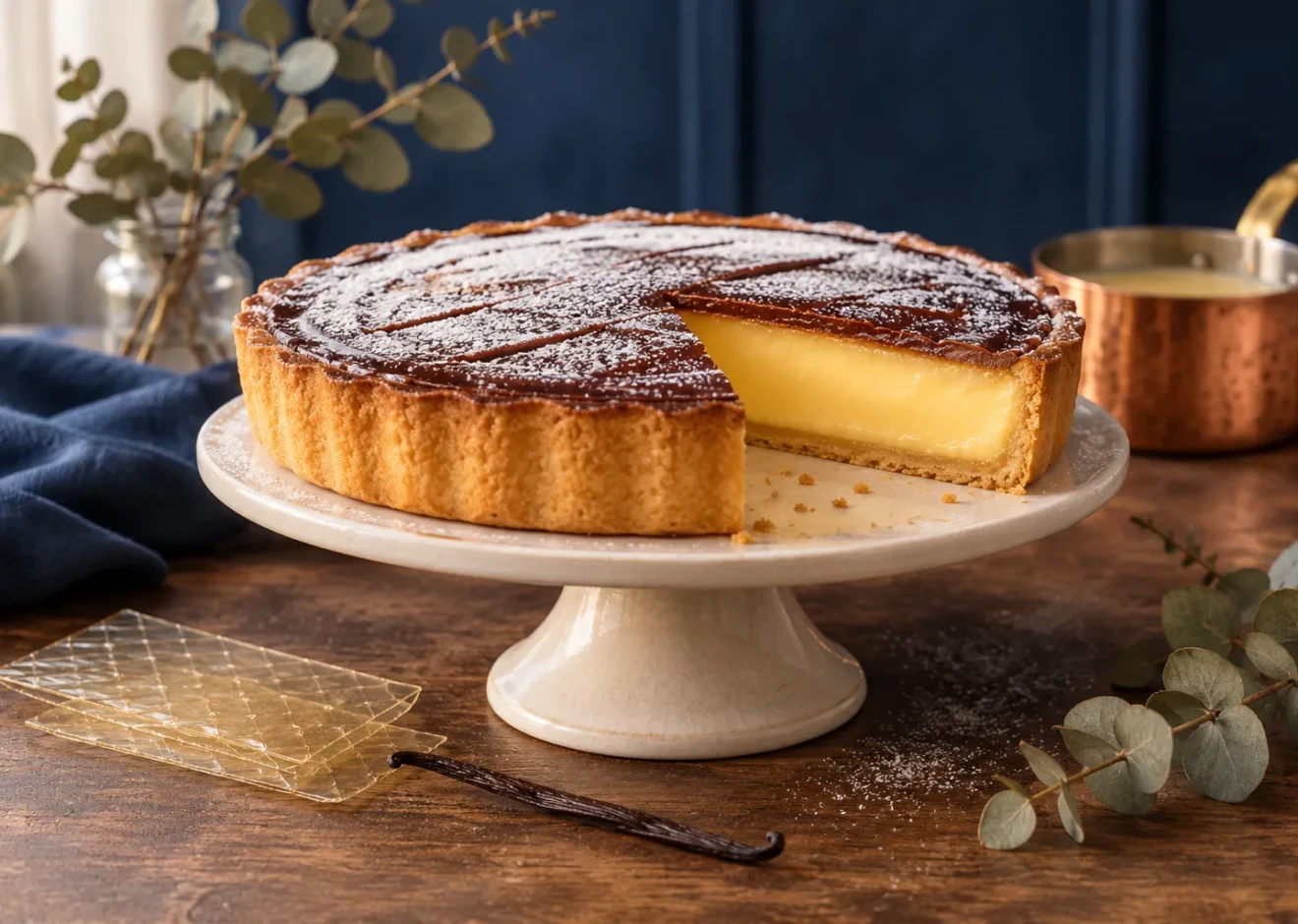
Bavarian cream pie is a chilled pie filled with Bavarian cream: a cooked egg-custard base (crème anglaise), stabilized with gelatin, then folded with whipped cream so it sets soft but sliceable [1][2]. The crust is usually a fully blind-baked pastry shell or a graham cracker crust, and the top is often finished with chocolate glaze, chocolate shavings, or plain whipped cream.
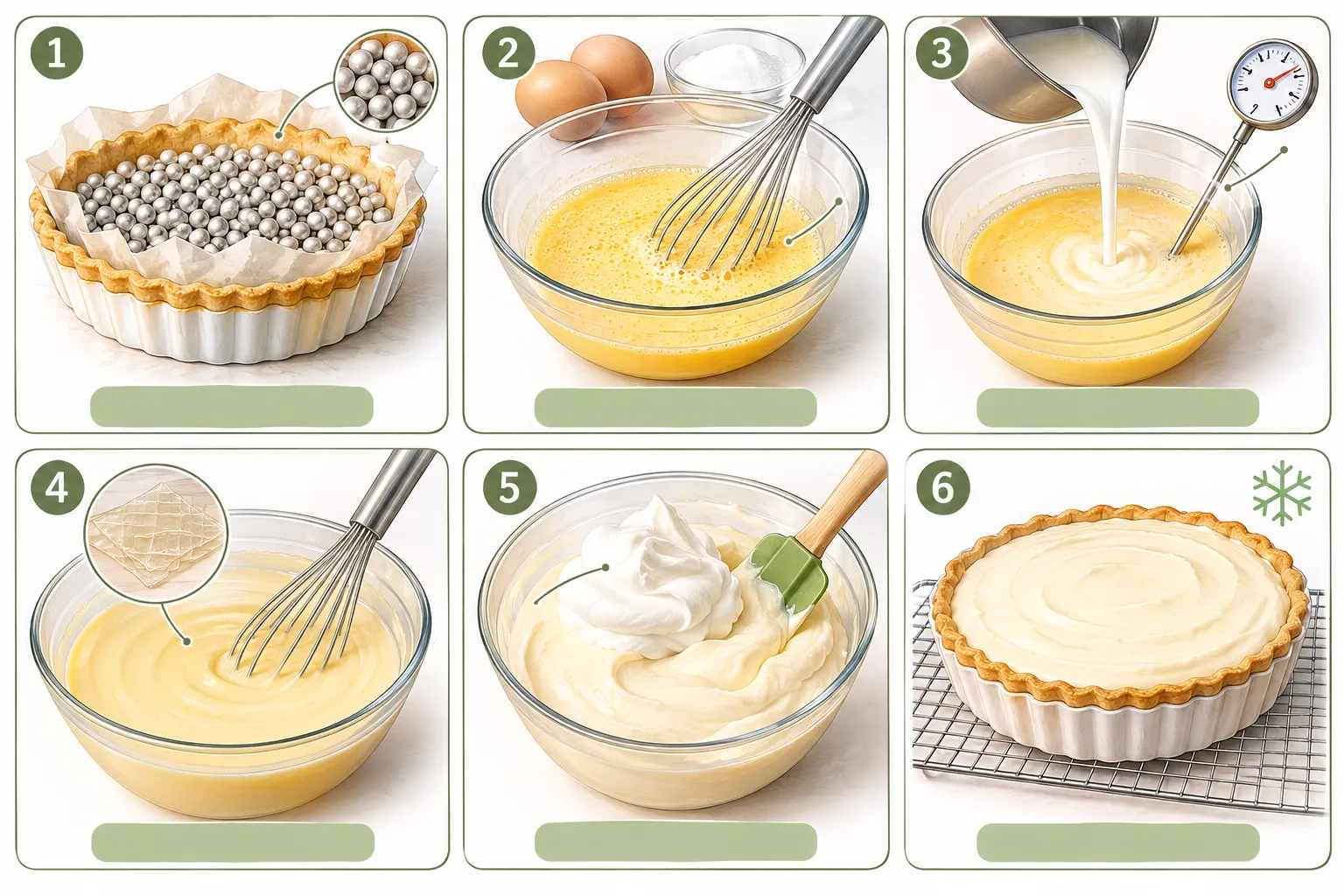
Texture is the whole point. Done right, the filling is lighter than a pudding pie and holds a clean edge when sliced, somewhere between a mousse and a set custard. Bostonians will notice the resemblance to Boston cream pie, which uses a similar filling between sponge cake layers rather than inside a crust.
Three components define it:
- Crème anglaise, milk or cream, egg yolks, sugar, vanilla, cooked to about 170-175°F.
- Gelatin, bloomed and dissolved into the warm custard; this is the structural element.
- Whipped cream, folded in once the base is cool and barely starting to thicken.
How do you make Bavarian cream pie from scratch?
Make the custard, dissolve gelatin into it, chill until it thickens slightly, fold in whipped cream, pour into a baked crust, and refrigerate at least four hours. The sequence matters more than the ingredient list.
Scratch method (9-inch pie):
- Blind-bake a pastry shell until deeply golden. A pale crust will go soggy under a wet filling.
- Bloom 2 teaspoons (about 1 packet) powdered gelatin in 3 tablespoons cold water for 5 minutes.
- Heat 1½ cups whole milk with a split vanilla bean or 1 teaspoon extract until steaming.
- Whisk 4 large egg yolks with ½ cup sugar and a pinch of salt until pale. Temper by streaming in the hot milk slowly while whisking.
- Return to low heat and stir constantly until it coats the back of a spoon, 170-175°F. Do not boil.
- Off heat, stir in the bloomed gelatin until fully dissolved. Strain through a fine sieve.
- Cool over an ice bath, stirring, until the custard is thick enough to leave a brief trail from the whisk but not yet set.
- Whip 1 cup heavy cream to soft peaks and fold it in with a spatula, in two additions.
- Pour into the crust, smooth the top, chill 4-6 hours (overnight is better).
Decision rule: if the custard has already set firm in the fridge, don’t fold whipped cream into it. Warm it gently over a bain-marie until loose again, then cool back to the right stage. For more custard-family technique, our frozen custard guide covers the same egg-yolk base in a different direction.
What’s the easiest Bavarian cream pie recipe?
The fastest honest version uses instant vanilla pudding, gelatin, and whipped cream in a store-bought graham crust: about 20 minutes of work plus chilling. It won’t match a scratch crème anglaise, but it sets reliably and tastes close.
Shortcut filling:
- 1 box (3.4 oz) instant vanilla pudding mix
- 1½ cups cold whole milk
- 1 teaspoon gelatin bloomed in 2 tablespoons water, then melted (15 seconds in the microwave)
- 1 cup heavy cream whipped to soft peaks
- 1 store-bought graham or shortbread crust
Whisk pudding and milk, let it thicken 5 minutes, whisk in the melted gelatin fast before it seizes, then fold in the whipped cream. Chill 3 hours. Finish with a ganache made from ¼ cup hot cream over ⅓ cup chopped semisweet chocolate.
The gelatin is the non-negotiable part. Skip it and you have a pudding pie, which tastes fine but slumps on the plate.
Bakers who want to work through more set-custard desserts will find plenty in our collection of 441 pudding recipes.
Where can I buy Bavarian cream pie near me, and how much does it cost?
Dedicated Bavarian cream pies are uncommon in chain grocery bakeries. Your realistic options are an independent German or Eastern European bakery, a full-service supermarket bakery that takes custom orders, or the far more common Bavarian cream doughnut from Dunkin’, Krispy Kreme, or a local shop.
| Source | Typical price (U.S., 2026) | Notes |
|---|---|---|
| Homemade, scratch | $8,$14 in ingredients | Eggs, cream, butter drive the cost |
| Homemade, shortcut | $6,$9 | Pudding mix and pre-made crust |
| Supermarket bakery, custom order | $18,$28 | Usually needs 24-48 hours notice |
| Independent/German bakery | $25,$35 | Often sold whole only |
| Bavarian cream doughnut | $1.50,$3.50 each | Widest availability by far |
Prices are typical retail ranges, not surveyed figures. Call ahead. Many bakeries list “Boston cream” and will make the same filling in a pie shell if you ask, since it’s the identical custard.
Bavarian cream pie vs regular cream pie: what’s the difference?
The setting agent. Bavarian cream is set with gelatin and lightened with folded whipped cream; a standard cream pie (coconut, banana, vanilla) is thickened with cornstarch or flour and sets firm from starch alone.
| Bavarian cream pie | Classic cream pie | |
|---|---|---|
| Thickener | Gelatin | Cornstarch or flour |
| Base | Crème anglaise (thin, pourable) | Pastry cream (thick, spoonable) |
| Aeration | Whipped cream folded in | Usually topped, not folded |
| Mouthfeel | Light, mousse-like, melts fast | Dense, creamy, clings |
| Serve temp | Must stay cold to hold shape | Holds shape at cool room temp |
A practical consequence: Bavarian cream softens on a warm dessert table within 30 minutes. Starch-set cream pies tolerate that far better. If you’re serving outdoors or buffet-style, go with the starch version. Compare the technique with the meringue-topped, starch-set approach in our guide to National Lemon Meringue Pie Day.
Why do we celebrate November 27 National Bavarian Cream Pie Day?
No founder, sponsor, or proclamation has ever been documented for the day [3][4]. It circulates through food-holiday calendars and bakery marketing rather than any government or trade-association origin, which puts it in the same category as hundreds of other unofficial U.S. food observances [2][5].
Two things likely keep it on the calendar. First, the date sits immediately after Thanksgiving in most years, when American households are already in dessert mode and looking for something that isn’t pumpkin. Second, Bavarian cream has broad name recognition in the U.S. through doughnuts, even among people who have never eaten the pie.
Expect the day to stay low-profile. There were no notable brand campaigns, retail discounts, or press coverage in 2025 or 2026, and the trajectory points to continued steady, modest interest driven by recipe searches rather than commerce [3][4]. If you enjoy tracking these dates, our archive of dessert food holidays lists more throughout the year.
What is the history of Bavarian cream?
Bavarian cream descends from crème bavaroise, a molded gelatin-set custard documented in French professional cookery of the late 18th and 19th centuries, closely associated with chefs working in the grande cuisine tradition, including Marie-Antoine Carême. The name references Bavaria, but the dessert as we know it is French kitchen technique.
The original was unmolded freestanding, chilled in a decorative mold and turned out, often flavored with fruit purée, coffee, or liqueur. Putting it in a pie shell is an American adaptation, as is the chocolate-glazed top borrowed from Boston cream pie.
The naming gap worth knowing: most products labeled “Bavarian cream” in American supermarkets, doughnut shops, and sheet cakes contain a sweetened pastry cream or a stabilized whipped filling with no gelatin-set custard at all. True bavaroise is now mostly a pastry-school and fine-dining item in the U.S.
Can you freeze Bavarian cream pie, and how long does it keep?
Refrigerated, a Bavarian cream pie holds 3 to 4 days covered loosely with plastic wrap or in a cake dome. Freezing is possible for up to one month, but gelatin-set custard weeps on thawing and the crust turns soft, so the result is noticeably worse than fresh.
If you must freeze:
- Freeze unglazed and untopped, uncovered, until the surface is firm (about 2 hours), then wrap tightly in plastic and foil.
- Thaw overnight in the refrigerator. Never thaw on the counter.
- Blot any surface liquid with a paper towel, then add the glaze or whipped cream after thawing.
Edge case: graham-crumb crusts freeze better than butter pastry because they absorb less moisture. A chocolate-cookie crust brushed with a thin layer of melted chocolate before filling resists sogginess best, frozen or not.
Eggs and gelatin mean it’s not shelf-stable. Don’t leave it out more than two hours.
Why did my Bavarian cream pie turn out runny?
Runny filling comes down to gelatin, temperature, or timing. The most common single cause is folding whipped cream into a custard that’s still warm, which melts the cream and prevents the gelatin from setting into a stable network.
Check these in order:
- Gelatin not fully dissolved. Undissolved granules mean undissolved structure. The custard must be hot enough (around 140°F or above) when the bloomed gelatin goes in, and you should see no grains.
- Too little gelatin for the liquid volume. As a working ratio, 2 teaspoons powdered gelatin per roughly 2½ cups total liquid (custard plus cream) gives a sliceable set.
- Custard under-cooked. Below about 165°F the yolks haven’t thickened at all, so you’re relying on gelatin alone.
- Fresh pineapple, kiwi, papaya, mango, or figs. These contain protease enzymes that destroy gelatin. Use canned or cooked fruit instead.
- Not chilled long enough. Four hours minimum; overnight is safer.
Rescue option: if it hasn’t set after 8 hours, scrape the filling into a saucepan, warm gently, whisk in another ½ teaspoon of bloomed gelatin, cool, fold in ½ cup fresh whipped cream, and refill a new crust.
Can you make Bavarian cream pie without eggs, and is it vegan friendly?
Yes to egg-free, and a reasonable yes to vegan with substitutions. Traditional Bavarian cream contains both egg yolks and gelatin, so neither the classic recipe nor most commercial versions are vegetarian or vegan as written.
Egg-free (still dairy): replace the yolk custard with 3 tablespoons cornstarch cooked into 1½ cups milk and ½ cup sugar until thick, then add bloomed gelatin and fold in whipped cream. The color is paler and the flavor less rich, but the set is just as good.
Vegan version:
- Swap dairy milk for full-fat coconut milk or barista oat milk.
- Swap gelatin for agar-agar (about ¾ teaspoon powdered agar per cup of liquid), which must be boiled one to two minutes to activate, unlike gelatin.
- Swap whipped cream for chilled, whipped coconut cream or a plant whipping cream.
- Use a vegan graham or cookie crust bound with coconut oil.
Agar sets firmer and more brittle than gelatin, so err on the low side and accept a softer slice. Carrageenan is an alternative for a more tender set. A note for vegetarians: kosher or halal gelatin is usually beef-derived, not plant-based, so it doesn’t solve the problem.
What are the most common Bavarian cream pie mistakes?
Most failures happen in the 10 minutes around folding, not in the baking. Here’s the checklist experienced bakers run:
- Boiling the crème anglaise. Over 180°F the yolks scramble. Use a thermometer or pull it at the coating-the-spoon stage.
- Adding gelatin to a cold base. It clumps instantly. Dissolve it in the warm custard.
- Folding whipped cream into warm custard. Cool the base to about 70°F first.
- Waiting too long and folding into a set base. You’ll get lumps of custard suspended in cream.
- Over-whipping the cream. Soft peaks only; stiff cream won’t fold and makes the filling grainy.
- Skipping the strainer. One pass through a fine sieve removes chalaza and any cooked bits.
- Under-baking the crust. A wet filling plus a pale crust equals a soggy bottom in two hours.
- Slicing too early. Use a thin knife wiped clean between cuts, and only after a full chill.
If folding and aeration are new territory, the technique notes in our 2,444-recipe cake collection carry over directly.
FAQ
When is National Bavarian Cream Pie Day? November 27 every year [5]. In 2026 that’s a Friday, and the date does not shift to a different weekday in future years.
Is it an official holiday? No. It’s an unofficial food observance with no documented founder, sponsor, or government proclamation [3][4].
Is Bavarian cream pie the same as Boston cream pie? The filling is essentially the same custard. Boston cream pie layers it between sponge cake with chocolate glaze; Bavarian cream pie puts it in a pastry or crumb crust.
Is Bavarian cream pie German? The name refers to Bavaria, but the dessert comes out of French professional pastry tradition as crème bavaroise. It isn’t a standard item in German bakeries today.
Does Bavarian cream contain eggs? Traditional Bavarian cream contains egg yolks. Many American commercial “Bavarian cream” fillings are egg-free pastry-cream styles, so check labels if it matters.
How long does it need to chill? Four hours minimum, overnight preferred. A fully chilled pie slices cleanly; a four-hour pie often sags at the tip.
Can I use gelatin sheets instead of powder? Yes. Roughly 3 silver-grade sheets equal 1 packet (2¼ teaspoons) of powdered gelatin. Soak sheets in ice water, squeeze dry, then stir into the warm custard.
What toppings work best? Chocolate ganache is the standard. Fresh raspberries, toasted almonds, or a caramel drizzle all work; our raspberry recipe collection has fruit toppings worth borrowing.
Why does my filling taste eggy? The custard went past 180°F or wasn’t strained. Cook to 170-175°F, strain, and add vanilla off the heat to keep the flavor clean.
Conclusion
Treat November 27 National Bavarian Cream Pie Day as a practical excuse to learn one transferable skill: setting a custard with gelatin and folding in whipped cream without deflating it. That technique carries into charlottes, mousse cakes, and panna cotta.
What to do next:
- If you’re baking: blind-bake the crust today, make the custard tomorrow morning, and assemble by noon so it chills a full six hours before dinner.
- If you’re buying: call an independent bakery 48 hours ahead and ask whether they’ll put their Boston cream filling in a pie shell.
- If you’re short on time: grab Bavarian cream doughnuts and serve them with coffee.
- If your first attempt failed: check the gelatin dissolution and the custard temperature before changing anything else in the recipe.
References
- National Bavarian Cream Pie Day. nationalday365.com.
- National Bavarian Cream Pie Day. nationaltoday.com.
- National Bavarian Cream Pie Day. awarenessdays.com.
- Bavarian Cream Pie Day. daysoftheyear.com.
- National Bavarian Cream Pie Day. checkiday.com.