November 23 National Eat A Cranberry Day: History, Health Benefits, and How to Celebrate
Last updated: November 23, 2026
Quick Answer
November 23 National Eat A Cranberry Day is an unofficial food holiday observed every year on November 23, including Monday, November 23, 2026 [1][2]. It has no government proclamation or documented founder, and conservation writers trace it to the internet’s sprawling “national day” calendars [3]. The point is simple: eat cranberries beyond the Thanksgiving sauce bowl, whether raw, cooked, dried, or juiced [2][4].
Key Takeaways
- The day falls on November 23 each year and is recognized by national day calendars and university extension food calendars, not by law [1][2][4].
- Raw cranberries are safe to eat. They’re just intensely tart because of high acidity and very low sugar.
- The United States grows about two-thirds of the world’s cranberries, roughly 800 million pounds a year on about 40,000 acres [5].
- Wisconsin led 2025 production with about 4.8 million barrels, down from over 6 million the year before [6].
- USDA forecast the 2025 U.S. crop at 8.13 million barrels, 9% below 2024 but near the five-year average of 7.95 million [7].
- Dried cranberries are usually sweetened, so they carry far more sugar per serving than fresh.
- People on warfarin, with kidney stones, or with an aspirin allergy should talk to a doctor before loading up on cranberry products.
- Fresh cranberries freeze well for about a year and need no thawing before baking.
Is National Eat A Cranberry Day actually a real holiday?
It’s real in the sense that it’s widely published and observed, but it isn’t official. No state or federal body proclaimed it, and no founder is on record. Today in Conservation flatly describes it as coming from the internet’s “nonsensical national day calendars” with no clear origin story [3]. A November 2026 syndicated column called it an unofficial holiday that was new even to a veteran writer [8].
That doesn’t make it useless. The day has a stated purpose: push cranberries out of their two-week holiday window and into year-round eating [2][4]. The University of Nebraska, Lincoln extension food calendar lists Eat a Cranberry Day for November 23, which gives it more institutional footing than most invented food days [1]. Alaska’s cooperative extension has marked it as well [9].
Treat it as a prompt, not a proclamation. The useful part is the reminder that cranberries work in oatmeal, salads, and pan sauces, not only beside turkey.
If you track food and drink awareness days, November 23 sits in a crowded stretch of the calendar right before Thanksgiving, which is exactly why it gets overlooked.
What are the health benefits of eating cranberries?
Cranberries are low in calories and sugar, high in vitamin C and fiber, and rich in polyphenols called proanthocyanidins. Those compounds are the reason cranberry keeps showing up in urinary tract health research, since they appear to interfere with bacteria sticking to the bladder wall.
What a cup of fresh cranberries delivers:
- Around 46 calories and about 4 grams of dietary fiber
- Roughly 22% of daily vitamin C
- Vitamin E, vitamin K1, copper, and manganese
- Very little natural sugar compared with most berries
A realistic read: cranberry juice and supplements have modest evidence for reducing recurrent UTIs in some women, and almost none for treating an active infection. If you have symptoms, see a clinician. Don’t substitute juice for antibiotics.
Can you eat raw cranberries or do you need to cook them?
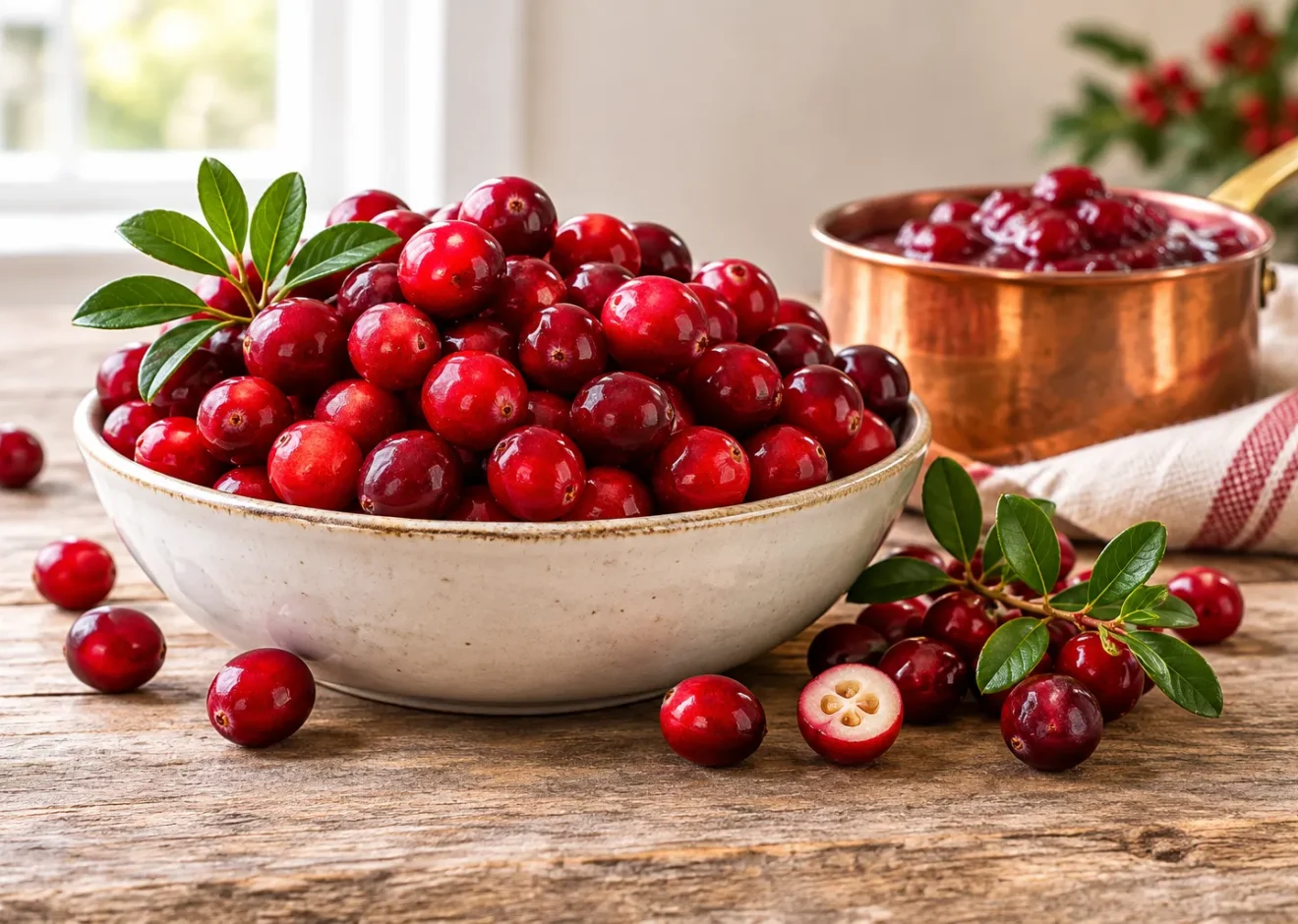
You can eat raw cranberries safely. They aren’t toxic and they don’t require cooking. The issue is palatability: a raw berry is sour and slightly bitter, with a dry, squeaky bite.
Where raw works well:
- Chopped fine into a relish with orange, sugar, and a pinch of salt
- Blitzed into smoothies with banana or mango to carry the acid
- Sliced thin over a kale or farro salad with goat cheese and pecans
- Frozen whole and dropped into sparkling water or cocktails as edible ice
Edge case to know: eating a large volume of raw cranberries at once can cause stomach upset or loose stool because of the fiber and acid. A handful is fine. A bowlful is a bad idea.
Why are cranberries so tart, and how do you make them less bitter?
Cranberries taste sharp because they contain citric, malic, and quinic acids with only about 4 grams of sugar per cup. Cooking doesn’t remove the acid, so you balance it instead.
Five ways to tame the tartness:
- Sugar, in stages. Add half, taste after the berries burst, then adjust. Cold sauce tastes less sweet than hot sauce.
- Salt. A quarter teaspoon in a batch of sauce blunts bitterness more effectively than extra sugar.
- Fat. Butter, cream cheese, or crème fraîche rounds off the edges in baked goods.
- Orange or maple. Zest and juice add aromatic sweetness; maple syrup adds depth that white sugar can’t.
- Don’t overcook. Boiling past the point where every berry has split releases more bitter compounds from the skins.
Common mistake: dumping all the sugar in at the start, then having no room to correct. Taste as you go.
How do you celebrate Eat a Cranberry Day on November 23?
Pick one cranberry thing you’ve never done and do it. The low-effort version is eating a single raw cranberry, which is literally what the day’s name asks [4].
Practical options, from fastest to most involved:
- Swap sweetened dried cranberries into your morning oats or a homemade granola batch
- Make a small-batch sauce with fresh berries, orange zest, and maple
- Stir cranberry juice into a shrub or spritz
- Put up a jar of cranberry preserves, which keeps for months and makes a good gift
- Visit a bog if you’re in Wisconsin or Massachusetts; harvest season runs September into November
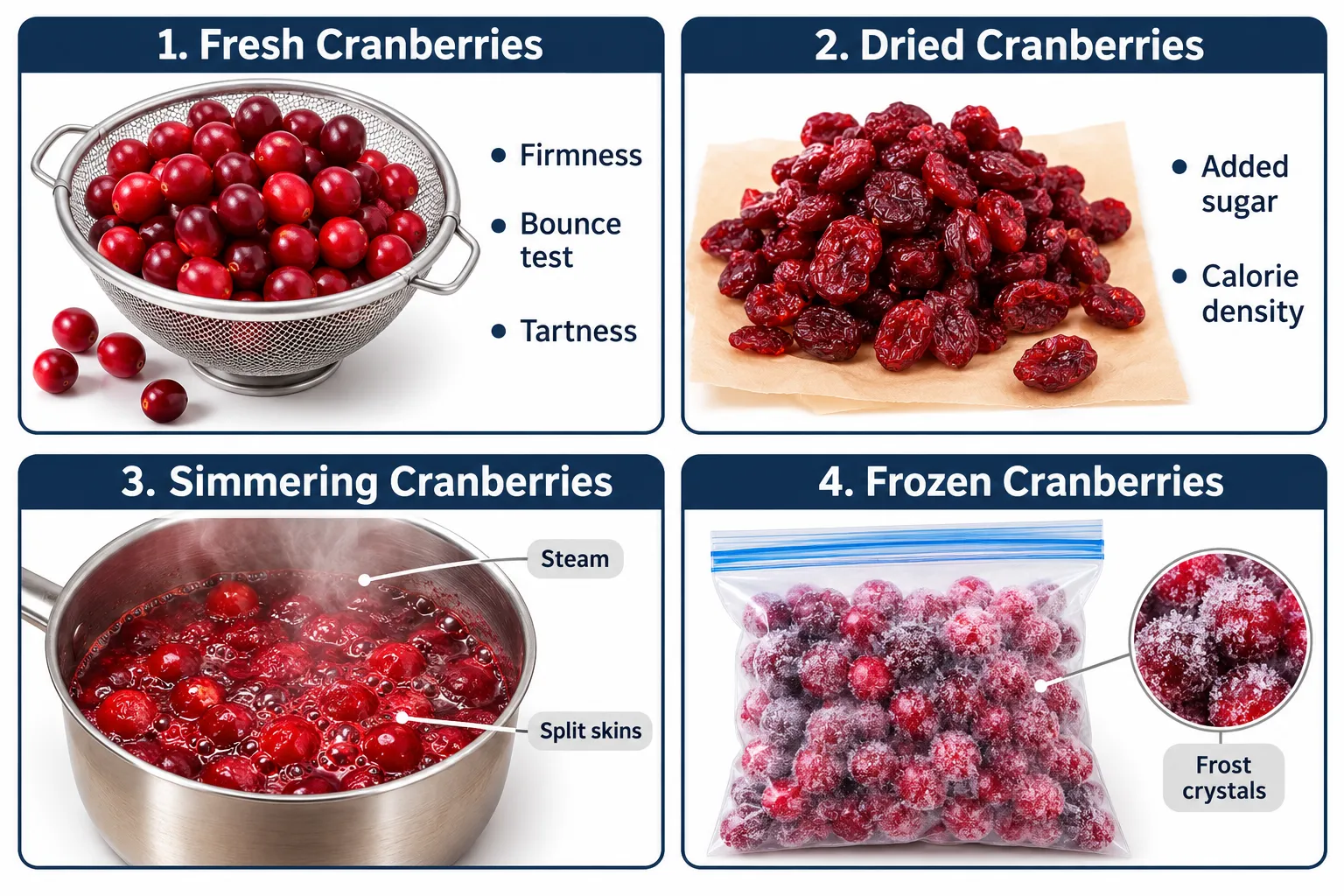
- Teach someone the bounce test: a fresh, firm cranberry bounces, a mushy one doesn’t
Schools and extension offices sometimes use the date for a nutrition lesson, which is a better fit than most comfort food holidays.
What are the best cranberry recipes for November 23?
The best recipe for the day is whichever one uses fresh berries, since fresh cranberries are only in stores for a few weeks. Sauce is the obvious choice. Less obvious choices often taste better.
| Recipe | Time | Difficulty | Uses fresh or dried |
|---|---|---|---|
| Orange-maple cranberry sauce | 20 min | Easy | Fresh or frozen |
| Cranberry-walnut quick bread | 70 min | Easy | Fresh or frozen |
| Cranberry chutney with ginger | 35 min | Easy | Fresh |
| Pan sauce for pork or duck | 15 min | Medium | Fresh |
| Cranberry-pistachio biscotti | 60 min | Medium | Dried |
| Cranberry curd tart | 2 hr | Hard | Fresh |
The pan sauce deserves more attention. Deglaze the skillet with stock, add a handful of cranberries and a spoon of sugar, reduce until the berries collapse, finish with butter. It works beautifully with roast duck and with pork loin. For the preserving route, a basic cranberry jam sets easily because cranberries are loaded with natural pectin, so no added pectin is needed.
Where can you buy fresh cranberries, and what’s the difference from dried?
Fresh cranberries appear in supermarket produce sections from late September through December, usually in 12-ounce bags. Outside that window, your choices are frozen, dried, or juice. Massachusetts and Wisconsin farm stands, co-ops, and some growers’ direct-ship programs are the best bet for just-harvested berries.
Fresh vs dried, in short:
- Fresh: tart, firm, about 46 calories and 4 g sugar per cup, highly perishable (3-4 weeks refrigerated)
- Dried: chewy and sweet, almost always sweetened with sugar or juice concentrate, roughly 120 calories and 26 g sugar per quarter cup, shelf-stable for a year
- Use fresh for sauces, baking where you want bursts of tartness, and raw relishes
- Use dried for granola, trail mix, grain salads, cookies, and stuffing
Cranberry ingredients travel far beyond the juice aisle. One trade report on a major growers’ cooperative described cranberry showing up in trail mixes, chocolate-covered bites, and canned cocktails, often with no cooperative branding visible on the package [5].
Are there risks or side effects to eating too many cranberries, and who should avoid them?
Cranberries are safe for most people in normal food amounts. Problems show up with concentrated juice, supplements, or very large quantities.
Watch for these:
- Warfarin interaction. Large amounts of cranberry juice may increase bleeding risk by affecting how warfarin is metabolized. Ask your prescriber.
- Kidney stones. Cranberries contain oxalates, so people with a history of calcium-oxalate stones should limit concentrated juice and supplements.
- Aspirin allergy. Cranberries contain salicylic acid; high-dose products are worth avoiding if you react to salicylates.
- Blood sugar. Sweetened juice cocktail and dried cranberries carry a lot of added sugar, which matters for people managing diabetes.
- GI upset. More than about a liter of juice a day can cause diarrhea in some people.
Decision rule: if you take an anticoagulant, have had kidney stones, or are giving cranberry supplements to a child, check with a clinician before making it a daily habit. Eating a cup of berries on November 23 isn’t the concern.
What foods pair well with cranberries?
Cranberry’s acid cuts fat, so it pairs best with rich foods. That’s why the turkey tradition stuck, and also why the berry works far outside it.
Reliable pairings:
- Proteins: turkey, duck, pork loin, venison, steak with a cranberry-port reduction, roast chicken
- Cheeses: brie, sharp cheddar, goat cheese, blue cheese
- Nuts: pecan, walnut, pistachio, almond
- Spices: cinnamon, star anise, clove, fresh ginger, black pepper
- Fruits: orange, apple, pear, pomegranate
- Grains: wild rice, farro, quinoa, oats
- Drinks: bourbon, gin, dry sparkling wine, strong black tea
Can you freeze cranberries, and how long do they last?
Yes, and freezing is the single most useful thing you can do with cranberries. Fresh berries last 3 to 4 weeks in the refrigerator in a sealed bag. Frozen, they hold good quality for about 12 months.
How to do it:
- Sort out any soft, shriveled, or discolored berries.
- Don’t wash before freezing; wash after thawing, or rinse and dry completely first.
- Freeze in the original bag, or spread on a sheet pan and then transfer to a freezer bag.
- Add them to batter frozen. Thawed berries bleed and turn batter grey-pink.
Buy two or three extra bags in late November. Supply varies year to year, and prices climb once the season ends.
Who grows cranberries, and does supply actually change?
It changes a lot. USDA forecast the 2025 U.S. crop at 8.13 million 100-pound barrels, down 9% from 2024 but close to the five-year average of 7.95 million barrels [7]. Wisconsin’s actual 2025 output came in around 4.8 million barrels, below both its prior near-record harvest of over 6 million and earlier forecasts for the year [6].
Scale, in numbers:
- U.S. growers produce roughly two-thirds of the world’s cranberries, farming about 40,000 acres [5]
- Wisconsin cranberries are the state’s largest fruit crop, worth close to $1 billion a year and supporting more than 4,000 jobs [6]
- About 300 Massachusetts farmers manage more than 13,000 acres of bogs, with some older sites being restored to natural wetlands [10]
- Market analysts valued the global cranberry market near $8.58 billion in 2025, with forecasts around $9.12 billion for 2026
What are good alternatives if you don’t like cranberries?
Substitute a fruit with similar acid and color rather than similar texture. Sour cherries are the closest match for sauces and baked goods.
- Sour or tart cherries: best all-around swap, works in sauce and bread
- Red currants or lingonberries: nearly identical acidity, common in Northern European sauces
- Pomegranate arils: same jewel-red pop and tang, no cooking required
- Rhubarb: strong acid, needs sugar, excellent in compote
- Tart apples with lemon: easiest pantry substitute for a chutney
- Strawberries: sweeter, but reliable when you want berry flavor without the bite
What mistakes do people make when preparing cranberries?
The big one is overcooking. Once every berry has popped, the sauce is done; past that you get bitterness and a gluey texture.
Others worth avoiding:
- Skipping the sort, so one mushy berry ruins the batch
- Using a reactive aluminum pan, which can pick up a metallic taste from the acid
- Measuring sugar by a recipe without tasting, since berry tartness varies by lot
- Judging sweetness while the sauce is hot
- Chopping raw berries in a food processor until they’re paste instead of pulsing to a coarse relish
- Treating sweetened dried cranberries as a low-sugar food
FAQ
When is National Eat A Cranberry Day? November 23 every year, including Monday, November 23, 2026 [1][2].
Who started National Eat A Cranberry Day? No founder is documented. It appears on internet national-day calendars without a formal proclamation or origin story [3].
Is it safe to eat a raw cranberry? Yes. Raw cranberries are safe and nutritious. They’re simply very tart, and eating a large quantity at once may cause stomach upset.
How many cranberries should you eat a day? There’s no official recommendation. A half cup of fresh berries or a quarter cup of unsweetened dried cranberries is a reasonable daily serving for most adults.
Do cranberries cure a UTI? No. Cranberry products may help reduce recurrent UTIs in some women, but they do not treat an active infection. See a clinician for symptoms.
How long do fresh cranberries keep? Three to four weeks in the refrigerator, or about 12 months frozen.
Which state grows the most cranberries? Wisconsin, with about 4.8 million barrels in 2025 [6].
Can dogs eat cranberries? Plain fresh or frozen cranberries in small amounts are generally fine. Sweetened dried cranberries and juice cocktails are not recommended. Ask your vet.
Does cooking destroy cranberry nutrients? Cooking reduces vitamin C somewhat, but fiber and most polyphenols survive. Added sugar is the bigger nutritional change.
Why do fresh cranberries bounce? Each berry has four internal air pockets. Firm, ripe berries bounce; soft or spoiled ones don’t, which is why the bounce test works.
Conclusion
November 23 National Eat A Cranberry Day gives you a reason to buy fresh cranberries while they’re actually in season, which is a narrower window than most people realize. Here’s what to do with it: pick up two bags this week, freeze one, and use the other for a small batch of orange-maple sauce you taste as you go. Try one raw berry so you know what you’re balancing. If you take warfarin or have had kidney stones, keep it to food amounts and talk to your doctor before adding juice or supplements. Then plan one non-holiday use for the frozen bag in February, when cranberries are gone from the produce aisle and a cranberry pan sauce still works perfectly well.
References
- Eat Cranberry Day. food.unl.edu.
- National Eat a Cranberry Day. awarenessdays.net.
- November 23 National Eat a Cranberry Day. todayinconservation.com.
- National Eat a Cranberry Day November 23. nationaldaycalendar.com.
- Behind the Juice Aisle Lies an Ingredients Business That Supplies Everything From Trail Mixes and Chocolate Bites to Canned Cocktails. foodnavigator.com.
- Wi Remains No 1 State For Cranberries With 4 8m Barrels In 2025. wispolitics.com.
- USDA Economic Research Service, Charts of Note. ers.usda.gov.
- Article318190264. sunherald.com.
- National Eat a Cranberry Day 2. ces.open.uaf.edu.
- What to Know About Cranberries Produced for Thanksgiving and the Bogs Being Restored to Wetlands. agrinews-pubs.com.