

Last updated: March 28, 2026
Quick Answer: January 30 National Croissant Day is an annual food holiday celebrated in the United States on January 30th. It honors the croissant, a buttery, flaky pastry with roots in Austrian and French culinary tradition. The day is a popular occasion for bakeries, home bakers, and food lovers to enjoy, share, and learn about one of the world’s most iconic pastries.
Key Takeaways 🥐
- January 30 is recognized annually as National Croissant Day in the United States.
- The croissant traces its origins to the Austrian kipferl, later refined into its modern laminated form in France.
- True croissants are made through a labor-intensive process called lamination, which creates the signature flaky layers.
- The day is celebrated by bakeries, cafés, restaurants, and home bakers with special offers, recipes, and social media events.
- Croissants come in many varieties: plain, chocolate (pain au chocolat), almond, savory, and more.
- Celebrating doesn’t require baking from scratch — buying from a quality local bakery is a perfectly valid way to participate.
- National Croissant Day has grown into a social media event, with hashtags like #NationalCroissantDay trending each January 30.
- The croissant is one of the most recognized pastries globally, sold in bakeries across more than 100 countries.
What Is January 30 National Croissant Day?
January 30 National Croissant Day is an unofficial food holiday observed in the United States each year on January 30th. It exists to celebrate the croissant as a culinary icon and to encourage people to enjoy this pastry in all its forms.
Food holidays like this one are informal observances, not federal or state holidays. They’re driven by food culture, social media, and the food industry rather than government proclamations. Still, they generate real enthusiasm — bakeries run promotions, food bloggers publish recipes, and millions of people mark the occasion online.
Who celebrates it?
- Home bakers looking for a fun baking challenge
- Café and bakery owners running promotions
- Food enthusiasts and pastry lovers
- Social media communities sharing food content
Where Did the Croissant Come From? A Brief History
The croissant did not originate in France, despite its strong association with French culture. Its ancestor is the Austrian kipferl, a crescent-shaped pastry that dates back centuries in Central Europe.
The modern croissant as most people know it — made with laminated, yeast-leavened dough — developed in France during the 19th century. According to food historians, Viennese entrepreneur August Zang opened a Viennese bakery in Paris around 1838–1840, introducing Parisian bakers to Austrian techniques. French bakers then adapted the recipe, incorporating the butter-lamination process that gives the croissant its distinctive layers and richness.
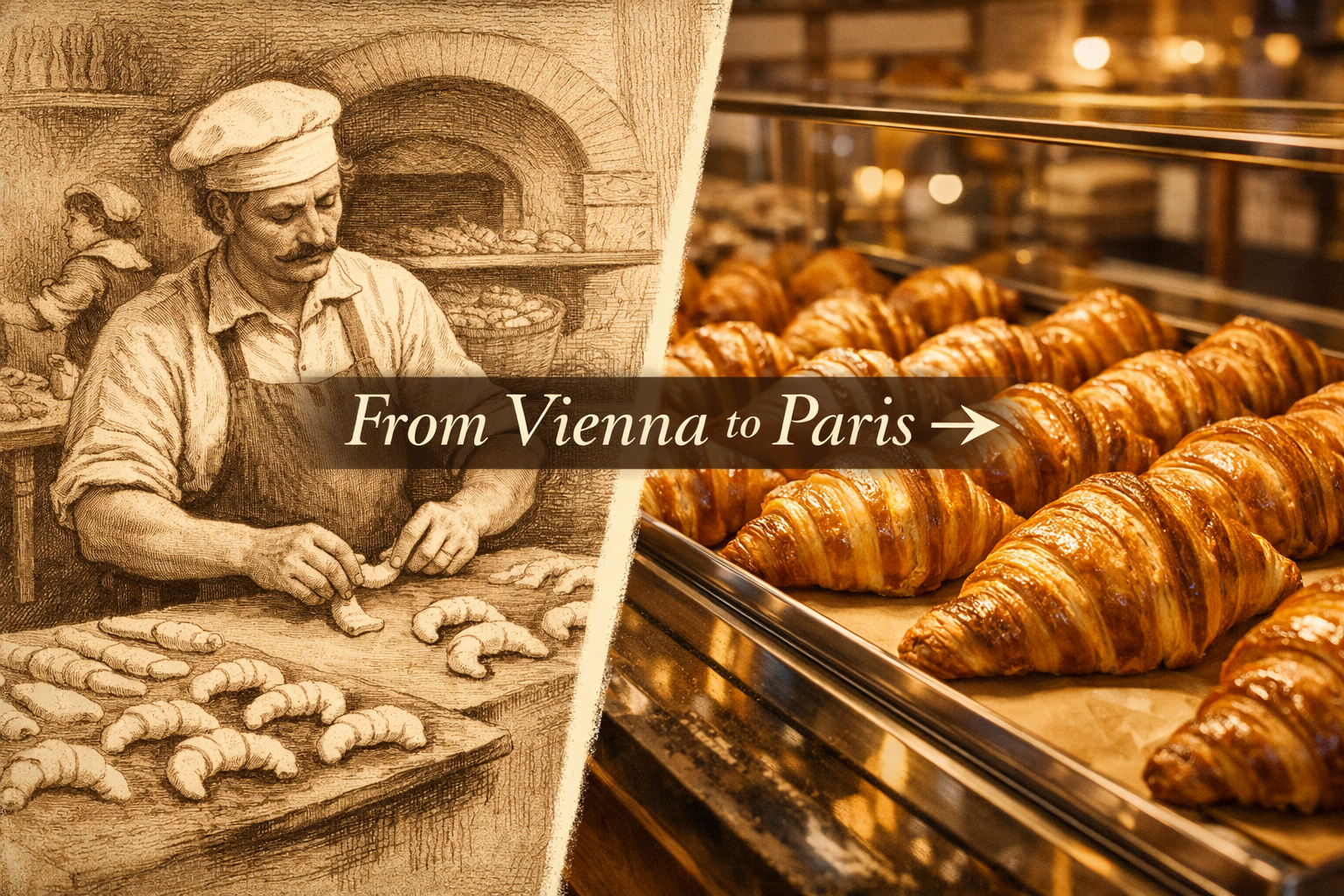
By the 20th century, the croissant had become a symbol of French breakfast culture and spread globally. Today, it’s produced and sold on every continent.
“The croissant is one of the great achievements of European baking — a pastry that rewards patience and precision in equal measure.”
Key historical milestones:
| Era | Development |
|---|---|
| Pre-19th century | Austrian kipferl (crescent roll) widely eaten in Central Europe |
| ~1838–1840 | August Zang opens Viennese bakery in Paris |
| Mid-to-late 1800s | French bakers develop the laminated butter dough technique |
| 20th century | Croissant becomes a global breakfast staple |
| 1981 | Industrial frozen croissant dough patented, enabling mass production |
How Is the Croissant Actually Made?
A real croissant is made through lamination — a process of folding butter into dough repeatedly to create hundreds of thin, alternating layers of fat and dough. When baked, steam from the butter causes those layers to puff and separate, producing the croissant’s characteristic flaky texture.
The basic lamination process:
- Prepare a yeast-leavened dough (détrempe) and chill it.
- Encase a flat sheet of cold butter in the dough.
- Roll and fold the dough in a series of “turns” (typically 3 to 4 folds).
- Chill the dough between folds to keep the butter firm.
- Roll out, cut into triangles, and roll each triangle into the crescent shape.
- Proof (let rise) until puffy, then egg-wash and bake at high heat.
A properly made croissant takes 12 to 24 hours from start to finish, accounting for resting and chilling times. This is why artisan croissants from skilled bakeries command a higher price than mass-produced versions.
Common mistake: Skipping the chilling steps causes the butter to melt into the dough rather than staying in distinct layers, resulting in a bread-like texture instead of a flaky one.
What Are the Different Types of Croissants?
Croissants come in far more varieties than the classic plain version. Understanding the options helps anyone celebrating January 30 National Croissant Day make a more informed choice — whether buying or baking.
Popular croissant varieties:
- Plain (Beurre): The classic, made with pure butter. The gold standard for judging a bakery’s skill.
- Pain au Chocolat: Rectangular, filled with dark chocolate batons. Technically a separate pastry but made from the same laminated dough.
- Almond Croissant: Filled and topped with almond cream (frangipane) and sliced almonds. Often made from day-old croissants.
- Ham and Cheese (Jambon-Fromage): A savory option, popular for lunch.
- Whole Wheat or Multigrain: A healthier variation, though lamination with whole grain flour is technically challenging.
- Vegan Croissant: Uses plant-based butter substitutes; texture varies by brand and recipe.
Choose plain if you want to evaluate a bakery’s technical skill. The plain butter croissant has nowhere to hide — quality of lamination, butter flavor, and bake are immediately apparent.
How Do People Celebrate January 30 National Croissant Day?
Celebrating January 30 National Croissant Day ranges from a simple bakery stop to a full day of pastry-focused activities. There’s no single right way to observe the day.
Common ways people celebrate:
- Visit a local bakery and try their signature croissant (or a variety you’ve never had before).
- Bake at home using a classic laminated dough recipe — a rewarding weekend project.
- Host a croissant tasting with friends, comparing plain, chocolate, and almond versions from different bakeries.
- Share on social media using #NationalCroissantDay to join the broader conversation.
- Try a new recipe using croissants as an ingredient — croissant French toast, breakfast sandwiches, or croissant bread pudding.
- Support local bakeries by buying in bulk or gifting croissants to coworkers.
Bakeries and cafés frequently offer discounts, free samples, or limited-edition flavors on January 30. Checking local bakery social media pages a day or two before the holiday often reveals promotions.
Croissant Nutrition: What to Know Before You Indulge
A standard plain butter croissant (approximately 57g) contains roughly 230–270 calories, with a significant portion coming from fat due to the butter content. Exact nutrition varies by size and recipe.
General nutrition profile (plain butter croissant, ~57g):
| Nutrient | Approximate Amount |
|---|---|
| Calories | 230–270 kcal |
| Total Fat | 12–14g |
| Saturated Fat | 7–8g |
| Carbohydrates | 26–30g |
| Protein | 4–5g |
| Sodium | 200–300mg |
Note: Values are estimates based on standard recipes. Actual nutrition depends on size and specific ingredients used.
National Croissant Day is a celebration, not a nutrition seminar. That said, people managing dietary restrictions should note that traditional croissants contain gluten, dairy, and eggs. Vegan and gluten-free alternatives exist but vary widely in texture and taste.
FAQ: January 30 National Croissant Day
Q: Is January 30 National Croissant Day an official holiday? A: No. It’s an informal food holiday with no government recognition. It’s celebrated voluntarily by food lovers, bakeries, and food media.
Q: Who created National Croissant Day? A: The exact origin is unclear. Like most food holidays in the U.S., it emerged organically through food culture and social media, with no single verified founder.
Q: Is National Croissant Day only celebrated in the United States? A: It originated in the U.S. and is most widely observed there, but food enthusiasts around the world participate, especially on social media.
Q: What’s the difference between a croissant and a crescent roll? A: A croissant uses laminated, yeast-leavened dough with butter folded in layers. A crescent roll (like the canned variety) uses a simpler, non-laminated dough and has a softer, bread-like texture.
Q: Can I make croissants at home without professional equipment? A: Yes. Home bakers make croissants successfully with a rolling pin, refrigerator, and patience. The process is time-consuming but doesn’t require specialized equipment.
Q: What’s the best way to reheat a croissant? A: Place it in an oven or toaster oven at 350°F (175°C) for 4–5 minutes. Avoid microwaving, which makes the layers soggy.
Q: Are there savory croissant options for people who don’t like sweet pastries? A: Yes. Ham and cheese croissants, spinach and feta, and smoked salmon croissants are all popular savory options widely available at bakeries.
Q: How do I know if a croissant is high quality? A: Look for visible, distinct layers in the cross-section, a deep golden-brown exterior, a honeycomb-like interior, and a strong butter aroma. It should shatter slightly when bitten.
Conclusion: Make January 30 Count 🥐
January 30 National Croissant Day is a simple but genuinely enjoyable occasion to slow down and appreciate a pastry that represents centuries of baking craft. Whether the goal is to support a local bakery, try baking laminated dough for the first time, or simply enjoy a great croissant with a morning coffee, the day offers something for everyone.
Actionable next steps:
- Find a quality local bakery that makes croissants from scratch — not frozen dough.
- Try one variety you’ve never had (almond, savory, or a seasonal special).
- Share the experience on social media with #NationalCroissantDay to connect with other enthusiasts.
- If you want to bake: Start the dough the evening of January 29 so it’s ready to bake on the morning of January 30.
- Gift croissants to a neighbor, coworker, or friend — it’s an easy and appreciated gesture.
The croissant earned its place in global food culture through skill, patience, and quality ingredients. Celebrating it for one day each January is the least anyone can do.
References
- Chevallier, Jim. August Zang and the French Croissant: How Viennoiserie Came to France. Chez Jim Books, 2009.
- Davidson, Alan. The Oxford Companion to Food. Oxford University Press, 1999.
- USDA FoodData Central. “Croissant, butter.” U.S. Department of Agriculture, 2019. https://fdc.nal.usda.gov/