
Last updated: March 28, 2026
Quick Answer: January 31 National Hot Chocolate Day is an annual food holiday celebrated in the United States on January 31st. It honors one of the world’s oldest and most beloved warm beverages — hot chocolate — and encourages people to enjoy, share, and explore creative variations of the drink. No registration or official body is required to participate; simply make a mug and celebrate.
Key Takeaways 🍫
- January 31 is the official date of National Hot Chocolate Day in the United States.
- Hot chocolate has a history spanning over 3,000 years, originating with ancient Mesoamerican civilizations.
- The holiday is distinct from National Hot Cocoa Day (December 13), though the two are often confused.
- Participation is simple: make a mug at home, visit a café, or host a tasting event.
- Businesses — especially cafés, bakeries, and restaurants — use the day to run promotions and seasonal specials.
- Hot chocolate and hot cocoa are technically different products (more on that below).
- The day is widely observed on social media under hashtags like #NationalHotChocolateDay and #HotChocolateDay.
- In 2026, January 31 falls on a Saturday, making it an ideal day for a cozy gathering or café outing.
What Is January 31 National Hot Chocolate Day?
January 31 National Hot Chocolate Day is an informal but widely recognized American food holiday dedicated to celebrating hot chocolate in all its forms. It falls every year on January 31st and sits at the heart of winter — a natural fit for a warm, comforting drink.
The holiday has no single founding organization. Like many food observances in the U.S., it grew organically through food bloggers, social media communities, and retailers who saw an opportunity to celebrate a universally loved beverage. Today, it appears on major holiday calendars, food publication editorial schedules, and retail promotional plans across the country.
Who it’s for: Anyone who enjoys a warm drink. The day appeals to home cooks, café owners, chocolate enthusiasts, families with children, and anyone looking for a low-effort reason to treat themselves in the middle of winter.
Hot Chocolate vs. Hot Cocoa: What’s the Difference?
These two drinks are often used interchangeably, but they are made differently and taste distinct.
| Feature | Hot Chocolate | Hot Cocoa |
|---|---|---|
| Base ingredient | Melted real chocolate (bars or chips) | Cocoa powder |
| Fat content | Higher (from cocoa butter in chocolate) | Lower |
| Texture | Thick, rich, creamy | Thinner, lighter |
| Sweetness | Varies by chocolate used | Often pre-sweetened |
| Prep time | Slightly longer | Quick (stir and heat) |
| Best for | Indulgent, European-style drinks | Everyday, quick preparation |
Hot chocolate is made by melting actual chocolate into warm milk or cream. Hot cocoa uses cocoa powder, which has had most of its fat (cocoa butter) removed. Both are delicious — the choice depends on how rich you want the result.
“Hot chocolate made from real chocolate bars delivers a depth of flavor that cocoa powder alone can’t replicate — but cocoa powder is faster and more pantry-friendly for everyday use.”
A Brief History of Hot Chocolate
Hot chocolate is one of the oldest prepared beverages in human history. Understanding its origins adds real meaning to January 31 National Hot Chocolate Day.
- Ancient Mesoamerica (circa 1500 BCE and earlier): The Olmec civilization is widely credited as the first to consume cacao. The Maya and Aztec cultures later developed sophisticated cacao-based drinks, typically consumed cold, bitter, and spiced — very different from what most people drink today.
- 16th century Europe: Spanish conquistadors brought cacao back to Europe, where it was sweetened with sugar and served hot. It became a luxury drink among European nobility.
- 17th–18th centuries: Chocolate houses opened across England and Europe, serving hot chocolate as a fashionable social drink — the coffeehouse equivalent of the era.
- 19th century: The invention of cocoa powder by Dutch chemist Coenraad van Houten in 1828 made hot cocoa accessible to the general public. (Source: The Oxford Companion to Sugar and Sweets, 2015)
- 20th–21st centuries: Mass production, flavored mixes, and specialty café culture transformed hot chocolate into a global everyday beverage.
How to Celebrate January 31 National Hot Chocolate Day
Celebrating January 31 National Hot Chocolate Day doesn’t require much planning. Here are practical ways to mark the occasion, from simple to more involved.
At Home
- Make a classic mug using your preferred method — melted dark chocolate in warm whole milk is a reliable starting point.
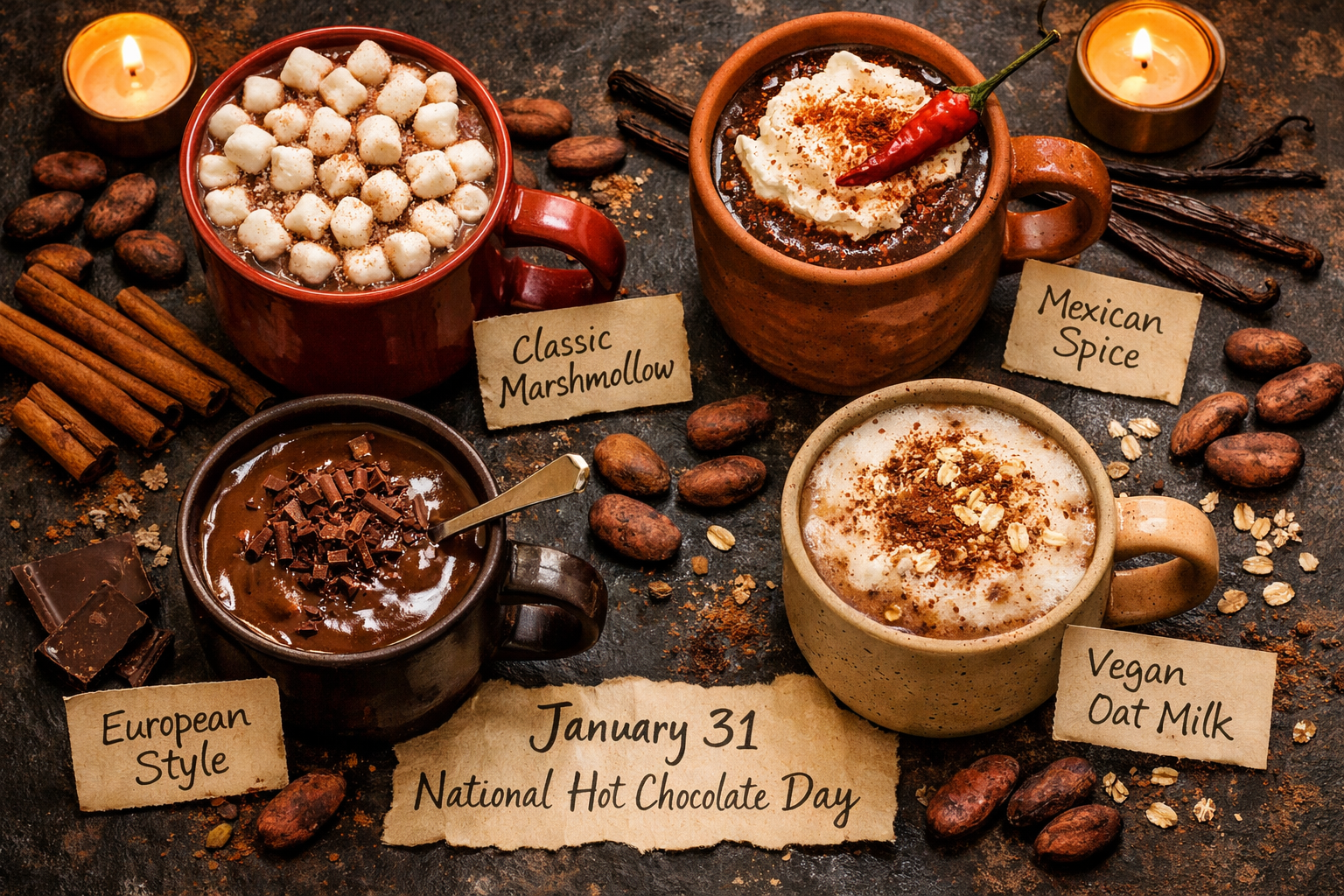
- Try a new recipe — options include Mexican hot chocolate (with cinnamon and chili), salted caramel hot chocolate, or a vegan version using oat milk and dairy-free chocolate.
- Set up a hot chocolate bar for family or friends: lay out toppings like whipped cream, mini marshmallows, crushed candy cane, caramel drizzle, and flavored syrups.
- Pair it with food — hot chocolate pairs well with churros, shortbread, croissants, or a simple piece of dark chocolate.
Out and About
- Visit a local café or chocolate shop and order something you’ve never tried before.
- Check if local businesses are running January 31 National Hot Chocolate Day promotions or specials.
- Attend a community event — some cities host winter market events or food festivals around this time of year.
On Social Media
- Post your mug using #NationalHotChocolateDay or #HotChocolateDay.
- Share a recipe, a café recommendation, or a photo of your homemade creation.
- Tag local businesses to help them gain visibility on the holiday.
Classic Hot Chocolate Recipe (Simple & Reliable)
No special equipment needed. This serves two.
Ingredients:
- 2 cups whole milk (or oat milk for a dairy-free version)
- 2 oz (about 60g) good-quality dark chocolate (60–70% cacao), finely chopped
- 1 tablespoon sugar (adjust to taste)
- Pinch of salt
- Optional: ¼ teaspoon vanilla extract, pinch of cinnamon
Steps:
- Heat milk in a small saucepan over medium-low heat until steaming — do not boil.
- Add chopped chocolate and whisk continuously until fully melted and smooth.
- Stir in sugar, salt, and any optional flavorings.
- Pour into mugs and top as desired.
- Serve immediately.
Choose this recipe if you want a rich, café-style result with minimal effort. For a thinner drink, use less chocolate or substitute one ounce with cocoa powder.
Why Businesses Should Pay Attention to This Food Holiday
Food holidays like January 31 National Hot Chocolate Day represent genuine marketing opportunities for cafés, bakeries, restaurants, and food brands — especially in January, a month when consumer spending typically dips after the holidays.
Practical moves for businesses:
- Create a limited-edition hot chocolate flavor or presentation for the day.
- Offer a discount or “buy one, get one” deal to drive foot traffic.
- Run a social media contest asking customers to share their hot chocolate photos.
- Partner with a local chocolate maker or dairy supplier for a co-branded promotion.
- Email your subscriber list a recipe or a special offer tied to the date.
January 31 is also a useful anchor for content marketing — recipe posts, “history of hot chocolate” articles, and product spotlights all perform well around food holidays because search interest spikes predictably.
Frequently Asked Questions
Q: When is National Hot Chocolate Day? National Hot Chocolate Day is celebrated every year on January 31st in the United States.
Q: Is January 31 National Hot Chocolate Day an official holiday? No. It is an informal food observance, not a federally recognized public holiday. No government body or single organization officially governs it.
Q: Is National Hot Chocolate Day the same as National Hot Cocoa Day? No. National Hot Cocoa Day is observed on December 13th. National Hot Chocolate Day falls on January 31st. The two drinks are also technically different products.
Q: What’s the best chocolate to use for hot chocolate? Dark chocolate with 60–70% cacao content melts smoothly and delivers a balanced, rich flavor without being overly bitter. Milk chocolate works well for a sweeter, milder result.
Q: Can hot chocolate be made dairy-free? Yes. Oat milk, almond milk, and coconut milk all work as substitutes. Oat milk produces the creamiest result closest to whole milk.
Q: What toppings go well with hot chocolate? Whipped cream, mini marshmallows, crushed candy cane, caramel drizzle, cocoa powder, cinnamon, and chocolate shavings are all popular choices.
Q: Is hot chocolate healthy? Hot chocolate made from real dark chocolate contains antioxidants (flavanols) from cacao. However, most commercial preparations are high in sugar and calories. Homemade versions allow full control over ingredients.
Q: What hashtags should I use on social media? Use #NationalHotChocolateDay, #HotChocolateDay, and #HotChocolate for maximum reach on January 31st.
Q: In 2026, what day of the week does January 31 fall on? In 2026, January 31 falls on a Saturday — a great day for a relaxed celebration or a café outing.
Conclusion
January 31 National Hot Chocolate Day is a simple, enjoyable occasion that needs no formal invitation. Whether the plan is a quiet mug at home, a café visit, or a hot chocolate bar with friends, the day offers a genuine reason to slow down and enjoy something warm in the middle of winter.
Actionable next steps for 2026:
- Mark January 31 on your calendar and decide how you want to celebrate.
- Stock up on quality chocolate — a good 60–70% dark chocolate bar is the foundation of a great cup.
- Try one new recipe or flavor you’ve never made before (Mexican spiced, salted caramel, or a vegan version are good starting points).
- Share your mug on social media using #NationalHotChocolateDay to connect with the broader community.
- If you run a food business, plan a promotion or limited special at least a week in advance to build anticipation.
Hot chocolate has been bringing people together for thousands of years. January 31 is simply a good excuse to remember that.
References
- Coe, Sophie D., and Michael D. Coe. The True History of Chocolate. Thames & Hudson, 1996.
- Mason, Laura, ed. The Oxford Companion to Sugar and Sweets. Oxford University Press, 2015.
- National Confectioners Association. “Chocolate Facts & Statistics.” https://www.candyusa.com, accessed 2024.