
Last updated: March 28, 2026
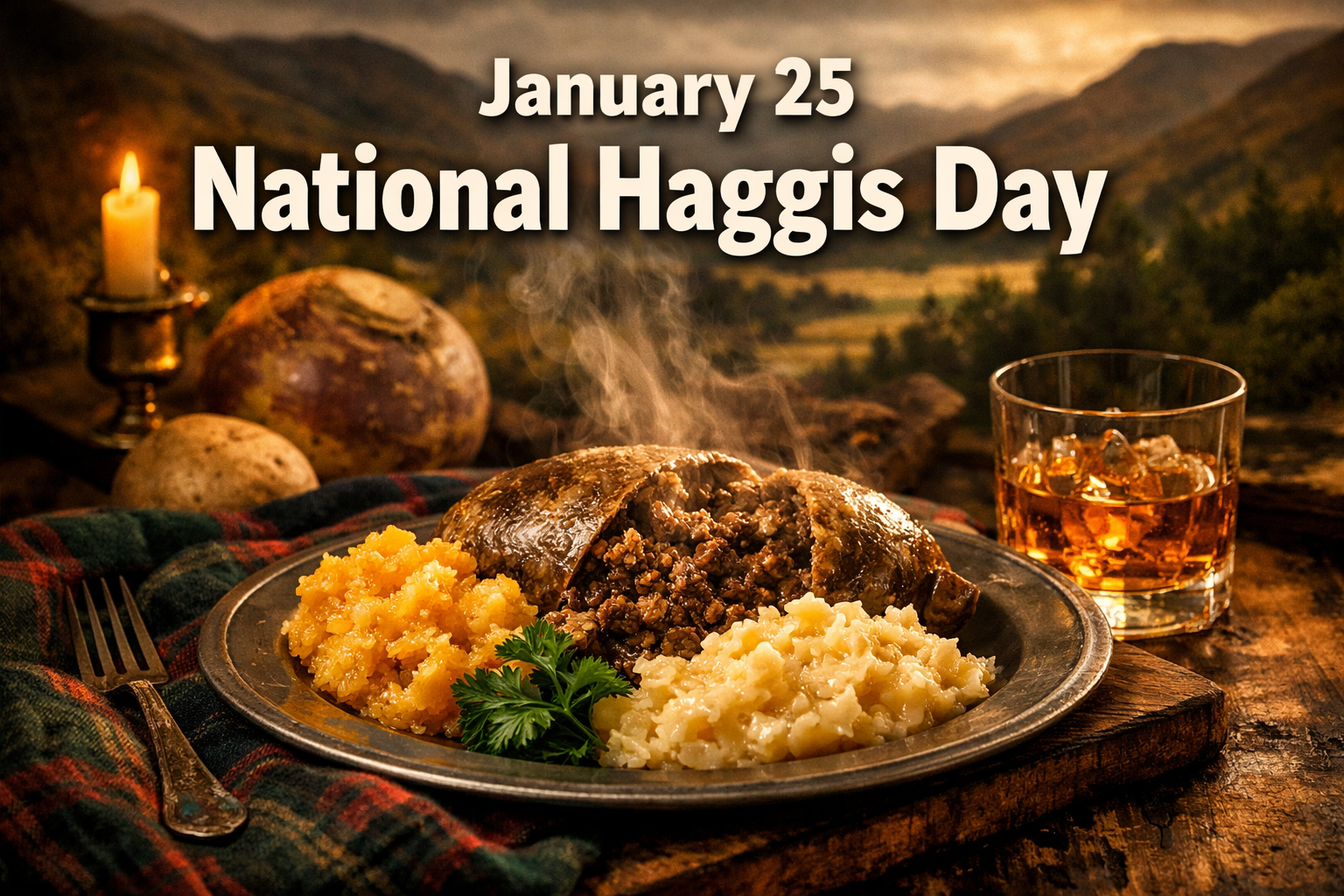
Quick Answer: January 25 National Haggis Day is celebrated annually on January 25 as part of Burns Night, Scotland’s tribute to poet Robert Burns. On this day, haggis — Scotland’s national dish — is served at gatherings worldwide, accompanied by neeps, tatties, and Scotch whisky. The tradition dates to the early 19th century and remains one of the most recognized cultural food observances in the world.
Key Takeaways 🏴
- January 25 marks both Burns Night and National Haggis Day, honoring Robert Burns (born January 25, 1759).
- Haggis is Scotland’s national dish, traditionally made from sheep offal, oatmeal, onions, and spices, cooked in a sheep’s stomach.
- The “Address to a Haggis” — a poem by Robert Burns — is recited at every traditional Burns Supper.
- Burns Suppers are held across Scotland, the UK, and in Scottish diaspora communities on every continent.
- Modern versions include vegetarian and vegan haggis, making the celebration accessible to more people.
- The day is not a public holiday but is widely observed through dinners, ceilidhs (Scottish dances), and cultural events.
- Haggis is also available year-round in Scotland and is exported to many countries, though U.S. import restrictions on certain offal products have historically limited availability.
- Celebrating at home requires just a few key ingredients and a willingness to follow a simple traditional menu.
What Is January 25 National Haggis Day?
January 25 National Haggis Day is the annual celebration of haggis, Scotland’s national dish, held every January 25 as the centerpiece of Burns Night. The date honors Robert Burns, Scotland’s national poet, who was born on January 25, 1759.
Burns Night and National Haggis Day are effectively the same observance. The evening traditionally follows a set format: guests gather for a multi-course supper, the haggis is piped in by a bagpiper, and Burns’ famous poem “Address to a Haggis” is recited before the meal begins. The event blends food, poetry, music, and Scottish pride into a single celebration.
“Fair fa’ your honest, sonsie face, Great chieftain o’ the puddin’-race!” — Robert Burns, “Address to a Haggis” (1787)
What Is Haggis, Exactly?
Haggis is a savory Scottish pudding made from sheep’s offal (heart, liver, and lungs) mixed with oatmeal, suet, onions, salt, and spices. Traditionally, the mixture is encased in the animal’s stomach and simmered for several hours.
Traditional haggis ingredients:
| Ingredient | Role in the Dish |
|---|---|
| Sheep offal (heart, liver, lungs) | Primary protein base |
| Pinhead oatmeal | Texture and binding |
| Beef suet | Fat for richness |
| Onion | Flavor base |
| Black pepper and spices | Seasoning |
| Sheep stomach (casing) | Traditional cooking vessel |
The flavor is earthy, peppery, and savory — closer to a spiced sausage or stuffing than to what many people expect. Most first-time eaters are pleasantly surprised.
Vegetarian and vegan haggis replaces offal with lentils, beans, mushrooms, and nuts. These versions are widely available in Scottish supermarkets and have become popular enough to appear at formal Burns Suppers.
Common mistake: Assuming haggis tastes “gamey” or unpleasant. Well-made haggis has a mild, warming flavor that pairs naturally with the buttery mash and turnip served alongside it.
How Did January 25 National Haggis Day Begin?
The origins of Burns Night trace back to 1801, when friends of Robert Burns gathered on the fifth anniversary of his death (July 21) to honor his memory. They recited his poetry, ate haggis, and drank whisky. The tradition shifted to January 25 — his birthday — and has been observed on that date ever since.
The first formal Burns Supper is generally credited to the Burns Club of Greenock, Scotland, founded in 1801 (source: The Burns Federation). Over the following decades, Burns Clubs spread across Scotland, England, and Scottish emigrant communities in North America, Australia, and beyond.
January 25 National Haggis Day as a named observance is a more recent, informal designation that grew alongside food-themed national days. It reinforces the culinary focus of Burns Night for audiences who may not be familiar with the poetry tradition.
How Is January 25 National Haggis Day Celebrated?

A traditional Burns Supper follows a clear structure. Whether hosting a formal dinner for twenty or a casual meal for four, the format is easy to adapt.
Classic Burns Supper order of events:
- Guests are seated — often with a piper playing as they arrive.
- Selkirk Grace is recited before the meal (a short blessing attributed to Burns).
- Starter course — traditionally cock-a-leekie soup or Cullen skink (smoked haddock chowder).
- The haggis is piped in — a bagpiper leads the cook carrying the haggis to the table.
- “Address to a Haggis” is recited, with the haggis ceremonially cut open at the line “An’ cut you up wi’ ready slight.”
- Main course served — haggis with neeps (mashed turnip/swede) and tatties (mashed potatoes), plus a dram of Scotch whisky.
- Speeches and toasts — including the “Immortal Memory” (a tribute to Burns), the “Toast to the Lassies,” and the “Reply from the Lassies.”
- Dessert — typically cranachan (whipped cream, oats, raspberries, and whisky) or clootie dumpling.
- Entertainment — poems, songs, and often a ceilidh (traditional Scottish dancing).
Choose this format if: hosting a group of four or more who want the full cultural experience. For a solo or casual celebration, simply cooking haggis with neeps and tatties and reading the poem aloud is entirely appropriate.
Where Is January 25 National Haggis Day Celebrated?
Burns Night and National Haggis Day are observed wherever Scottish communities exist — which means virtually every country in the world. Scotland sees the highest concentration of events, but major celebrations also take place in:
- United States — Scottish societies in cities like New York, Boston, and Chicago host formal suppers.
- Canada — particularly in Nova Scotia (“New Scotland”), with strong Highland heritage.
- Australia and New Zealand — large Scottish diaspora communities hold events in Sydney, Melbourne, and Auckland.
- United Arab Emirates and Singapore — expatriate communities organize Burns Suppers in major cities.
In 2026, many events have expanded to include haggis-themed food festivals, cooking demonstrations, and virtual Burns Suppers streamed online, making participation accessible to anyone with an interest in Scottish culture.
Can You Celebrate January 25 National Haggis Day at Home?
Yes — celebrating at home is straightforward and doesn’t require formal event planning. Haggis is available canned, vacuum-packed, or fresh from Scottish specialty retailers and many online food shops.
Simple home celebration checklist:
- Source haggis (canned, fresh, or vegetarian)
- Buy turnip/swede and potatoes for neeps and tatties
- Pick up a bottle of Scotch whisky (optional but traditional)
- Print or bookmark “Address to a Haggis” by Robert Burns
- Prepare cranachan ingredients for dessert
- Play Scottish folk music or a bagpipe playlist during dinner
Edge case: If haggis is unavailable locally, many Scottish food retailers ship internationally. In the U.S., some offal-based haggis products face import restrictions, but domestic producers make compliant versions, and vegetarian haggis ships freely.
FAQ: January 25 National Haggis Day
Q: Is January 25 National Haggis Day an official public holiday? A: No. It is a cultural observance, not a public holiday in Scotland or anywhere else. Businesses and schools operate normally on January 25.
Q: Is haggis safe to eat? A: Yes. Commercially produced haggis is fully cooked and meets food safety standards. It has been a staple of Scottish cuisine for centuries.
Q: What does haggis taste like? A: Haggis tastes savory, peppery, and slightly nutty from the oatmeal. It is often compared to a well-seasoned sausage or stuffing rather than anything strongly “offal-like.”
Q: Is vegetarian haggis authentic? A: Vegetarian haggis is a modern adaptation, not a historical original. However, it is widely accepted at Burns Suppers and is a practical choice for non-meat-eaters.
Q: Why is haggis banned in the United States? A: Traditional haggis containing sheep lung is prohibited under U.S. Department of Agriculture regulations that ban the sale of livestock lungs for human consumption. American-made haggis omits lung and is legal.
Q: Do you need a bagpiper to celebrate Burns Night? A: No. A bagpipe recording works fine for home celebrations. The piping-in of the haggis is a ceremonial touch, not a strict requirement.
Q: What whisky pairs best with haggis? A: A smoky Islay Scotch (such as Laphroaig or Bowmore) or a robust Highland malt (such as Dalmore) pairs well with haggis. The whisky is also used to make the traditional toast.
Q: Can children participate in Burns Night? A: Absolutely. Children can enjoy haggis, neeps, and tatties, recite Burns poems, and join in ceilidh dancing. The whisky toast is simply replaced with juice or water for younger participants.
Q: Where can you buy haggis outside Scotland? A: Scottish specialty food shops, some international grocery stores, and online retailers such as Real Foods or Macsween (which ships internationally) stock haggis year-round.
Q: How long has haggis been Scotland’s national dish? A: Haggis has been associated with Scottish identity since at least the 15th century, with early written recipes appearing in that era. Robert Burns’ 1787 poem cemented its status as a national symbol.
Conclusion: How to Make the Most of January 25 National Haggis Day
January 25 National Haggis Day is more than a quirky food observance — it’s a genuine cultural tradition with over 200 years of history behind it. Whether attending a formal Burns Supper, hosting friends at home, or simply cooking haggis for the first time, the day offers a direct connection to Scottish heritage and the enduring legacy of Robert Burns.
Actionable next steps for 2026:
- Find or order haggis now — fresh and specialty versions sell out close to January 25.
- Read “Address to a Haggis” beforehand so the recitation feels natural at the table.
- Follow the traditional menu (starter, haggis with neeps and tatties, cranachan) for the full experience.
- Invite others — Burns Night is a communal celebration, and sharing the meal is half the point.
- Explore Burns’ poetry beyond the haggis address — “Auld Lang Syne” and “To a Mouse” are excellent starting points.
Scotland’s national dish deserves its day. January 25 is the perfect occasion to try it.
References
- The Burns Federation. History of Burns Night. burnsscotland.com. (n.d.)
- Macsween of Edinburgh. What Is Haggis? macsween.co.uk. (n.d.)
- Historic Environment Scotland. Robert Burns: Scotland’s National Poet. historicenvironment.scot. (2019)
- U.S. Department of Agriculture Food Safety and Inspection Service. Livestock Slaughter Regulations. fsis.usda.gov. (2017)
- VisitScotland. Burns Night Guide. visitscotland.com. (2023)