

Every year on March 26, health enthusiasts, home cooks, and nutrition advocates unite to celebrate one of the world’s most powerful vegetables. March 26 Spinach Day is a fun, food-focused observance that shines a well-deserved spotlight on spinach — a leafy green that has fueled athletes, inspired cartoons, and stocked kitchens for centuries. Whether someone is a devoted health nut or simply curious about food holidays, this annual celebration offers the perfect excuse to add more greens to the plate.
Key Takeaways 📌
- March 26 Spinach Day is an annual food observance dedicated to celebrating the nutritional power and culinary versatility of spinach.
- Spinach is one of the most nutrient-dense vegetables on the planet, packed with iron, vitamins, and antioxidants.
- The holiday encourages people of all ages to incorporate more spinach into their daily diets.
- Celebrating is easy — from smoothies to salads to sautéed dishes, spinach fits into almost any meal.
- Awareness days like this one play a meaningful role in promoting long-term healthy eating habits.
What Is March 26 Spinach Day?
March 26 Spinach Day is an unofficial but widely recognized food holiday observed annually on March 26. Like many food awareness days, its exact origin is difficult to trace to a single founder or organization. However, its purpose is clear: to encourage people to appreciate, eat, and celebrate spinach in all its forms.
Food holidays have grown significantly in popularity over the past two decades, largely driven by social media. Platforms like Instagram, TikTok, and Pinterest turn observances like Spinach Day into trending moments — complete with recipe shares, cooking challenges, and nutrition tips. In 2026, the hashtag culture around food holidays continues to grow, making March 26 a great opportunity for food bloggers, nutritionists, and home cooks to engage their audiences.
“Let food be thy medicine and medicine be thy food.” — Hippocrates
Spinach, in many ways, embodies that ancient wisdom perfectly.
The Nutritional Powerhouse Behind the Holiday
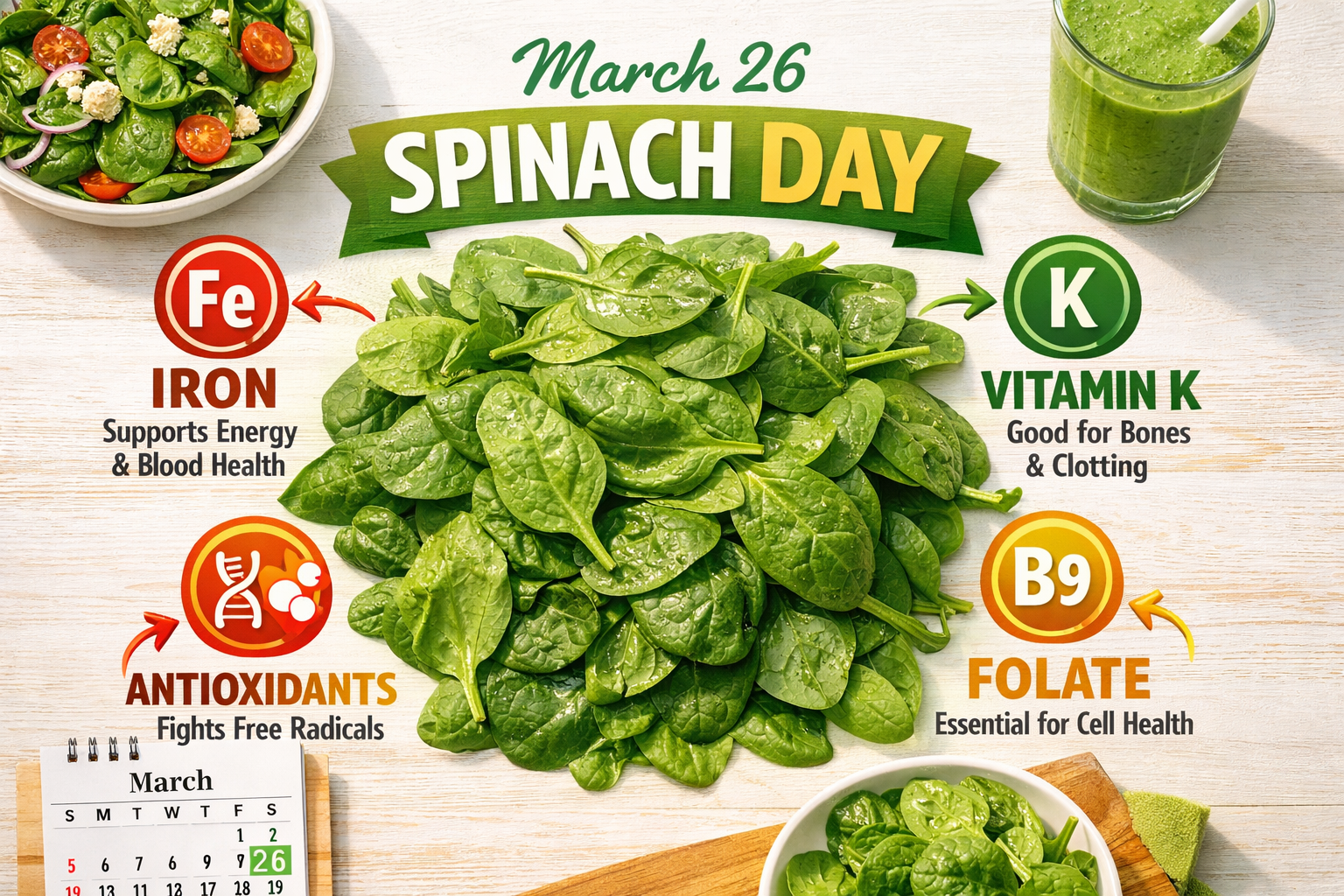
One reason March 26 Spinach Day resonates so strongly with the health community is the sheer nutritional value packed into every leaf. Spinach (Spinacia oleracea) is a flowering plant in the family Amaranthaceae, native to central and western Asia. Today, it is grown and consumed worldwide.
Key Nutrients Found in Spinach
| Nutrient | Benefit | Amount per 100g (raw) |
|---|---|---|
| Iron | Supports red blood cell production | 2.7 mg |
| Vitamin K | Essential for bone health and clotting | 483 µg |
| Folate (B9) | Critical for cell growth and DNA repair | 194 µg |
| Vitamin A | Supports eye health and immunity | 469 µg RAE |
| Vitamin C | Antioxidant, boosts immune function | 28.1 mg |
| Magnesium | Supports muscle and nerve function | 79 mg |
| Calcium | Strengthens bones and teeth | 99 mg |
Source: USDA FoodData Central
Spinach is also remarkably low in calories — just 23 calories per 100 grams — making it one of the most efficient foods for nutrient delivery. It contains powerful antioxidants like lutein and zeaxanthin, which are strongly linked to reduced risk of age-related macular degeneration.
Why Spinach Stands Out Among Leafy Greens
While kale, arugula, and Swiss chard all deserve recognition, spinach holds a unique position:
- 🟢 Mild flavor — easier to incorporate into meals without overpowering other ingredients
- 🟢 Versatile texture — works raw in salads or wilted in hot dishes
- 🟢 Year-round availability — accessible in fresh, frozen, and canned forms
- 🟢 Budget-friendly — one of the most affordable leafy greens at most grocery stores
A Brief History of Spinach
Understanding the history of spinach adds depth to the celebration of March 26 Spinach Day. Spinach is believed to have originated in ancient Persia (modern-day Iran). It traveled to China via Nepal around 647 AD and reached Europe through the Arab-controlled regions of Spain by the 11th century.
By the 16th century, spinach had become a favorite of European royalty. Catherine de’ Medici, the Italian-born Queen of France, was reportedly so fond of spinach that dishes served on a bed of spinach are still called “Florentine” — a nod to her Florentine roots.
In the 20th century, spinach gained worldwide pop-culture fame through Popeye the Sailor Man, the cartoon character created by E.C. Segar in 1929. Popeye’s habit of squeezing open a can of spinach to gain superhuman strength made spinach synonymous with power and health — especially for children. Interestingly, this cultural moment is widely credited with boosting spinach consumption in the United States during the 1930s.
How to Celebrate March 26 Spinach Day 🎉
Celebrating March 26 Spinach Day does not require a special event or elaborate planning. Here are some accessible and enjoyable ways to mark the occasion:
🥗 In the Kitchen
- Make a spinach smoothie — blend fresh spinach with banana, mango, and almond milk for a nutrient-packed green smoothie
- Toss a spinach salad — combine baby spinach with strawberries, walnuts, feta cheese, and balsamic vinaigrette
- Cook a classic dish — try spinach and ricotta stuffed pasta, palak paneer, or a simple sautéed spinach with garlic and olive oil
- Bake with spinach — add spinach to quiches, frittatas, or savory muffins
📱 On Social Media
- Share a spinach recipe using the hashtag #SpinachDay or #March26SpinachDay
- Post a before-and-after photo of a spinach-based meal
- Challenge friends and family to cook one spinach dish on March 26
🏫 In Schools and Communities
- Host a nutrition workshop focused on leafy greens
- Introduce spinach-based recipes in school cafeteria menus
- Partner with local farmers markets to highlight fresh, locally grown spinach
Spinach Around the World 🌍
Spinach is not just a Western staple. It plays a central role in cuisines across the globe:
| Region | Popular Spinach Dish |
|---|---|
| India | Palak Paneer (spinach and cottage cheese curry) |
| Middle East | Fatayer bi Sabanekh (spinach-filled pastry) |
| Greece | Spanakopita (spinach and feta phyllo pie) |
| Japan | Ohitashi (blanched spinach with soy sauce) |
| Italy | Pasta Fiorentina (pasta with spinach sauce) |
| USA | Creamed spinach, spinach dip |
This global reach is a testament to spinach’s adaptability and universal appeal — and a great reason to celebrate it on March 26 each year.
Health Benefits Backed by Science
The enthusiasm surrounding March 26 Spinach Day is well-supported by scientific research. Studies have consistently linked regular spinach consumption to a range of health benefits:
- Heart health: The nitrates in spinach help lower blood pressure and reduce the risk of heart disease.
- Bone strength: High levels of Vitamin K support bone mineralization and reduce fracture risk.
- Blood sugar regulation: Spinach contains alpha-lipoic acid, an antioxidant shown to lower glucose levels and increase insulin sensitivity.
- Cancer prevention: Compounds like MGDG and SQDG found in spinach have demonstrated the ability to slow tumor growth in preliminary studies.
- Brain health: Lutein and other plant-based nutrients in spinach are associated with slower cognitive decline in older adults.
💡 Quick Tip: Cooking spinach slightly increases the availability of certain nutrients like iron and calcium by breaking down oxalic acid, which can inhibit absorption when consumed raw.
Conclusion: Make March 26 Count 🥬
March 26 Spinach Day is more than just a quirky food holiday — it is a meaningful reminder of the incredible power that simple, whole foods hold over long-term health. Spinach has earned its place on plates across the world through centuries of culinary tradition, robust nutritional science, and even pop-culture fame.
Actionable Next Steps for 2026:
- Add spinach to one meal on March 26 — even a small handful in a smoothie counts.
- Share the celebration — post a spinach recipe on social media and inspire others.
- Go beyond the day — aim to incorporate spinach into meals at least 3–4 times per week.
- Explore global recipes — try a new spinach dish from a different culture this month.
- Talk to a nutritionist — get personalized advice on how leafy greens can support specific health goals.
Small dietary changes, consistently applied, lead to lasting results. Let March 26 be the starting point for a greener, healthier plate — all year long.
References
- USDA FoodData Central. (2019). Spinach, raw. U.S. Department of Agriculture. https://fdc.nal.usda.gov/
- Bohn, T., et al. (2004). Phytic acid added to white-wheat bread inhibits fractional apparent magnesium absorption in humans. The American Journal of Clinical Nutrition, 79(3), 418–423.
- Ranganathan, S., & Bhargava, A. (2007). Spinach (Spinacia oleracea L.): A nutritional overview. Journal of Horticultural Science and Biotechnology, 82(2), 175–181.
- Morris, M. C., et al. (2018). Nutrients and bioactives in green leafy vegetables and cognitive decline. Neurology, 90(3), e214–e222.
- Segar, E. C. (1929). Thimble Theatre (Popeye the Sailor Man debut). King Features Syndicate.