May 6 National Crêpes Suzette Day: History, Recipe, and How to Celebrate in 2026
- 0
- 16 Min Read

Last updated: May 6, 2026
Quick Answer: May 6 National Crêpes Suzette Day is an annual food observance dedicated to one of French cuisine’s most theatrical desserts, thin crêpes bathed in a buttery orange sauce and finished tableside with a flambé. Celebrated each year on May 6, the day honors a dish with more than a century of culinary history. Home cooks and restaurant diners alike use the occasion to experience (or re-create) this classic French preparation.
Key Takeaways
- May 6 National Crêpes Suzette Day falls annually on May 6 and celebrates a classic French dessert with roots in the late 19th century.
- Crêpes Suzette differs from plain crêpes because of its signature orange-butter sauce (suzette sauce) and the optional flambé with Grand Marnier or Cointreau.
- The dish is widely attributed to a kitchen accident at the Café de Paris in Monte Carlo around 1895, though the exact origin story is disputed.
- Beginner home cooks can make crêpes Suzette successfully with standard kitchen equipment, a flambé is optional, not required.
- The sauce can be made ahead of time and stored refrigerated for up to three days.
- A non-alcoholic version of the dish is easy to prepare by substituting fresh orange juice for the liqueur.
- Dry sparkling wines, light dessert wines, or a classic Sauternes pair well with the dish’s bright citrus notes.
- Restaurant pricing for crêpes Suzette typically ranges from $14 to $28 per serving in the United States, depending on the establishment.

What Is Crêpes Suzette and Where Did It Come From?
Crêpes Suzette is a French dessert consisting of thin crêpes served in a warm sauce of butter, sugar, orange juice, and orange liqueur, traditionally finished with a tableside flambé. It is considered one of the signature dishes of classic French haute cuisine.
The most widely cited origin story places the dish’s invention around 1895 at the Café de Paris in Monte Carlo. According to culinary legend, a young assistant named Henri Charpentier accidentally set the sauce alight while preparing a dessert for the Prince of Wales (the future King Edward VII). The prince reportedly enjoyed the result, and the dish was named after a young woman in his party, Suzette. Charpentier himself later claimed full credit in his 1934 memoir, though food historians note the account contains inconsistencies.
A competing theory credits the dish to French chef Auguste Escoffier, who documented a similar preparation in the early 1900s. Regardless of which account is accurate, the dish became a fixture of fine French dining throughout the 20th century and remains a symbol of classic tableside service.
For more on celebrated French-influenced baked goods, see the National Croissant Day guide for another deep dive into French culinary tradition.
Why Is May 6 National Crêpes Suzette Day?
May 6 National Crêpes Suzette Day is an informal American food holiday observed each year on May 6 to honor crêpes Suzette and French culinary heritage. Like most national food days in the United States, the date was established by food enthusiasts and culinary organizations rather than by government proclamation.
No single founding body has been officially credited with setting May 6 as the date. The observance follows the broader pattern of national food days that have proliferated across the American culinary calendar, giving food lovers a dedicated reason to cook, dine out, and share recipes. The date sits in early May, a time when citrus flavors feel seasonal and celebratory.
If you enjoy exploring these food observances, the National Blueberry Pancake Day guide covers another beloved breakfast-style dish with its own dedicated day.
What Is the Difference Between Crêpes Suzette and Regular Crêpes?
Regular crêpes are thin, unleavened pancakes made from flour, eggs, milk, and butter, served with a wide range of sweet or savory fillings. Crêpes Suzette is a specific preparation in which plain crêpes are folded into quarters and cooked in a distinct orange-butter sauce, then optionally flambéed.
Here is a side-by-side comparison:
| Feature | Regular Crêpes | Crêpes Suzette |
|---|---|---|
| Base | Thin batter crêpe | Same thin crêpe |
| Sauce | Varies (jam, cream, Nutella) | Orange-butter suzette sauce |
| Alcohol | Optional or none | Grand Marnier or Cointreau (traditional) |
| Flambé | Never | Traditional but optional |
| Occasion | Casual, everyday | Special occasion, fine dining |
The key distinction is the sauce. Suzette sauce transforms a simple crêpe into an elegant dessert with a complex flavor profile, buttery, citrusy, slightly caramelized, and (when flambéed) subtly smoky from the burnt-off alcohol.
What Sauce Goes on Crêpes Suzette?
Suzette sauce is a warm, emulsified mixture of unsalted butter, sugar, fresh orange juice, orange zest, and orange liqueur (traditionally Grand Marnier or Cointreau). The sauce is cooked in a wide pan until the sugar caramelizes lightly and the butter and juice combine into a glossy, fragrant coating.
Standard suzette sauce ingredients (serves 4):
- 4 tablespoons unsalted butter
- 3 tablespoons granulated sugar
- Zest and juice of 2 large oranges
- 1 tablespoon fresh lemon juice
- 3 tablespoons Grand Marnier or Cointreau (or substitute fresh orange juice for a non-alcoholic version)
The sauce should be made in a wide, heavy-bottomed pan or skillet so the crêpes can be folded and heated directly in it. The finished sauce is bright orange, glossy, and lightly thickened from the caramelized sugar.
How Do You Make Crêpes Suzette at Home?
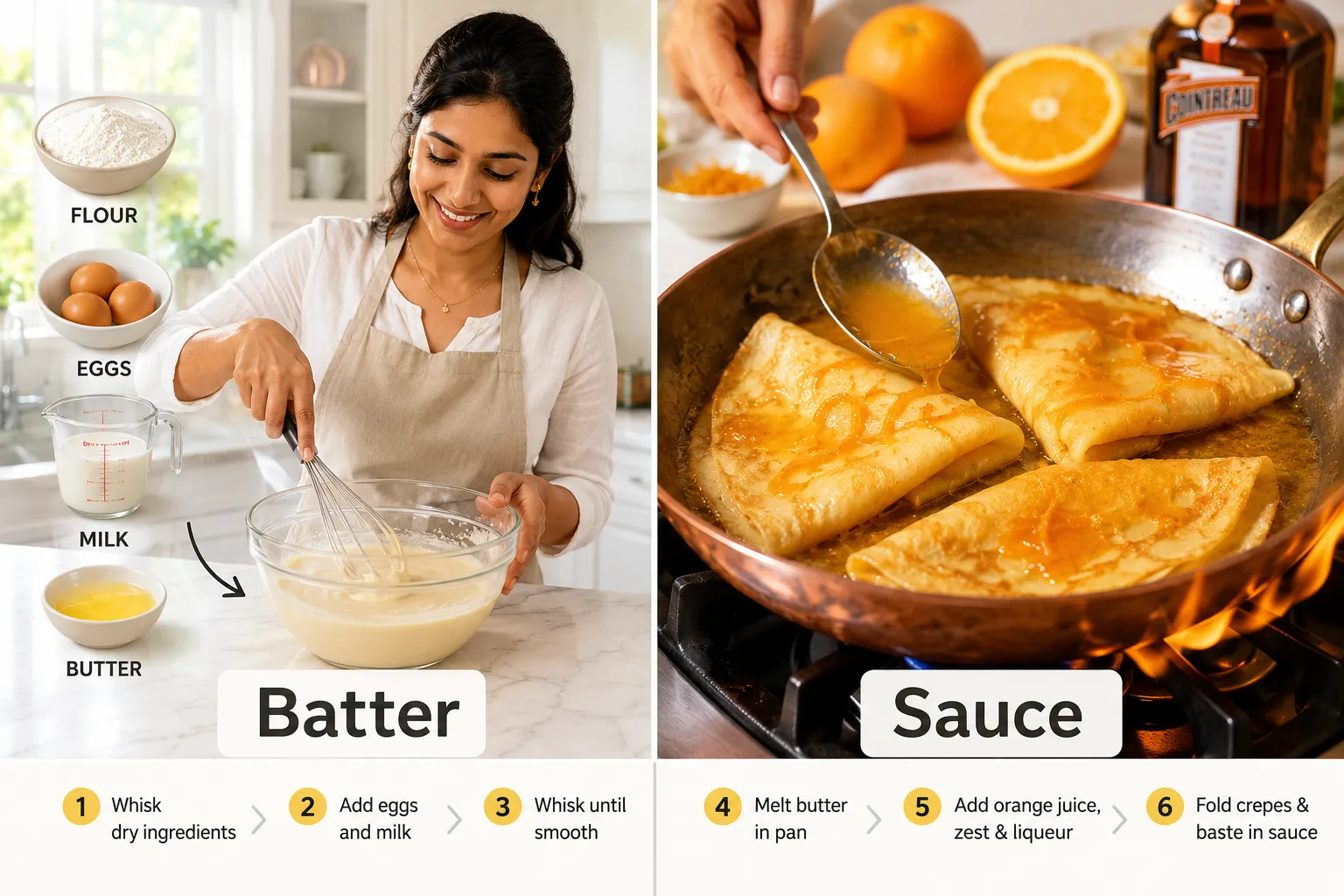
Crêpes Suzette can be made at home in about 45 to 60 minutes with standard kitchen equipment. The process involves three stages: making the crêpe batter, cooking the crêpes, and preparing the suzette sauce.
Step-by-Step Home Recipe
Step 1, Make the batter (rest 30 minutes): Whisk together 1 cup all-purpose flour, 2 large eggs, 1.5 cups whole milk, 2 tablespoons melted butter, 1 tablespoon sugar, and a pinch of salt until smooth. Rest the batter for at least 30 minutes at room temperature. Resting reduces gluten tension and produces more tender crêpes.
Step 2, Cook the crêpes: Heat a non-stick 8- or 9-inch skillet over medium heat. Lightly butter the pan. Pour about 3 tablespoons of batter and swirl immediately to coat the pan in a thin, even layer. Cook 60 to 90 seconds until the edges lift and the surface is set, then flip and cook 30 seconds more. Stack finished crêpes on a plate. This recipe yields approximately 10 to 12 crêpes.
Step 3, Make the suzette sauce: In a wide skillet over medium heat, melt the butter with the sugar. Add orange zest, orange juice, and lemon juice. Stir until the sugar dissolves and the sauce begins to bubble and reduce slightly, about 3 to 4 minutes.
Step 4, Finish the crêpes in the sauce: Fold each crêpe into quarters (forming a triangle). Place folded crêpes into the sauce, overlapping slightly. Spoon sauce over the top and warm through for 1 to 2 minutes.
Step 5, Optional flambé: Add the liqueur to the pan. Tilt the pan slightly away from you and use a long-handled lighter to ignite the vapors at the edge of the pan. Let the flames die naturally (about 30 to 60 seconds). Serve immediately.
Is Crêpes Suzette Hard to Make for Beginners?
Crêpes Suzette is an intermediate-level recipe, not a beginner one, but the difficulty is manageable. The crêpe batter itself is straightforward; the learning curve is in cooking thin, even crêpes without tearing them. The flambé step is optional and can be skipped entirely without affecting the flavor significantly.
Common mistakes to avoid:
- Skipping the batter rest: Unrested batter produces tough, rubbery crêpes. Always rest for at least 30 minutes.
- Pan too hot or too cold: Medium heat is correct. Too hot and the crêpe burns before it sets; too cold and it sticks.
- Sauce too thin: If the sauce doesn’t thicken, the heat is too low or there is too much liquid. Increase heat slightly and reduce for another minute.
- Flambéing in a small pan: Always use a wide, low-sided pan with plenty of clearance. Never flambé in a deep pot.
- Adding cold liqueur: Room-temperature or slightly warmed liqueur ignites more reliably than cold.
Choose the no-flambé version if cooking for children, if you are new to stovetop cooking, or if you are working in a kitchen with limited ventilation.
How Do You Flambé Crêpes Suzette Safely?
A flambé is performed by adding a high-proof alcohol to a hot pan and igniting it to burn off the alcohol, leaving behind concentrated flavor. For crêpes Suzette, the standard approach uses Grand Marnier (40% ABV) or Cointreau (40% ABV).
Safety checklist before flambéing:
- Clear the area above the pan of cabinets, paper towels, or any flammable material.
- Use a long-handled lighter or a long match, never a short lighter.
- Turn off the overhead exhaust fan (it can spread flames).
- Keep a lid nearby to smother the flame if it grows unexpectedly.
- Never pour liqueur directly from the bottle into a flaming pan.
- Measure the liqueur into a small cup first, then add it to the pan off the heat, then return to heat and ignite.
The flames from a properly executed crêpes Suzette flambé are low and brief, burning out within 30 to 60 seconds as the alcohol is consumed.
Can You Make Crêpes Suzette Ahead of Time?
Yes, crêpes Suzette components can be prepared ahead of time, which makes the dish practical for dinner parties. The crêpes themselves can be made up to two days in advance, stacked between sheets of parchment paper, wrapped tightly, and refrigerated. They can also be frozen for up to one month.
The suzette sauce can be made up to three days ahead and stored in an airtight container in the refrigerator. Reheat gently over low heat before adding the pre-made crêpes.
What cannot be done ahead: The final assembly, folding the crêpes into the sauce and performing the flambé, must be done just before serving. The dish loses its texture and visual appeal if it sits assembled for more than a few minutes.
Can You Make Crêpes Suzette Without Alcohol?
A non-alcoholic version of crêpes Suzette is easy to prepare and still delivers the dish’s signature citrus-butter flavor. Simply replace the Grand Marnier or Cointreau with an equal volume of fresh orange juice, or use a non-alcoholic orange extract (about 1 teaspoon, since extracts are more concentrated).
The flambé step is skipped in the alcohol-free version, but the sauce is otherwise identical. The flavor will be slightly less complex, the liqueur adds a faint bitter-orange depth that juice alone does not replicate, but the result is still an excellent dessert.
This version is ideal for households with children, for guests who do not consume alcohol, or for anyone who prefers to avoid the flambé step. The National Chocolate Fondue Day guide covers another classic tableside dessert experience that can similarly be adapted for all ages.
Best Restaurants to Get Crêpes Suzette on May 6 and How Much It Costs
On May 6 National Crêpes Suzette Day, French bistros and fine dining establishments are the most reliable places to find the dish. Classic French restaurants in major cities, particularly in New York, Chicago, San Francisco, Los Angeles, and New Orleans, are most likely to offer crêpes Suzette as a standing menu item or as a special for the occasion.
Typical restaurant pricing (U.S. estimates, 2026):
- Casual French bistro: $14 to $18 per serving
- Mid-range French restaurant: $18 to $24 per serving
- Fine dining or hotel restaurant with tableside service: $24 to $35 per serving
Prices vary by city and establishment. Tableside flambé service, which requires a trained server and a flambé cart, typically commands a premium at the higher end of that range.
How to find a restaurant for May 6: Search for “crêpes Suzette near me” on Google Maps or Yelp in the week leading up to May 6. Calling ahead to confirm availability is recommended, as the dish is not universally stocked and some restaurants prepare it only on request or for special occasions.
What Wine Pairs With Crêpes Suzette?
The best wine pairings for crêpes Suzette are those that complement the dish’s bright citrus and caramelized sugar notes without overpowering the delicate crêpe. Dry or off-dry sparkling wines work particularly well, as the acidity cuts through the butter and refreshes the palate.
Recommended pairings:
- Champagne or Crémant d’Alsace (Brut or Extra Brut): The classic French pairing; acidity and fine bubbles balance the richness of the sauce.
- Sauternes: A classic French dessert wine with notes of apricot and honey that echo the orange flavors in the sauce.
- Muscat de Beaumes-de-Venise: A lightly sweet, floral French fortified wine that pairs naturally with citrus desserts.
- Late-harvest Riesling: The wine’s natural acidity and stone-fruit character complement the orange notes.
- Non-alcoholic option: A sparkling orange-infused water or a light citrus shrub mocktail mirrors the dish’s flavor profile cleanly.
Avoid heavy red wines or tannic whites, they clash with the delicate butter-citrus sauce.
For another classic French dessert pairing experience, the National Plum Pudding Day guide explores wine and spirit pairings for a similarly rich, celebration-worthy dish.
How to Celebrate May 6 National Crêpes Suzette Day in 2026

May 6 National Crêpes Suzette Day is worth celebrating whether you cook at home or dine out. The day fits naturally into a broader appreciation of French culinary tradition, and there are several practical ways to mark the occasion.
At home:
- Make a full crêpes Suzette recipe for family or guests using the step-by-step guide above.
- Host a French-themed dinner party with crêpes Suzette as the dessert course, paired with a bottle of Champagne.
- Try the alcohol-free version if cooking for a mixed-age group.
- Document the flambé on video, it is one of the most visually striking moments in home cooking.
Dining out:
- Reserve a table at a French restaurant and request crêpes Suzette in advance.
- Ask for tableside service if the restaurant offers it.
- Share the experience on social media using the hashtag #NationalCrepesSuzetteDay.
Learning and sharing:
- Watch a professional chef demonstrate the flambé technique before attempting it at home.
- Share the history of the dish with guests, the origin story makes excellent dinner conversation.
If you enjoy celebrating national food days, the February 7 National Fettuccine Alfredo Day guide and the National Carrot Cake Day guide offer similar deep dives into beloved classic recipes with their own fascinating histories.
FAQ: May 6 National Crêpes Suzette Day
What day is National Crêpes Suzette Day? National Crêpes Suzette Day is observed annually on May 6 in the United States.
Who invented crêpes Suzette? The most commonly cited inventor is Henri Charpentier, who claimed in his 1934 memoir to have created the dish accidentally around 1895 while working at the Café de Paris in Monte Carlo. However, food historians note the account is disputed, and some credit the broader tradition to Auguste Escoffier.
Do you have to flambé crêpes Suzette? No. The flambé is traditional and theatrical, but it is optional. Skipping it does not significantly change the flavor of the finished dish.
What alcohol is used in crêpes Suzette? Grand Marnier and Cointreau are the most traditional choices. Both are orange-flavored liqueurs with approximately 40% ABV, which is sufficient to ignite safely.
How long does it take to make crêpes Suzette from scratch? Plan for about 45 to 60 minutes total, including a 30-minute batter rest. Active cooking time is approximately 20 to 25 minutes.
Can crêpes Suzette be made gluten-free? Yes. Substitute the all-purpose flour with a 1:1 gluten-free flour blend. The texture of the crêpe will be slightly more delicate, so handle with care when flipping.
What is the difference between Grand Marnier and Cointreau in this recipe? Both are orange liqueurs, but Grand Marnier is cognac-based with a richer, slightly more complex flavor, while Cointreau is neutral-spirit-based and brighter in citrus character. Either works well; Grand Marnier is the more traditional choice for crêpes Suzette.
Is crêpes Suzette served hot or cold? Crêpes Suzette is always served hot, directly from the pan. It does not hold well and should be plated and eaten immediately after the sauce step.
How many crêpes are in a typical serving? A standard restaurant serving is two to three folded crêpes per person. A home recipe yielding 10 to 12 crêpes serves four people comfortably.
What is the calorie count for crêpes Suzette? A typical two-crêpe restaurant serving with full suzette sauce contains an estimated 400 to 550 calories, depending on butter quantity and whether the dish is flambéed (which burns off some alcohol but not the sugar or fat). These are estimates based on standard recipe proportions, not laboratory analysis.
Can children eat crêpes Suzette? Yes, if the alcohol-free version is prepared. The flambé burns off most but not all of the alcohol in the traditional recipe, so the non-alcoholic substitution is the appropriate choice for children.
Where can I find more national food day guides? The national food days archive at stillcooking.com covers dozens of food observances throughout the year with history, recipes, and celebration ideas.
Conclusion
May 6 National Crêpes Suzette Day is more than a novelty calendar entry, it is a genuine opportunity to engage with one of French cuisine’s most enduring and elegant preparations. The dish has a compelling origin story, a straightforward (if technique-dependent) recipe, and a theatrical flambé finish that makes it memorable whether you are cooking at home or ordering at a restaurant.
Actionable next steps for May 6, 2026:
- Decide on your approach: Home cook or restaurant? If dining out, call ahead this week to confirm availability.
- Prep in advance: Make the crêpe batter and suzette sauce the day before to reduce day-of stress.
- Practice the flambé once on a small test batch before the main event, or simply skip it and focus on the sauce.
- Select a wine pairing, a Brut Champagne or a glass of Sauternes elevates the experience significantly.
- Share the history of the dish with whoever you are celebrating with. The origin story alone is worth the conversation.
Crêpes Suzette rewards a modest investment of time and attention with a result that feels genuinely special. May 6 is the perfect occasion to find out why this dish has remained on menus for more than a century.
References
- Charpentier, Henri, and Boyden Sparkes. Life à la Henri: Being the Memoirs of Henri Charpentier. Simon and Schuster, 1934.
- Escoffier, Auguste. Le Guide Culinaire. Flammarion, 1903.
- Davidson, Alan. The Oxford Companion to Food. Oxford University Press, 1999.
- Herbst, Sharon Tyler. The New Food Lover’s Companion. Barron’s Educational Series, 2007.