
Last updated: March 28, 2026
Quick Answer: January 12 National French Onion Soup Day is an annual food holiday celebrated every January 12 in the United States. It honors one of France’s most iconic dishes — a slow-cooked onion broth topped with toasted bread and melted cheese. The day gives home cooks, restaurants, and food lovers a reason to make, share, or order this classic comfort soup.
Key Takeaways 🍲
- January 12 is officially recognized as National French Onion Soup Day in the U.S. food holiday calendar.
- French onion soup traces its roots to 18th-century France, though onion-based soups existed in ancient times.
- The dish’s signature elements are caramelized onions, a rich beef broth, a toasted crouton, and melted Gruyère or Swiss cheese.
- The holiday is a great opportunity to cook at home, visit a French bistro, or host a soup-themed dinner.
- Caramelizing onions properly — low heat, 45 to 60 minutes — is the single most important step for authentic flavor.
- Vegetarian and vegan versions exist and are widely popular; vegetable broth and plant-based cheese work well as substitutes.
- Restaurants often run January 12 specials, making it easy to celebrate without cooking.
- The dish pairs well with a dry white wine (like Chardonnay) or a light red (like Pinot Noir).
What Is January 12 National French Onion Soup Day?
January 12 National French Onion Soup Day is a U.S. food observance dedicated to celebrating French onion soup. It appears on the national food holiday calendar alongside dozens of other ingredient- and dish-specific days throughout the year.
The holiday has no single founding organization or official government designation. Like many food holidays, it grew through food bloggers, culinary communities, and social media over the past two decades. By 2026, it’s widely recognized by food media outlets, restaurant chains, and home cooking communities across the country.
Who it’s for: Anyone who enjoys soup, French cuisine, or simply a warm bowl of comfort food during the coldest month of the year.
A Brief History of French Onion Soup
French onion soup’s origins go back much further than its modern fame. Onion soups were common in ancient Rome and medieval Europe because onions were cheap, widely available, and easy to store through winter.
The version most people recognize today — caramelized onions in a rich broth, topped with bread and melted cheese — became popular in 18th-century France. Paris’s Les Halles market district is often credited with popularizing the dish among working-class Parisians who needed an affordable, filling meal.
The soup gained international fame in the 20th century, largely thanks to French cuisine’s global influence and the rise of French-American bistros. Julia Child’s television work in the 1960s and 1970s introduced many Americans to the dish, helping cement its place in U.S. culinary culture.
“French onion soup is one of those rare dishes that is both peasant food and fine dining — it belongs to everyone.” — A sentiment shared widely in culinary writing about French bistro cuisine.
What Makes an Authentic French Onion Soup?
Authentic French onion soup depends on three non-negotiable elements: properly caramelized onions, a flavorful broth, and the right cheese.
The Core Ingredients
| Component | Traditional Choice | Common Substitutes |
|---|---|---|
| Onions | Yellow onions | Sweet onions, white onions |
| Broth | Beef broth | Chicken broth, vegetable broth |
| Bread | Baguette slice (toasted) | Sourdough, country bread |
| Cheese | Gruyère | Swiss, Comté, Emmental |
| Wine | Dry white wine or sherry | Omit for alcohol-free versions |
The Most Common Mistake: Rushing the Onions
Caramelizing onions takes 45 to 60 minutes over low to medium-low heat. Many recipes claim 20 minutes is enough — it isn’t. Rushing this step produces pale, slightly sweet onions instead of the deep, jammy, amber-brown base that defines the dish.
Choose this approach if: You want the full, complex flavor that makes French onion soup worth the effort. If time is short, a slow cooker can caramelize onions overnight on the low setting.
How to Celebrate January 12 National French Onion Soup Day
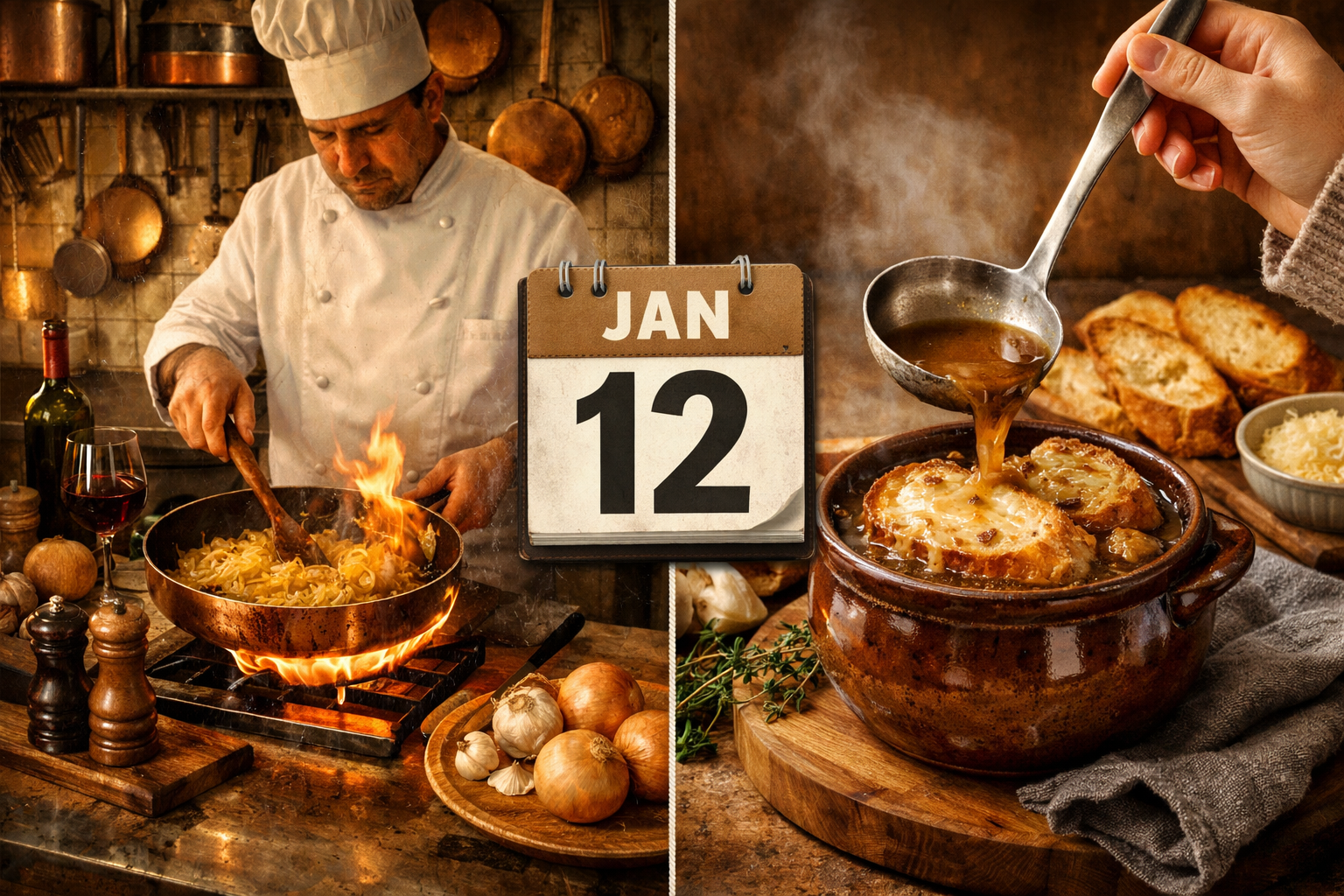
Celebrating January 12 National French Onion Soup Day doesn’t require a culinary degree. There are several straightforward ways to mark the occasion.
Option 1: Cook It at Home
Making French onion soup from scratch is a rewarding project for a cold January evening. Here’s a simplified process:
- Slice 4–5 large yellow onions thinly.
- Caramelize in butter over low heat for 45–60 minutes, stirring occasionally.
- Deglaze with dry white wine or sherry (about ½ cup), scraping up the browned bits.
- Add beef broth (about 6 cups) and simmer for 20–30 minutes.
- Season with salt, pepper, fresh thyme, and a bay leaf.
- Ladle into oven-safe crocks, top with a toasted baguette slice, and cover generously with shredded Gruyère.
- Broil until the cheese is golden and bubbling, about 3–5 minutes.
Option 2: Visit a Restaurant
Many French bistros and casual dining restaurants run January 12 specials. Calling ahead or checking a restaurant’s social media page on January 12 often reveals limited-time deals or featured menu items tied to the holiday.
Option 3: Host a Soup Night
A French onion soup dinner party is low-cost and crowd-pleasing. Set up a topping bar with different cheeses, bread types, and garnishes so guests can customize their crocks.
Vegetarian and Vegan Versions: Do They Work?
Yes — vegetarian and vegan French onion soup works well when the substitutions are made thoughtfully.
- Broth: A deeply flavored vegetable broth or mushroom broth replaces beef broth effectively. Adding a splash of soy sauce or miso paste deepens the umami flavor.
- Cheese: Vegan Gruyère-style cheeses have improved significantly in recent years. Nutritional yeast sprinkled on top also adds a savory, cheesy note.
- Wine: Most French onion soup recipes already use wine, so this element stays the same.
Edge case: If using store-bought vegetable broth, taste it before adding — many commercial versions are too sweet or too salty, which throws off the soup’s balance.
Nutritional Profile: Is French Onion Soup Healthy?
French onion soup is moderately nutritious but calorie-dense when made traditionally. Onions are low in calories and rich in antioxidants, including quercetin, which has been studied for its anti-inflammatory properties (National Institutes of Health, various publications). The cheese and bread topping add significant saturated fat and sodium.
A typical restaurant serving (approximately 8–10 oz soup plus topping) contains roughly 300–500 calories, depending on portion size and cheese quantity. Home versions can be lighter by reducing the cheese or using a lower-sodium broth.
- High in: Vitamin C (from onions), calcium (from cheese), protein (from broth and cheese)
- Watch for: Sodium content, especially with commercial broths
- Lighter swap: Use less bread, reduce cheese, or choose a lower-fat cheese
FAQ: January 12 National French Onion Soup Day
Q: Is January 12 National French Onion Soup Day an official U.S. holiday? A: No. It’s an unofficial food observance, not a federal or state holiday. It’s recognized by food communities and media but has no government backing.
Q: Who created National French Onion Soup Day? A: The exact origin is unclear. Like most food holidays, it emerged organically through food bloggers and culinary communities, with no single founding organization on record.
Q: What’s the best cheese for French onion soup? A: Gruyère is the traditional choice because it melts smoothly and has a nutty, slightly salty flavor that complements the sweet onions. Comté and Emmental are close alternatives.
Q: Can French onion soup be made ahead of time? A: Yes. The soup base (without bread and cheese) keeps well in the refrigerator for up to 4 days and freezes for up to 3 months. Add the bread and cheese topping just before broiling.
Q: What wine pairs best with French onion soup? A: A dry white Burgundy or unoaked Chardonnay is a classic pairing. A light Pinot Noir also works if you prefer red wine.
Q: Is French onion soup gluten-free? A: Not traditionally — the baguette crouton contains gluten. Substituting a gluten-free bread slice makes the dish accessible for those with gluten sensitivities.
Q: How long does it take to make French onion soup from scratch? A: Plan for about 90 minutes total: 45–60 minutes for caramelizing onions, 20–30 minutes for simmering the broth, and 5–10 minutes for broiling.
Q: Are there any restaurant chains that celebrate January 12 National French Onion Soup Day? A: Some casual dining chains and French-style bistros run promotions on January 12. It’s worth checking local restaurant social media pages or calling ahead on the day.
Conclusion: Make January 12 Count 🧅
January 12 National French Onion Soup Day is a simple but genuinely enjoyable food holiday. It falls in the middle of winter — exactly when a warm, deeply flavored bowl of soup feels most welcome.
Actionable next steps for 2026:
- Mark your calendar for January 12 and plan whether you’ll cook at home or dine out.
- Shop ahead — pick up yellow onions, Gruyère, a baguette, and beef (or vegetable) broth a day or two before.
- Give yourself time — block out 90 minutes if cooking from scratch, and don’t rush the onions.
- Share it — post your soup on social media with the hashtag #NationalFrenchOnionSoupDay to join the broader food community celebrating the day.
- Explore variations — try a vegetarian version, experiment with different cheeses, or add a splash of cognac to the broth for a richer flavor.
French onion soup rewards patience. The slow caramelization, the long simmer, the bubbling cheese under the broiler — each step builds toward something genuinely satisfying. January 12 is as good a reason as any to slow down and cook something worth eating.
References
- National Institutes of Health, National Center for Complementary and Integrative Health. “Quercetin.” NCCIH. https://www.nccih.nih.gov/health/quercetin (accessed 2024).
- Child, Julia, Louisette Bertholle, and Simone Beck. Mastering the Art of French Cooking. Alfred A. Knopf, 1961.
- Davidson, Alan. The Oxford Companion to Food. Oxford University Press, 1999.