
Last updated: March 28, 2026
Quick Answer: January 11 National Risotto Day is an annual food holiday celebrated in the United States on January 11 that honors one of Italy’s most beloved rice dishes. It’s a day for home cooks, restaurants, and food enthusiasts to make, share, and appreciate risotto in all its forms. Whether you’re a seasoned cook or a curious beginner, this day is the perfect excuse to try your hand at a classic Italian comfort dish.
Key Takeaways
- January 11 is officially recognized as National Risotto Day in the United States.
- Risotto is a northern Italian rice dish made with high-starch rice (usually Arborio), broth, butter, and parmesan.
- The dish originated in northern Italy, particularly in the Lombardy and Piedmont regions.
- The “toasting” and slow-ladling technique is what gives risotto its signature creamy texture — no cream required.
- Common varieties include mushroom, saffron (Risotto alla Milanese), seafood, and lemon risotto.
- Risotto can be adapted for vegetarian, vegan, and gluten-free diets with simple substitutions.
- Restaurants and home cooks across the country use this holiday to share recipes, host dinners, and post on social media.
- Arborio is the most widely available risotto rice, but Carnaroli and Vialone Nano are preferred by many Italian chefs for superior texture.
What Is January 11 National Risotto Day?
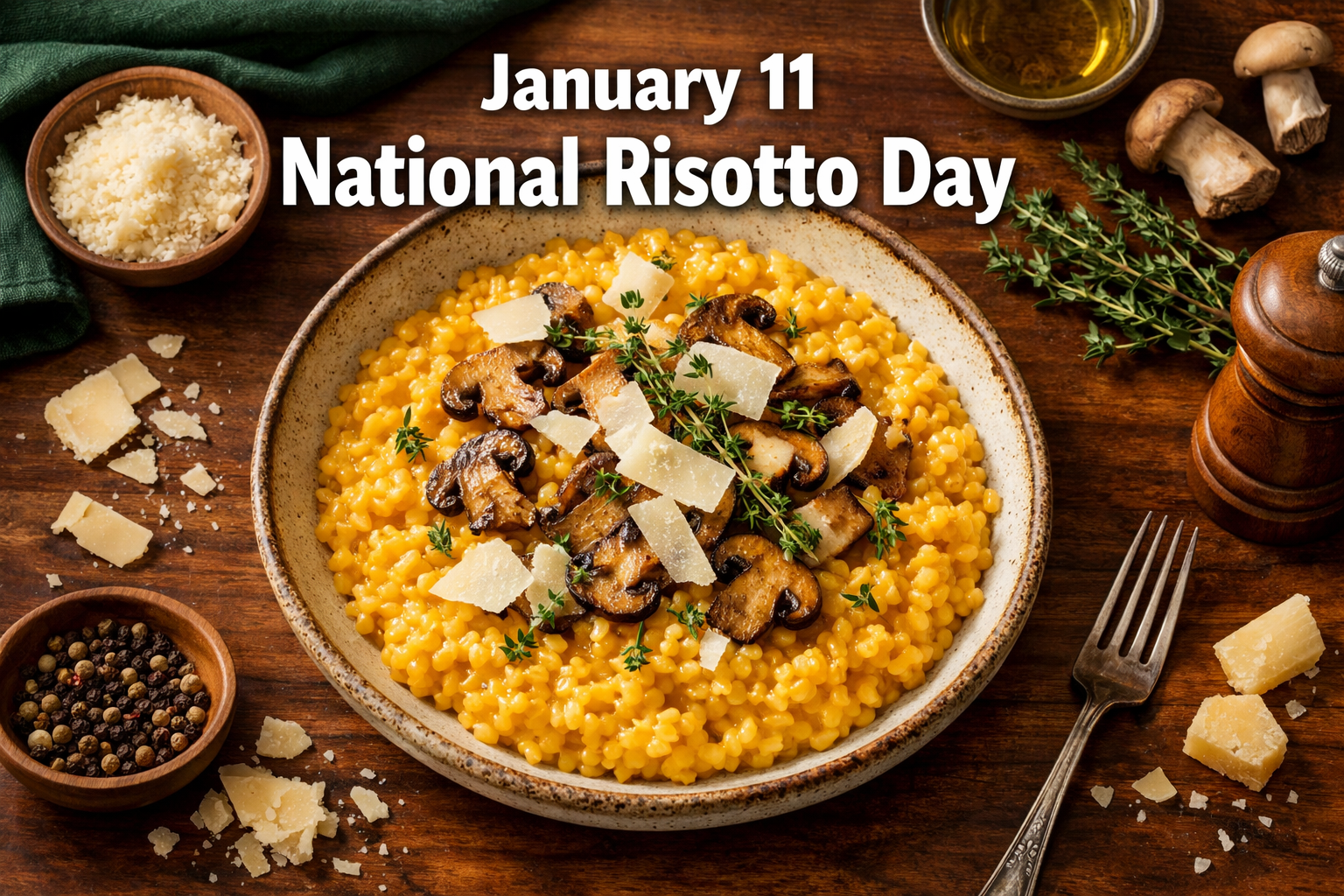
January 11 National Risotto Day is an unofficial but widely observed American food holiday dedicated to celebrating risotto. Each year on January 11, food lovers across the country cook, order, and share risotto dishes as a way to honor this iconic Italian staple.
Food holidays like this one serve a real purpose: they give restaurants a marketing moment, inspire home cooks to try something new, and build community around shared culinary traditions. National Risotto Day fits squarely into the January calendar as a warm, comforting antidote to cold winter days.
🍚 “Risotto is not just a recipe — it’s a technique. Once you master it, the variations are endless.”
The origin of the holiday itself is not officially documented by a government body or major culinary institution. Like many American food holidays, it likely emerged from food bloggers, culinary brands, or social media communities in the early 2000s and gained traction over time through annual celebration and recipe sharing.
What Is Risotto and Where Did It Come From?
Risotto is a creamy Italian rice dish made by slowly cooking high-starch short-grain rice in warm broth, stirring frequently to release the rice’s natural starches. The result is a thick, velvety dish that’s rich without being heavy — when done correctly.
Origins: Risotto traces its roots to northern Italy, specifically the Lombardy region around Milan. Rice cultivation in the Po Valley dates back to the 15th century, and risotto as a cooking method became established in Italian cuisine by the 19th century. The most famous version, Risotto alla Milanese, is flavored with saffron and has been a Milan staple for centuries.
Why northern Italy? The Po Valley’s climate and irrigation systems made it ideal for rice farming, which is why pasta dominates the south while rice dishes like risotto are central to northern Italian cooking.
How Is Risotto Made? The Core Technique
Risotto’s creamy texture comes entirely from technique, not from added cream. The process is straightforward but requires attention.
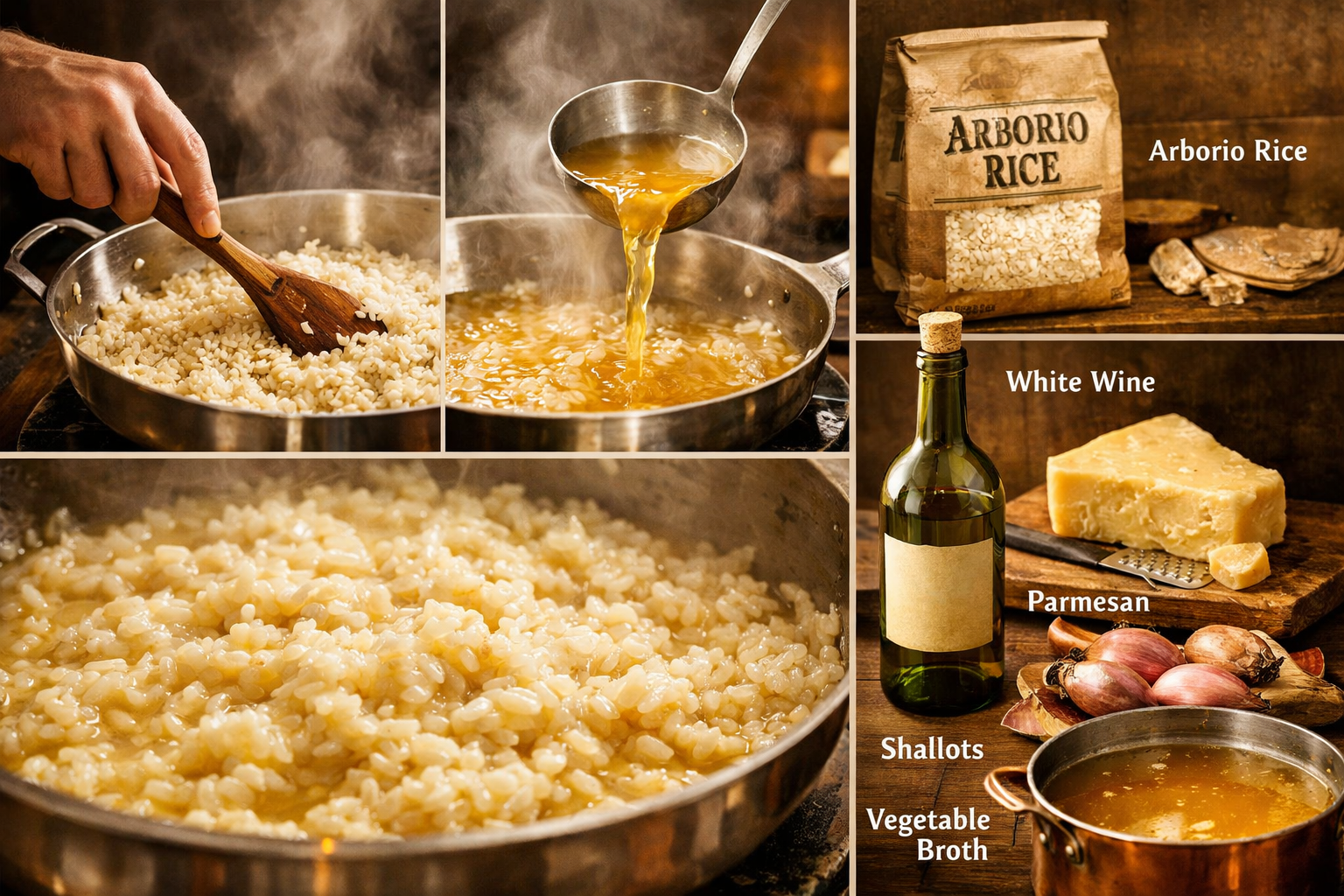
The classic risotto method:
- Toast the rice — Heat butter or olive oil in a wide, heavy pan. Add the dry rice and stir for 1-2 minutes until the grains turn slightly translucent at the edges. This step (called tostatura) builds flavor and helps the rice hold its structure.
- Add wine — Pour in a splash of dry white wine and stir until absorbed. This adds acidity that balances the richness.
- Ladle in warm broth — Add broth one ladle at a time, stirring constantly and waiting for each addition to absorb before adding the next. Use warm broth — cold broth stops the cooking process and affects texture.
- Finish with fat and cheese — When the rice is al dente (tender but with a slight bite), remove from heat and stir in cold butter and freshly grated parmesan. This step, called mantecatura, is what creates the final creamy consistency.
- Rest and serve immediately — Risotto waits for no one. Serve right away, as it continues to thicken off the heat.
Common mistake: Adding all the broth at once. This turns risotto into rice soup. The slow, ladle-by-ladle method is non-negotiable for proper texture.
What Types of Risotto Can You Make for January 11 National Risotto Day?
There’s no single “correct” risotto — the base technique supports dozens of flavor combinations. Here are the most popular varieties to consider making on January 11 National Risotto Day:
| Risotto Variety | Key Ingredients | Best For |
|---|---|---|
| Risotto alla Milanese | Saffron, bone marrow, parmesan | Traditional Italian experience |
| Mushroom Risotto | Porcini or cremini mushrooms, thyme | Earthy, umami-rich flavor |
| Seafood Risotto | Shrimp, clams, squid, white wine | Coastal Italian style |
| Lemon & Herb Risotto | Lemon zest, parsley, peas | Light, spring-forward option |
| Beet Risotto | Roasted beets, goat cheese | Striking color, earthy-sweet |
| Butternut Squash Risotto | Roasted squash, sage, nutmeg | Perfect for winter months |
| Vegan Risotto | Olive oil, nutritional yeast, vegetable broth | Plant-based adaptation |
Choose mushroom or butternut squash risotto if you’re cooking in January — both use ingredients that are widely available in winter and pair well with the season’s flavors.
What Rice Should You Use?
The right rice makes a significant difference. Risotto requires short-grain, high-starch rice varieties. Long-grain rice like basmati or jasmine will not work — they don’t release enough starch to create the creamy consistency.
- Arborio — The most common and easiest to find in U.S. grocery stores. Produces a creamy result with a slightly softer texture.
- Carnaroli — Often called the “king of risotto rice” by Italian chefs. Holds its shape better than Arborio and produces a silkier finish. Harder to find but worth seeking out.
- Vialone Nano — Popular in the Veneto region of Italy. Absorbs broth exceptionally well and works beautifully with seafood risotto.
Choose Arborio if this is your first time making risotto. Choose Carnaroli if you want a restaurant-quality result and can find it at a specialty grocery store.
How to Celebrate January 11 National Risotto Day
Celebrating this food holiday doesn’t require anything elaborate. Here are practical ways to mark the occasion:
- Cook at home — Pick one recipe from the table above and make it from scratch. Invite friends or family to share the meal.
- Order from an Italian restaurant — Support a local restaurant that specializes in Italian cuisine. Many restaurants run specials or promotions on food holidays.
- Share on social media — Post your dish with the hashtag #NationalRisottoDay to join the broader community of food enthusiasts celebrating the day.
- Host a risotto bar — Set up a base risotto and offer toppings like roasted vegetables, different cheeses, and proteins so guests can customize their bowls.
- Try a new variety — If mushroom risotto is your go-to, challenge yourself with saffron or beet risotto instead.
FAQ
Q: When is National Risotto Day? National Risotto Day is celebrated on January 11 each year in the United States.
Q: Is National Risotto Day an official holiday? No. It’s an unofficial food holiday, not recognized by the U.S. government. It’s observed voluntarily by food lovers, restaurants, and culinary communities.
Q: Can risotto be made ahead of time? Risotto is best served immediately after cooking. However, you can make it about 75% of the way through, stop, spread it on a baking sheet to cool, and finish it later by reheating with a bit of warm broth.
Q: Is risotto gluten-free? Yes, traditional risotto made with rice, broth, butter, and parmesan is naturally gluten-free. Always check broth labels, as some contain gluten-based additives.
Q: Can risotto be made vegan? Yes. Substitute butter with olive oil, parmesan with nutritional yeast or a vegan cheese alternative, and use vegetable broth. The texture will be slightly different but still satisfying.
Q: What wine pairs well with risotto? A dry white wine like Pinot Grigio, Sauvignon Blanc, or Vermentino pairs well with most risotto varieties. For mushroom risotto, a light red like Pinot Noir also works.
Q: Why does my risotto turn out gluey? Over-stirring or cooking at too high a heat can break down the starch too aggressively, resulting in a gluey texture. Keep the heat at medium and stir regularly but not constantly.
Q: How long does risotto take to cook? Most risotto recipes take 25 to 35 minutes from start to finish, not counting prep time for ingredients.
Q: What’s the difference between risotto and rice pilaf? Rice pilaf is cooked by absorption (liquid added all at once, then covered). Risotto uses the slow-ladle method with constant stirring to release starch. The techniques and textures are completely different.
Q: How much risotto should I make per person? As a main course, plan for about 70-80 grams (roughly 1/3 cup) of dry Arborio rice per person. As a side dish, 50 grams per person is sufficient.
Conclusion
January 11 National Risotto Day is more than a quirky calendar entry — it’s a genuine invitation to slow down, cook something from scratch, and connect with a centuries-old culinary tradition. The dish itself rewards patience: the slow ladling, the constant stirring, the final swirl of cold butter that brings everything together.
Actionable next steps for 2026:
- Mark January 11 on your calendar now and plan your risotto variety in advance.
- Source Carnaroli rice from a specialty grocer if you want to elevate your result beyond the standard Arborio.
- Make a batch of homemade vegetable or chicken broth ahead of time — it makes a noticeable difference in flavor.
- Invite at least one other person to share the meal. Risotto is a communal dish at heart.
- Share your creation on social media with #NationalRisottoDay to connect with the wider food community.
Whether it’s a classic Risotto alla Milanese or a creative beet-and-goat-cheese variation, January 11 is the perfect day to pick up a wooden spoon and start stirring.
References
- Hazan, Marcella. Essentials of Classic Italian Cooking. Knopf, 1992.
- Riley, Gillian. The Oxford Companion to Italian Food. Oxford University Press, 2007.
- Plotkin, Fred. Italy for the Gourmet Traveler. Kyle Cathie, 1996.