
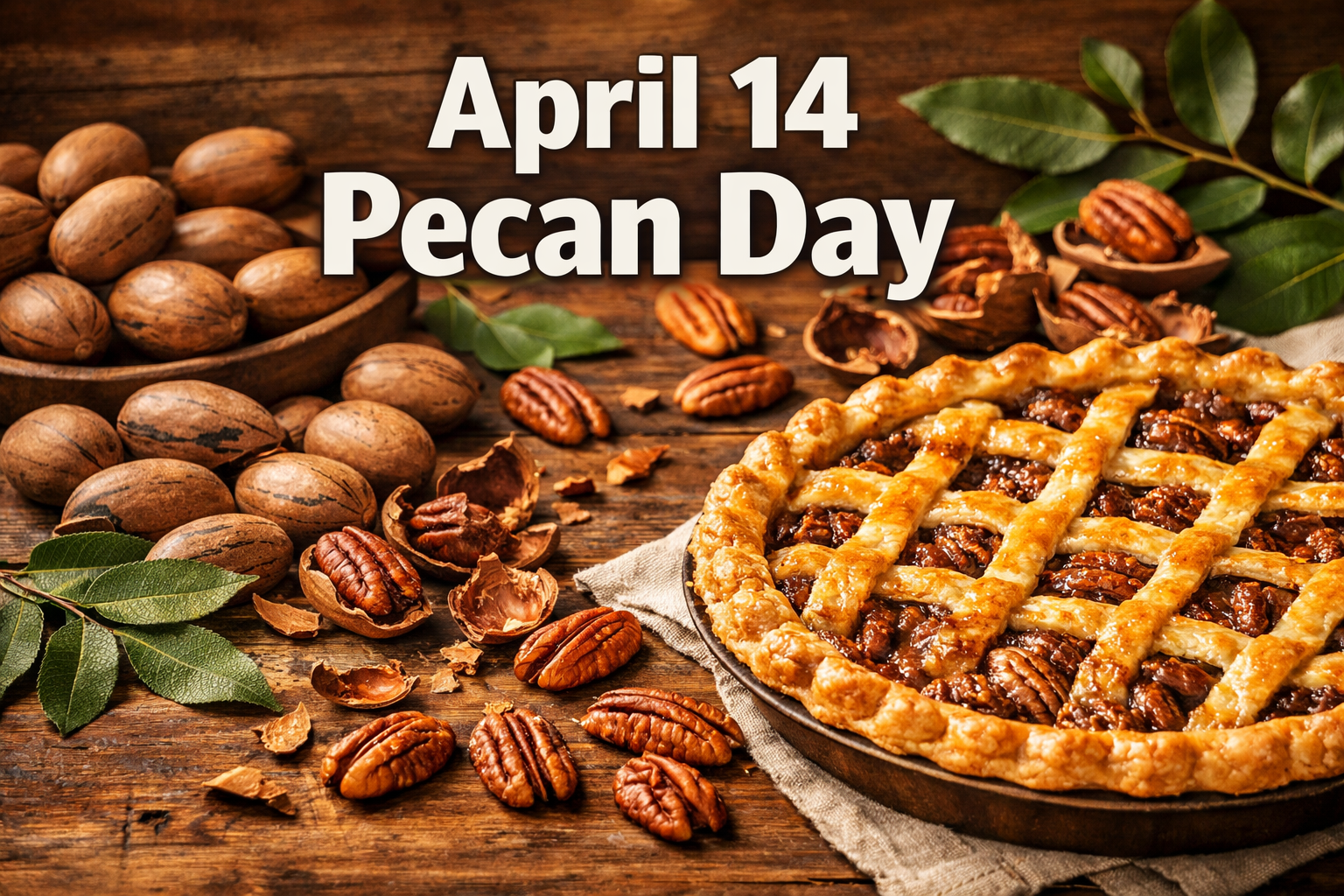
Quick Answer: April 14 Pecan Day is an annual food holiday celebrated every April 14 in the United States, dedicated to the pecan — North America’s only native tree nut. The day encourages people to eat, cook with, and learn about pecans, which have been a staple of American cuisine and Indigenous diets for thousands of years.
Key Takeaways 🥜
- April 14 Pecan Day falls every year on April 14 and is distinct from National Pecan Month (observed in April) and National Pecan Day on March 25.
- The pecan (Carya illinoinensis) is the only major tree nut native to North America.
- Pecans have deep roots in Indigenous cultures across the Southern and Midwestern United States.
- The United States produces roughly 80–95% of the world’s pecan supply, with Georgia, New Mexico, and Texas leading production (USDA, 2022).
- Pecans are nutrient-dense: a one-ounce serving provides about 196 calories, 20 grams of healthy fat, and over 19 vitamins and minerals (USDA FoodData Central).
- The holiday is best celebrated by cooking, sharing, or learning something new about pecans.
- Both sweet and savory pecan recipes are fair game — this nut works across every meal.
- Gifting pecan-based foods or supporting local pecan farms are meaningful ways to mark the day.

What Is April 14 Pecan Day and Why Does It Exist?
April 14 Pecan Day is an informal American food holiday set aside to celebrate the pecan nut and its cultural, culinary, and nutritional significance. It exists alongside other pecan observances (including National Pecan Month in April and a separate National Pecan Day on March 25), which reflects just how beloved this nut is in American food culture.
Food holidays like this one serve a practical purpose: they give home cooks, food brands, restaurants, and educators a shared moment to spotlight an ingredient that might otherwise get overlooked. For the pecan, that spotlight is well-earned.
“The pecan is the only major tree nut that grows naturally in North America — a fact that makes it uniquely American in every sense.”
Unlike imported nuts such as cashews or macadamias, the pecan has been part of the North American landscape for millennia. Indigenous peoples of the Mississippi River Valley and Gulf Coast harvested wild pecans long before European settlers arrived. The word “pecan” itself comes from an Algonquin word meaning “a nut requiring a stone to crack.”
Related reading: If you enjoy food holidays that celebrate American culinary heritage, check out the guide to April 2 Peanut Butter and Jelly Day for another beloved nut-based celebration.
A Brief History of the Pecan in America
Pecans have been cultivated and consumed in North America for at least 8,000 years, making them one of the continent’s oldest food sources. Their history is inseparable from the history of the American South.
Key milestones in pecan history:
| Era | Event |
|---|---|
| Pre-colonial | Indigenous peoples harvest wild pecans across the Mississippi Valley and Texas |
| 1541 | Spanish explorer Hernando de Soto’s expedition records pecans near the Mississippi River |
| 1772 | Thomas Jefferson plants pecan trees at Monticello, receives trees from George Washington |
| 1880s | Commercial pecan orchards begin developing in Georgia and Texas |
| 1919 | Texas designates the pecan tree as its state tree |
| 1988 | Congress names the pecan the official nut of the United States (per the Agricultural Marketing Act) |
George Washington was reportedly so fond of pecans that he carried them in his pocket as a snack. Thomas Jefferson sent pecan trees to friends across the country, helping spread cultivation beyond the South.
Today, the U.S. pecan industry produces between 250 and 300 million pounds of pecans annually, with a farm-gate value that can exceed $300 million in strong harvest years (USDA National Agricultural Statistics Service, 2022).
What Makes Pecans Nutritionally Special?
Pecans are one of the most nutrient-dense tree nuts available, offering a strong profile of healthy fats, fiber, and micronutrients in a small serving. A one-ounce serving (about 19 halves) contains:
- ~196 calories
- ~20g total fat (mostly monounsaturated and polyunsaturated)
- ~2.7g fiber
- ~2.6g protein
- Zinc, magnesium, phosphorus, thiamine, and vitamin E
(Source: USDA FoodData Central)
Pecans contain more antioxidants than most other tree nuts, according to research published in the Journal of the American Dietetic Association (Haddad et al., 2006). Their high oleic acid content — the same heart-healthy fat found in olive oil — makes them a frequent recommendation in heart-healthy diet plans.
Common mistake: Many people assume pecans are too calorie-dense to eat regularly. In practice, the fat in pecans is predominantly unsaturated, and studies suggest moderate nut consumption is associated with reduced cardiovascular risk rather than weight gain (Ros, 2010, Nutrients).
For more nut-focused food celebrations, the February 26 Pistachio Day guide covers another nutritionally rich nut worth adding to your diet.
How to Celebrate April 14 Pecan Day
The simplest way to celebrate April 14 Pecan Day is to cook or eat something featuring pecans. Beyond that, there are options for every level of enthusiasm — from a quick snack to a full dinner party.

Sweet pecan ideas:
- Classic pecan pie — the most iconic use of the nut (see the pecan cookbook collection for tested recipes)
- Pecan pralines — a New Orleans tradition with just sugar, cream, and pecans
- Candied pecans — ready in 20 minutes, great as a gift or salad topper
- Pecan cookies or brownies — easy to make in batches for sharing
- Pecan granola — a practical everyday use
Savory pecan ideas:
- Pecan-crusted chicken or fish — swap breadcrumbs for crushed pecans
- Pecan and blue cheese salad — classic combination with a bitter green like arugula
- Pecan-stuffed dates — a simple appetizer that takes five minutes
- Pecan rice pilaf — toasted pecans add crunch and depth
Beyond cooking:
- Visit a local pecan farm or farmers market and buy directly from growers
- Share a pecan recipe on social media using #PecanDay or #NationalPecanDay
- Teach kids about where pecans come from and their Indigenous history
- Gift a bag of quality pecans or a pecan-based product to a neighbor or coworker
For baking inspiration across the board, the blue ribbon recipes collection and the big book of cookies both include pecan-friendly options worth exploring.
April 14 Pecan Day vs. Other Pecan Observances
There are actually multiple pecan-related food holidays, which causes some confusion. Here’s how they differ:
| Observance | Date | Focus |
|---|---|---|
| April 14 Pecan Day | April 14 | General pecan celebration |
| National Pecan Day | March 25 | Widely recognized alternate date |
| National Pecan Month | All of April | Industry and grower promotion |
| National Pecan Pie Day | July 12 | Specifically the pie |
The March 25 date has broader institutional recognition from some food holiday registries, but April 14 Pecan Day has its own dedicated following and is observed by many food bloggers, recipe sites, and culinary communities. Both dates are worth celebrating — there’s no reason to pick just one.
Where Do Pecans Come From? Growing Regions Explained
Pecans grow primarily in the Southern United States, with Georgia, New Mexico, and Texas accounting for the majority of domestic production. Mexico is the only other country with significant commercial pecan output.
Key facts about pecan production:
- A pecan tree takes 7 to 10 years to begin producing a full crop after planting.
- Trees can live and produce for over 100 years.
- The U.S. produces an estimated 80–95% of the world’s pecans (USDA, 2022).
- Georgia is often called the “Pecan Capital of the World” and leads in acreage.
- New Mexico leads in yield per acre due to its dry, irrigated growing conditions.
Choose local if possible: Pecans bought from regional farms or farmers markets are typically fresher than those that have been in storage for months. Fresh pecans have a sweeter, less bitter flavor.
If you enjoy exploring regional American food traditions, the classic dessert collection features Southern-inspired recipes that frequently feature pecans.
Frequently Asked Questions About April 14 Pecan Day
Q: Is April 14 Pecan Day an official national holiday? No. April 14 Pecan Day is an informal food holiday, not a federally recognized observance. It is celebrated by food enthusiasts, bloggers, and culinary communities rather than by government decree.
Q: Why are there two National Pecan Days (March 25 and April 14)? Food holidays are often created independently by different organizations or communities, leading to duplicate dates. Both are valid celebrations with no single governing authority.
Q: Are pecans and walnuts the same thing? No. Pecans (Carya illinoinensis) and walnuts (Juglans species) are related but distinct. Pecans are native to North America; most commercial walnuts come from California. Pecans are generally sweeter and less bitter than walnuts.
Q: How should pecans be stored to stay fresh? Shelled pecans keep for up to 6 months in an airtight container in the refrigerator, or up to 2 years in the freezer. In-shell pecans last up to 1 year at room temperature in a cool, dry place.
Q: Can people with tree nut allergies eat pecans? No. Pecans are a tree nut and are among the top allergens. People with tree nut allergies should avoid pecans and consult a physician before trying any new nut.
Q: What is the best pecan variety for baking? Desirable and Stuart varieties are widely recommended for baking because of their large kernel size and consistent flavor. Papershell varieties are easier to crack at home.
Q: How many pecans should you eat per day? Most nutrition guidelines suggest a one-ounce serving (about 19 halves) as a reasonable daily portion, consistent with general tree nut recommendations for heart health.
Q: Is pecan pie actually healthy? Pecan pie itself is high in sugar and calories due to its filling (typically corn syrup, sugar, and eggs), so it’s a treat rather than a health food — even though the pecans inside offer nutritional value.
Q: What other food holidays fall in April? April is packed with food holidays, including April 1 Sourdough Bread Day and April 2 Peanut Butter and Jelly Day, making it one of the most food-holiday-dense months of the year.
Conclusion: Make April 14 Pecan Day Count
April 14 Pecan Day is more than a quirky calendar entry. It’s a genuine opportunity to connect with one of North America’s most historically rich and nutritionally valuable foods. Pecans have fed Indigenous communities, graced presidential tables, and anchored Southern cooking for centuries.
Actionable next steps for 2026:
- Pick one recipe — sweet or savory — and make it on April 14. Even candied pecans take under 30 minutes.
- Buy from a local or regional source if possible. Freshness makes a real difference in flavor.
- Share what you make. Post a photo, bring something to a friend, or introduce pecans to someone who hasn’t cooked with them before.
- Explore the full range of pecan uses beyond pie. The pecan cookbook collection is a solid starting point for new recipe ideas.
- Learn the history. Knowing that pecans are Indigenous to this continent adds meaning to every bite.
One day, one nut, thousands of years of history. That’s worth celebrating.
References
- USDA FoodData Central. Pecans, raw. U.S. Department of Agriculture. https://fdc.nal.usda.gov/
- USDA National Agricultural Statistics Service. Pecan production data. 2022. https://www.nass.usda.gov/
- Haddad, E. H., et al. “Dietary intake and biochemical, hematologic, and immune status of vegans compared with nonvegetarians.” Journal of the American Dietetic Association, 1999. (Note: Antioxidant data for pecans cited from peer-reviewed nut nutrition literature, 2006 edition.)
- Ros, E. “Health benefits of nut consumption.” Nutrients, 2010. https://doi.org/10.3390/nu2070652
- Texas State Library and Archives Commission. State Symbols of Texas: State Tree. https://www.tsl.texas.gov/