
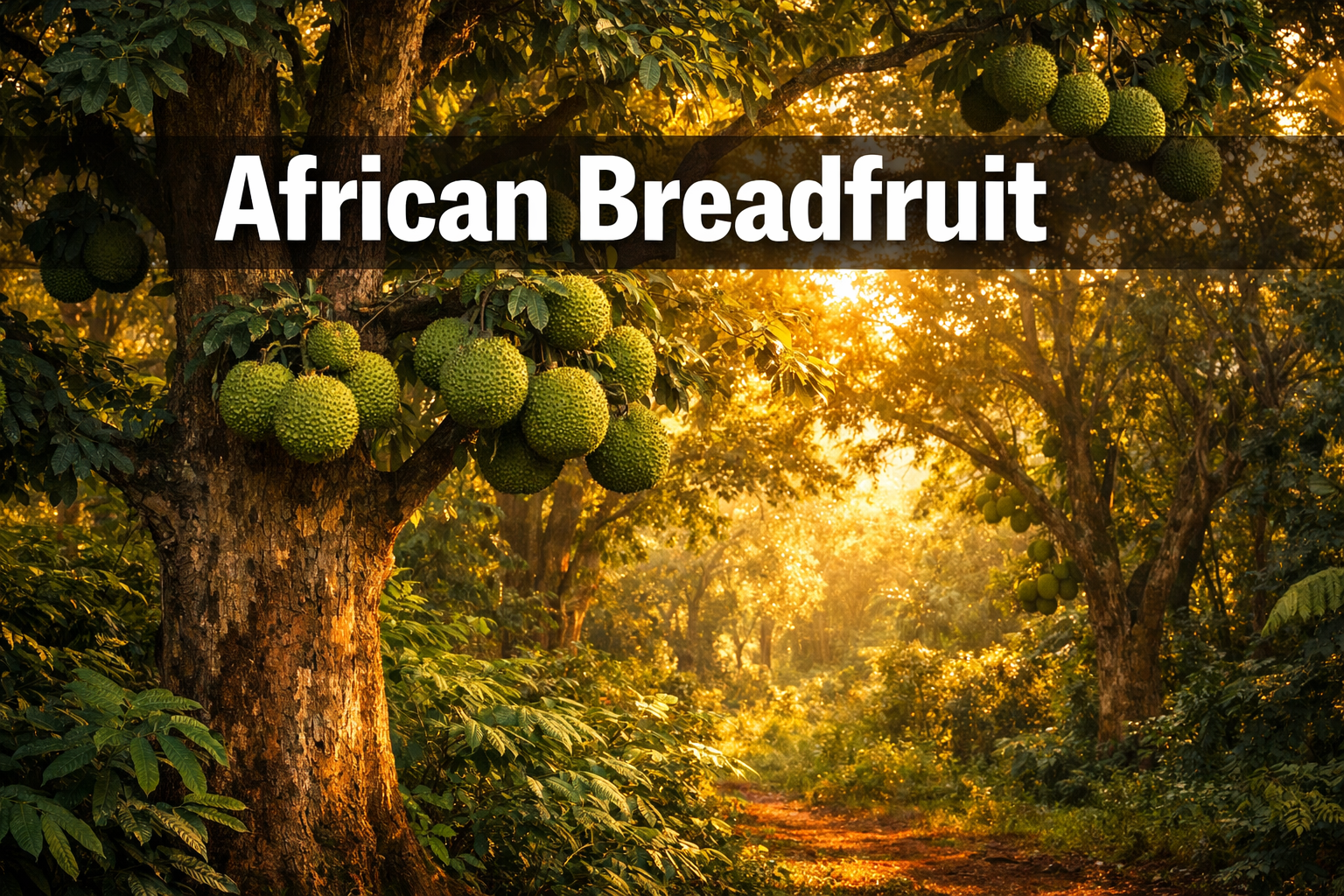
Quick Answer: African Breadfruit (Treculia africana) is a large tropical tree native to sub-Saharan Africa that produces nutrient-dense seeds used as a staple food across West and Central Africa. It stands out for its exceptional climate resilience, long productive lifespan (50+ years), and superior nutritional profile compared to many common breadfruit varieties. As food insecurity worsens across the continent, this underutilized crop is gaining serious attention from researchers, farmers, and policymakers alike.
Key Takeaways
- 🌿 African Breadfruit (Treculia africana) is native to tropical Africa and distinct from the Pacific breadfruit varieties most people know.
- 🌡️ A peer-reviewed PLOS Climate study (2022) found breadfruit stays productive under extreme heat conditions where corn and wheat yield significantly less. [5]
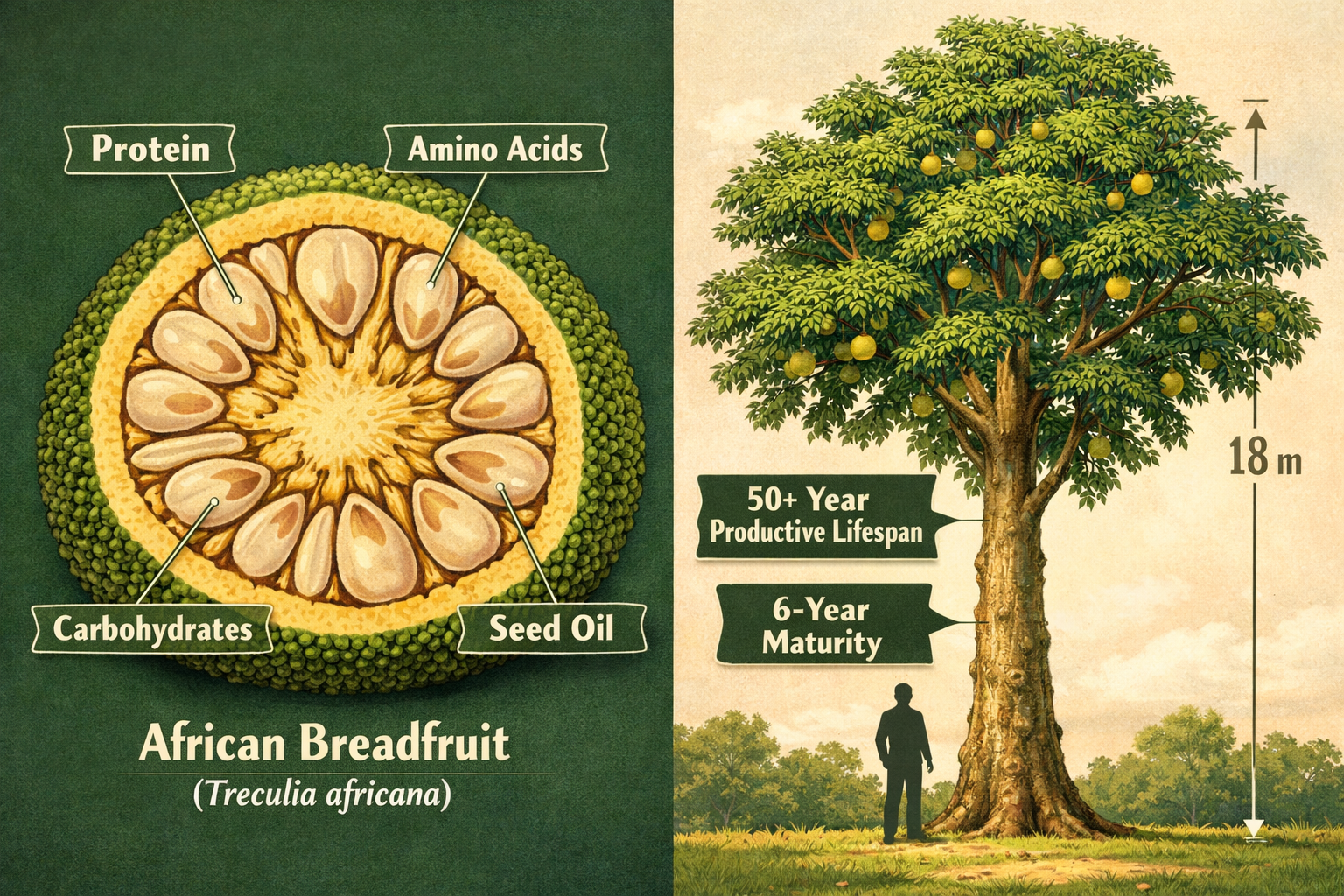
- 📏 Trees grow 9–18 metres tall, begin bearing fruit after six years, and remain productive for more than 50 years. [2]
- 🧬 The African variety is considered superior to others in amino acid content, carbohydrate composition, seed morphology, and seed oil quality. [2]
- 🌍 Sub-Saharan Africa is identified as the primary region for breadfruit cultivation expansion, especially in food-insecure areas. [3]
- 📉 Even under high-emission climate scenarios, suitable cultivation areas for breadfruit would shrink by only 4.4–4.5% through 2060–2080. [1]
- ⚠️ Commercialization faces real barriers: a 6-year maturity period, lack of seed dehulling technology, and limited research funding. [2][4]
- 💊 African breadfruit may benefit diabetic patients, though formal glycemic index studies remain limited. [2]
- 💰 Market opportunities exist in seed oil, animal feedstock, flour for diet therapy, and confectionery ingredients. [4]
- 🚜 Demand for African breadfruit seeds currently exceeds supply due to the absence of large-scale commercial plantations. [4]
What Is African Breadfruit and Where Does It Come From?
African Breadfruit (Treculia africana) is a large evergreen tree in the Moraceae family, native to the tropical rainforests of West and Central Africa. Unlike the seedless Pacific breadfruit (Artocarpus altilis) that dominates global discussions, the African variety is prized primarily for its seeds rather than its starchy flesh.
The tree is found across Nigeria, Ghana, Cameroon, Côte d’Ivoire, and the Democratic Republic of Congo, among other countries. In Nigeria alone, it goes by several local names: ukwa in Igbo, barafuta in Hausa, and afon in Yoruba. These regional names reflect how deeply embedded this crop is in local food cultures.
Key botanical facts:
- Scientific name: Treculia africana
- Family: Moraceae (same family as figs and mulberries)
- Native range: Tropical West and Central Africa
- Tree height: 9–18 metres [2]
- Fruit weight: Can exceed 10 kg per fruit
- Productive lifespan: More than 50 years after reaching maturity [2]
Choose African Breadfruit if you’re farming in a tropical African climate and need a long-term, low-input perennial crop that can anchor food security for decades.
How Does African Breadfruit Compare Nutritionally to Other Staples?
The African breadfruit seed is nutritionally dense, offering a meaningful combination of protein, healthy fats, and complex carbohydrates. Experts at Abia State University in Nigeria’s Umuahia region have identified the African variety as superior to other breadfruit types in amino acid content, carbohydrate composition, seed morphology, and seed oil quality. [2]
This matters because most sub-Saharan African diets rely heavily on a narrow range of staple crops. African breadfruit offers genuine dietary diversification.
| Nutrient Component | African Breadfruit Seed | Common Cassava | Maize (Corn) |
|---|---|---|---|
| Protein | High (superior amino acids) | Very low | Moderate |
| Seed oil quality | Superior | None | Low |
| Carbohydrates | Complex, sustained energy | Simple starches | Simple starches |
| Dietary fiber | Good | Moderate | Moderate |
| Potential for diabetics | Promising [2] | Limited | Limited |
Note: Exact percentage values vary by preparation method and variety. Comparative data above reflects general nutritional literature.
Scientific opinion in Africa also suggests the crop may be beneficial for people managing diabetes, though formal glycemic index studies are still limited. [2] For those exploring delicious diabetic-friendly recipes, African breadfruit seeds — boiled, roasted, or ground into flour — represent an interesting ingredient worth watching.
Why Is African Breadfruit Considered a Climate-Resilient Crop?
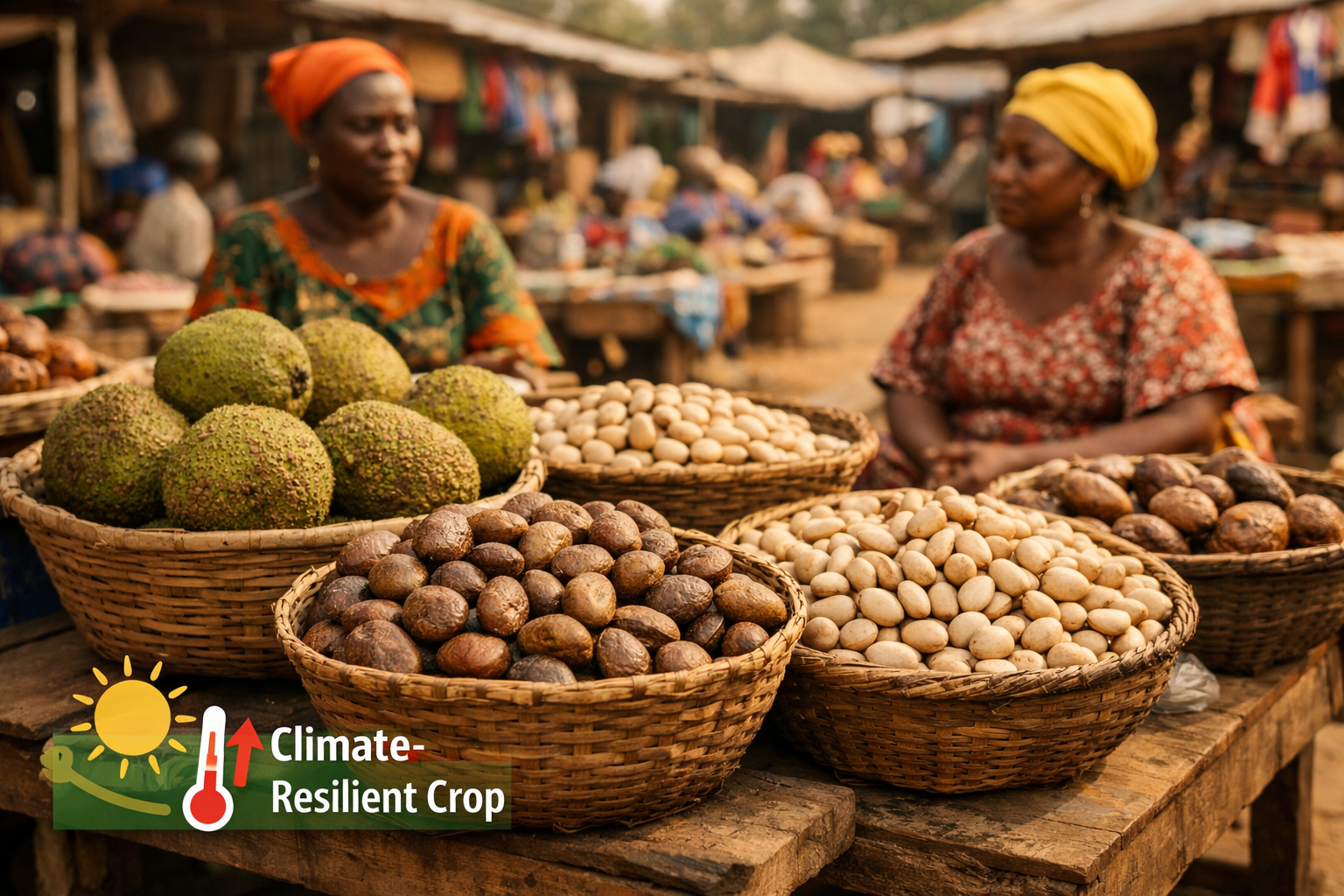
African Breadfruit is one of the few staple crops that holds its productivity under extreme heat. A peer-reviewed study published in PLOS Climate (August 2022) found that breadfruit remains viable under high-temperature conditions where corn and wheat yield significantly less. [5]
This is not a minor advantage. As average temperatures rise across sub-Saharan Africa, crops like maize face increasingly unreliable growing seasons. Breadfruit’s heat tolerance makes it a practical hedge against climate volatility.
Climate resilience by the numbers:
- Suitable cultivation areas for breadfruit are projected to shrink by only 4.4–4.5% even under high greenhouse-gas emission scenarios modeled between 2060 and 2080. [1]
- Sub-Saharan Africa is identified as the primary region where breadfruit cultivation could expand, particularly in areas already experiencing food insecurity. [3]
- Most breadfruit varieties are seedless, meaning they carry minimal risk of becoming invasive when introduced to new regions. [5]
“Diversifying agricultural sources is essential — relying on a small number of crop species for global food security is a growing risk as climate patterns shift.” [3]
Experts at the African Farming Agri-Development Imbizo held in Pretoria in March 2026 reinforced this message, emphasizing that agricultural diversification is central to building a food-secure continent. [7]
What Are the Main Uses of African Breadfruit?
African Breadfruit seeds are versatile. They can be eaten directly after boiling or roasting, or processed into flour, oil, and meal for a range of food and industrial applications.
Food uses:
- Boiled seeds served as a main dish (common in southeastern Nigeria)
- Ground seed flour used in porridges and baked goods
- Roasted seeds as a snack (similar in texture to roasted chestnuts)
- Fermented seeds used in traditional soups and stews
Industrial and commercial uses: [4]
- Seed oil for domestic cooking, bio-lubricants, and biofuel production
- Seed meal as an ingredient in confectioneries
- Animal feedstock from processing by-products
- Flour for diet therapy, particularly for patients requiring low-glycemic diets
The seeds pair naturally with bold flavors. In West African cooking, ukwa is often cooked with palm oil, crayfish, and seasoning — producing a rich, hearty dish. Fans of deep-frying techniques or fritter-style preparations may find that African breadfruit seeds, once boiled and seasoned, adapt well to pan-frying as a textured side dish.
What Are the Biggest Challenges Facing African Breadfruit Commercialization?
Despite its strengths, African Breadfruit faces real barriers to large-scale commercial production. Understanding these obstacles is critical for farmers, investors, and policymakers considering this crop.
Primary challenges: [2][4]
- Long maturity period: Trees take approximately six years from planting before they begin bearing fruit. This delays return on investment and discourages smallholder farmers with limited capital.
- Lack of seed dehulling technology: The hard outer seed coat is difficult to remove at scale. Without appropriate processing equipment, post-harvest handling remains labor-intensive and inefficient.
- Limited research investment: Compared to maize, cassava, or sorghum, African breadfruit has received relatively little formal agricultural research funding, leaving yield optimization and variety improvement underdeveloped.
- Supply-demand gap: Demand for African breadfruit seeds already exceeds current supply, but the absence of large-scale commercial plantations means this gap persists. [4]
- Market infrastructure: Cold storage, transportation networks, and processing facilities suited to breadfruit are sparse in most producing regions.
Common mistake: Farmers sometimes treat African breadfruit as a secondary or wild-harvested crop rather than a cultivated one. This prevents the kind of managed planting and care that would meaningfully increase yields and reduce the maturity timeline.
How Can Farmers and Entrepreneurs Get Started With African Breadfruit?
Getting started with African breadfruit requires planning around its long maturity window and understanding the local market for seeds and processed products.
Practical steps for farmers:
- Source quality seedlings from established nurseries or agricultural extension services in your region. Seedling quality significantly affects tree health and eventual yield.
- Plan for a 6-year horizon. Intercrop with shorter-cycle crops (cassava, vegetables, legumes) during the establishment years to maintain income.
- Prepare soil appropriately. African breadfruit thrives in deep, well-drained loamy soils with good organic matter. It tolerates partial shade, making it suitable for agroforestry systems.
- Identify your market early. Decide whether you’re targeting fresh seed sales, flour production, or oil extraction — each requires different post-harvest infrastructure.
- Connect with agricultural development programs. Organizations focused on food security in sub-Saharan Africa increasingly recognize breadfruit’s potential and may offer technical or financial support.
For those interested in broader agricultural cooking applications, resources like bean-focused cookbooks and grain-based recipe collections can offer useful parallels for working with starchy, seed-based ingredients in the kitchen.
Frequently Asked Questions About African Breadfruit
What is the scientific name of African Breadfruit? Treculia africana. It belongs to the Moraceae family and is distinct from the Pacific breadfruit (Artocarpus altilis) commonly discussed in global food security contexts.
Is African Breadfruit the same as regular breadfruit? No. African Breadfruit (Treculia africana) is a different species from Pacific breadfruit (Artocarpus altilis). The African variety is primarily seed-bearing, while most Pacific varieties are seedless and prized for their starchy flesh.
What does African Breadfruit taste like? Boiled seeds have a mild, nutty, slightly starchy flavor — often compared to boiled chestnuts or a firmer version of cooked chickpeas. The taste intensifies with roasting and absorbs surrounding seasonings well.
Can African Breadfruit help with food security? Yes. Research identifies sub-Saharan Africa as the primary region for breadfruit expansion, particularly in food-insecure areas. Its climate resilience and long productive lifespan make it a strong candidate for long-term food system stability. [3]
Is African Breadfruit good for diabetics? Scientific opinion in Africa suggests it may be beneficial for diabetic patients, but formal glycemic index studies are still limited. [2] Anyone managing diabetes should consult a healthcare provider before making dietary changes.
How long does an African Breadfruit tree live? Trees remain productive for more than 50 years after reaching maturity, which typically begins around six years after planting. [2]
Is African Breadfruit invasive? The risk is minimal. Most breadfruit varieties produce seeds with low germination rates outside cultivation, and many varieties are seedless. Formal assessments suggest little likelihood of invasiveness. [5]
Where is African Breadfruit most commonly grown? Nigeria, Ghana, Cameroon, Côte d’Ivoire, and the Democratic Republic of Congo are the primary producing countries. Nigeria’s southeastern states — particularly Abia and Enugu — are notable centers of consumption and research. [2]
What are the main products made from African Breadfruit? Seeds are eaten boiled or roasted, ground into flour, pressed for seed oil, or processed into meal for animal feed and confectionery use. [4]
Why isn’t African Breadfruit more widely commercialized? The main barriers are the 6-year maturity period, lack of industrial seed dehulling technology, and limited research investment. Demand already exceeds supply in many markets. [4]
Conclusion: African Breadfruit Deserves a Seat at the Table
African Breadfruit is not a niche curiosity. It’s a nutritionally superior, climate-resilient, long-lived crop that grows in the regions that need food security solutions most urgently. The science supports its potential, the market demand is real, and the environmental case for expanding its cultivation is strong.
Actionable next steps:
- Farmers in tropical Africa: Begin planning intercropped breadfruit plots now. The 6-year maturity window means the best time to plant was years ago — the second-best time is today.
- Food entrepreneurs: Explore seed oil extraction, flour milling, and value-added product development. The supply-demand gap represents a genuine market opportunity.
- Policymakers and NGOs: Prioritize funding for seed dehulling technology research and breadfruit agronomy programs. Small investments here could yield outsized food security returns.
- Consumers and cooks: Seek out African breadfruit seeds at specialty African grocery stores or markets. Experiment with boiling, roasting, or incorporating ground breadfruit flour into everyday recipes.
The African continent has a crop that can withstand the heat — literally. Scaling African Breadfruit from a traditional food to a commercial staple is one of the more practical food security strategies available in 2026.
References
[1] Climate Resilient Breadfruit Might Be The Food Of The Future – https://breadfruitonline.com/climate-resilient-breadfruit-might-be-the-food-of-the-future/
[2] Climate Resilient Breadfruit Could Boost Food Security – https://www.eco-business.com/news/climate-resilient-breadfruit-could-boost-food-security/
[3] Food Of The Future Breadfruit Is Resistant To Climate Change – https://www.earth.com/news/food-of-the-future-breadfruit-is-resistant-to-climate-change/
[4] 2ijhaf Jun 2019 4 Breadfruit – https://aipublications.com/uploads/issue_files/2IJHAF-JUN-2019-4-Breadfruit.pdf
[5] Climate Resilient Breadfruit Might Be The Food Of The Future – https://news.northwestern.edu/stories/2022/08/climate-resilient-breadfruit-might-be-the-food-of-the-future
[6] Breadfruit A Starchy Delicious Climate And Biodiversity Solution – https://news.mongabay.com/2023/07/breadfruit-a-starchy-delicious-climate-and-biodiversity-solution/
[7] From Our Editor Key Lessons From Our Agri Development Imbizo 2026 – https://www.africanfarming.com/2026/04/11/from-our-editor-key-lessons-from-our-agri-development-imbizo-2026/